A raised bed and a row cover will get you a few extra weeks at each end of the season. A walk-in tunnel greenhouse gets you months. Once you can stand up inside a hoop house, you can start tomatoes in March, keep peppers producing into November and grow greens through cold snaps that would flatten an open garden. The catch is that bigger tunnels catch more wind, so frame, cover and anchoring matter as much as square footage.
We rebuilt this guide around VEVOR’s US range of high tunnel greenhouses, the large walk-in hoop house kits sold for home gardens and small farms. The four picks run from a 15 foot tunnel with a built-in watering system to a 27 foot tunnel with 16 roll-up windows. We will add more brands to this page as we review them.
One honest note on the name. In farm programs, a high tunnel usually means a permanent structure with a heavy steel frame. The kits here are lighter, portable hoop houses with galvanized steel hoops and a polyethylene cover. They do the same job for a backyard or market garden, but they need careful anchoring, which we cover below.
Our Quick Picks
Best Overall
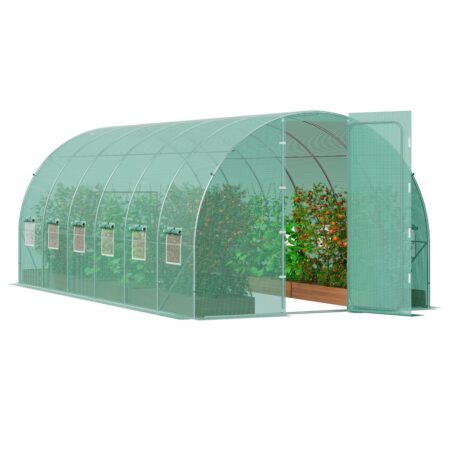
VEVOR 19.4 x 9.7 x 7.4 ft Walk-In Tunnel Greenhouse
19.4 x 9.7 x 7.4 ft · 1 in galvanized pipe · 12 windows, swing door
Check Price at VEVORRead the reviewBest for the Biggest Gardens
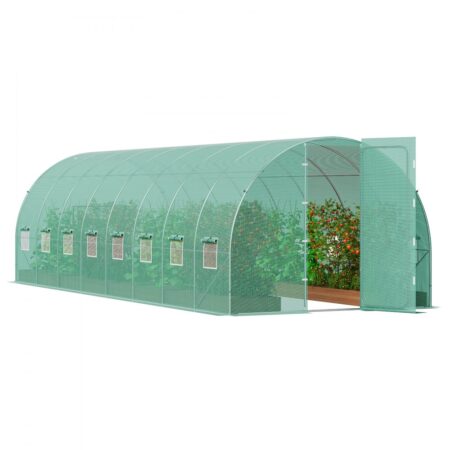
VEVOR 27.4 x 9.5 x 7.4 ft Walk-In Tunnel Greenhouse
27.4 x 9.5 x 7.4 ft · 1 in galvanized pipe · 16 windows, side door
Check Price at VEVORRead the reviewBest With Two Doors
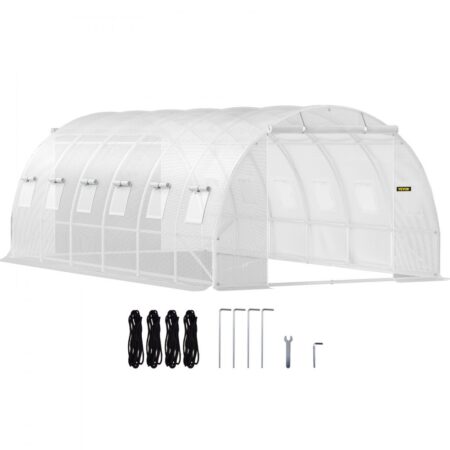
VEVOR 20 x 10 x 7 ft Walk-In Tunnel Greenhouse
20 x 10 x 7 ft · 0.8 in galvanized hoops · 12 windows, 2 zippered doors
Check Price at VEVORRead the reviewBest With Built-In Watering: VEVOR 15 x 7 x 7 ft Tunnel Greenhouse With Watering SystemCompare all 4 side by side
Best High Tunnel Greenhouses: Full Reviews
At a glance
- Size (L x W x H)
- 19.4 x 9.7 x 7.4 ft
- Frame
- 1 in galvanized pipe
- Windows and Doors
- 12 windows, swing door
- Extras
- Extended cover edges
1. VEVOR 19.4 x 9.7 x 7.4 ft Walk-In Tunnel Greenhouse: Best Overall
This is the size that suits the most serious home gardeners. At 19.4 feet long, 9.7 feet wide and 7.4 feet tall, it holds two long beds with a walkway between them, or a row of shelving down each side, and still leaves headroom to stand upright and stake tomatoes. It is large enough to change how you garden but small enough to fit a typical suburban backyard.
VEVOR builds it on thickened galvanized steel pipes with a 1 inch diameter and 0.02 inch wall, with reinforced door poles, diagonal bars, U-shaped ground stakes and tie-downs. The cover is a 140 gsm PE plastic with double-stitched seams and reinforced window seams, and the cover edges run long so you can bury them or weigh them down to seal in heat and humidity. Twelve roll-up windows with mesh screens and a side-opening swing door handle ventilation, with Velcro to hold them open.
The kit weighs 74.9 lb. The instructions are confusing, so check every part first, and secure the cover well, because it can tear in the wind. Plan on two people for a few hours, or two to four helpers for a faster build.
Key Features
- 19.4 x 9.7 x 7.4 ft walk-in space
- Galvanized steel pipes, 1 in diameter, 0.02 in wall
- 140 gsm PE cover with double-stitched seams
- 12 roll-up mesh windows and a swing door
- Extended cover edges for burying or weighting
- U-shaped stakes, tie-downs and diagonal bracing
- 74.9 lb, model 3x6x2.25m(6)G
What We Like
- Big enough for real crop rows with room to stand
- Thicker 1 inch pipes than the 20 x 10 ft kit below
- Plenty of ventilation for summer heat
- Long cover edges help seal in warmth
What We Don’t Like
- The instructions are confusing, so plan on two or more people and a few hours.
Overall
If you want one tunnel that makes a real difference to your growing season without taking over the yard, start here. It balances size, frame strength and ventilation better than the others.
VEVOR Black Friday Pre-Sale
Up to 50% off, plus an extra 8% with code VVOTD (Nov 9 to Nov 18).
At a glance
- Size (L x W x H)
- 27.4 x 9.5 x 7.4 ft
- Frame
- 1 in galvanized pipe
- Windows and Doors
- 16 windows, side door
- Extras
- Extended cover edges
2. VEVOR 27.4 x 9.5 x 7.4 ft Walk-In Tunnel Greenhouse: Best for the Biggest Gardens
For market gardeners, homesteaders or anyone who wants a serious amount of growing space, the 27 foot tunnel is the biggest kit in this group. It measures 27.38 x 9.51 x 7.38 feet, long enough for three or four long beds end to end or a full row of shelving on each side for seedlings.
It shares the same build as our top pick: 1 inch galvanized steel pipes with a 0.02 inch wall, reinforced door poles, diagonal bars, U-shaped stakes and tie-downs, and a 140 gsm PE cover with double-stitched seams and extended edges. The difference is ventilation, with 16 roll-up mesh windows plus a side-opening door, which matters because a longer tunnel traps more heat on sunny days.
At 87.3 lb, it is the heaviest kit here, and the larger footprint means more cover for the wind to push against. VEVOR’s own Q&A notes it is not very stable in strong winds without extra anchoring. If you live somewhere windy, plan on extra anchoring from day one rather than relying on the included stakes alone.
Key Features
- 27.38 x 9.51 x 7.38 ft walk-in space
- Galvanized steel pipes, 1 in diameter, 0.02 in wall
- 140 gsm PE cover with double-stitched seams
- 16 roll-up mesh windows and a side-opening door
- Extended cover edges for burying or weighting
- U-shaped stakes and tie-downs
- 87.3 lb, model 3×8.4×2.25m(8)G
What We Like
- Most growing space of any pick
- Sixteen windows to control heat in a long tunnel
- Same sturdy frame as the 19 foot model
- Room for beds, shelving and a work area
- Good fit for small market gardens
What We Don’t Like
- Not very stable in strong wind without extra anchoring.
Overall
Buy the 27 foot tunnel when space is the goal and you can anchor it properly. In a sheltered yard it gives you the most growing room per kit.
At a glance
- Size (L x W x H)
- 20 x 10 x 7 ft
- Frame
- 0.8 in galvanized hoops
- Windows and Doors
- 12 windows, 2 zippered doors
- Extras
- 3 top beams, 4 diagonal poles
3. VEVOR 20 x 10 x 7 ft Walk-In Tunnel Greenhouse: Best With Two Doors
This tunnel is close to our top pick in footprint, at 20 x 10 x 7 feet, but it is built a little differently. It has two roll-up zippered doors, one at each end, along with 12 mesh windows. Two doors make a real difference in summer, because opening both ends sends a breeze straight through the tunnel, and they make it easier to move a wheelbarrow in one end and out the other.
The frame uses galvanized steel hoops 0.8 inch in diameter with a 0.02 inch wall, slightly slimmer than the 1 inch pipes on our first two picks, braced with 3 top beams and 4 diagonal poles. VEVOR lists the cover as 140 gsm PE that is waterproof and UV resistant. The kit weighs 67.5 lb and comes in white, which is the version we link to.
A white cover diffuses sunlight more than a clear or green one, which can help reduce hot spots and scorching on bright days, though it lets in less light overall. Expect the usual budget-tunnel caveats: the instructions are thin and some small parts are basic.
Key Features
- 20 x 10 x 7 ft walk-in space
- Two roll-up zippered doors
- 12 mesh windows
- Galvanized steel hoops, 0.8 in diameter, 0.02 in wall
- 3 top beams and 4 diagonal poles
- 140 gsm PE cover in white
- 67.5 lb, model VV-TG-12107WHITE
What We Like
- Doors at both ends for cross ventilation
- Easy access with a wheelbarrow or cart
- White cover diffuses strong sun
- Lighter kit than the 1 inch frame models
- Well braced with beams and diagonal poles
What We Don’t Like
- Its 0.8 inch hoops are slimmer than the 1 inch pipes on the 19 and 27 foot models.
Overall
Choose this tunnel if you garden somewhere hot and want the airflow of two doors, or if you like the softer light of a white cover. It is a practical alternative to our top pick at a similar size.
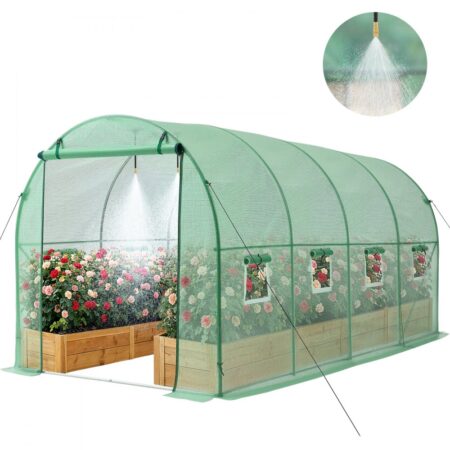
At a glance
- Size (L x W x H)
- 15 x 7 x 7 ft
- Frame
- 0.5 mm galvanized tube
- Windows and Doors
- 8 windows, roll-up door
- Extras
- 6 brass nozzles, 32.8 ft hose
4. VEVOR 15 x 7 x 7 ft Tunnel Greenhouse With Watering System: Best With Built-In Watering
Watering is the chore that decides whether a greenhouse succeeds, especially in summer when a closed tunnel can dry out pots in a day. This 15 x 7 x 7 foot tunnel solves part of that problem out of the box. It comes with 6 brass nozzles and a 32.8 foot hose with connectors, and the nozzles have adjustable angles and 3 spray modes, so you can set up overhead watering without buying a separate kit.
The frame is 0.5 mm galvanized steel with a center support bar, ground stakes and guy ropes, and the connections bolt together, which VEVOR says reduces wobble. The cover is 140 gsm double-sided coated PE with Level 6 sun protection, plus an extended bottom edge you can weigh down with soil, rocks or sandbags. A roll-up zipper door measuring 50.4 x 63 inches and 8 windows at 11.8 x 11.8 inches handle airflow.
At 45 lb and 15 feet long, it is the easiest kit here to assemble and move. The usual cautions apply: the instructions can be confusing, and some parts are basic. The door is smaller than the full-height doors on the larger tunnels, so check it fits your cart.
Key Features
- 15 x 7 x 7 ft walk-in space
- 6 brass nozzles with 3 spray modes
- 32.8 ft hose and connectors included
- 0.5 mm galvanized steel frame with center support bar
- 140 gsm double-sided coated PE cover, Level 6 sun protection
- Roll-up door and 8 windows
- 45 lb, model 2×4.5x2m(4)G-D
What We Like
- Watering system included
- Lightest and most manageable kit here
- Bolted connections reduce wobble
- Extended bottom edge for extra anchoring
- Good size for a starter tunnel
What We Don’t Like
- The 50.4 x 63 in door is smaller than on the bigger tunnels, so measure your cart.
Overall
If you want a tunnel that is easy to set up and helps with daily watering, this is the one. It suits gardeners moving up from raised beds who want walk-in space without a 20 foot footprint.
Side-by-Side Comparison
| Model | Size (L x W x H) | Frame | Windows and Doors | Extras | Weight | Price |
|---|---|---|---|---|---|---|
| VEVOR 19.4 ft | 19.4 x 9.7 x 7.4 ft | 1 in galvanized pipe | 12 windows, swing door | Extended cover edges | 74.9 lb | Check price |
| VEVOR 27.4 ft | 27.4 x 9.5 x 7.4 ft | 1 in galvanized pipe | 16 windows, side door | Extended cover edges | 87.3 lb | Check price |
| VEVOR 20 x 10 ft | 20 x 10 x 7 ft | 0.8 in galvanized hoops | 12 windows, 2 zippered doors | 3 top beams, 4 diagonal poles | 67.5 lb | Check price |
| VEVOR 15 ft watering | 15 x 7 x 7 ft | 0.5 mm galvanized tube | 8 windows, roll-up door | 6 brass nozzles, 32.8 ft hose | 45 lb | Check price |
Specs come from VEVOR’s US product listings at the time of writing. All four use a 140 gsm PE cover.
What a High Tunnel Greenhouse Does
A tunnel greenhouse traps solar heat. Sunlight passes through the plastic cover, warms the soil and plants inside, and the cover slows that heat from escaping. On a sunny spring day, the inside can run far warmer than the outside air, which lets you plant earlier and protects tender crops from frost and wind. In summer, the same effect can cook plants, which is why ventilation matters as much as insulation.
Unheated tunnels will not keep warm-season crops alive through a hard northern winter, but they extend both ends of the season and let cold-hardy greens, herbs and root crops keep growing longer. Adding a heater, a thermal mass like water barrels or an inner row cover pushes the season further. For a tunnel built specifically for the cold months, see our guide to heavy duty greenhouses for winter.
How to Choose the Right Size
Start with the beds you want inside. A common layout is two beds along the long walls with a walkway down the middle. In a tunnel about 10 feet wide, that leaves room for two beds of roughly 3 feet each and a path of 3 to 4 feet. Length is then simply how many plants you want to grow. A 15 foot tunnel suits a family vegetable garden, 20 feet gives room for tomatoes, peppers and greens together, and 27 feet starts to feel like a small market garden.
Leave space around the outside too. You need room to walk around the tunnel to open windows and to dig in or weight down the cover edges, and you want it away from trees that drop branches. Pick a level, sunny spot, ideally with the long side facing south for the most winter sun.
Frames, Covers and Ventilation
Frame
Hoop house kits use galvanized steel tubes. Thicker pipe resists bending in wind and snow better. In this group, the 19 and 27 foot tunnels use 1 inch pipe and the 20 x 10 foot tunnel uses 0.8 inch hoops, both with a 0.02 inch wall. Diagonal braces and top beams add stiffness along the length, which keeps the frame from racking sideways.
Cover
All four picks use a 140 gsm polyethylene cover. PE is light and affordable but will wear out over time from sun exposure and abrasion, so plan on replacing a cover eventually. Keeping it tight on the frame and away from sharp edges makes it last longer. Green and white covers diffuse light more than clear film, which can reduce scorching in strong summer sun.
Ventilation
More windows give you more control. On hot days, open the windows and doors in the morning before the tunnel heats up, and close them in the late afternoon to hold heat overnight. Tunnels with doors at both ends, like the 20 x 10 foot pick, move air through the fastest.
Anchoring a Tunnel Greenhouse Against Wind
Wind is the biggest risk to any hoop house kit. A tunnel acts like a sail, and a gust under a loose cover can lift the whole frame. The included stakes and guy ropes are a start, not the whole answer. VEVOR’s own Q&A notes that the larger tunnels need extra anchoring in strong wind.
- Bury the extended cover edges in a trench of soil, or weigh them down with sandbags or rocks along the whole length.
- Use longer ground anchors or auger-style stakes at each hoop in loose or sandy soil.
- Run the guy ropes out at an angle and tension them evenly on both sides.
- Fix the base frame to a timber perimeter if you plan to leave the tunnel up all year.
- Close the doors and windows before high winds so air cannot get under the cover.
- Brush heavy snow off the roof so the hoops are not overloaded.
Inside, a layer of heavy duty weed barrier fabric on the walkways keeps weeds down and mud off your boots, and a sturdy wheelbarrow makes filling beds and moving compost much easier.
Watering and Growing Inside
Plants under cover never see rain, so they rely on you. Soil in raised beds dries faster than ground beds, and pots dry fastest of all. A drip line or overhead nozzles on a timer save a lot of time, which is why the 15 foot pick’s built-in system is useful. Run a heavy duty water hose to the tunnel rather than a light one that kinks.
Raised beds also suit tunnels well because they warm up quickly in spring and drain well. Our guide to raised garden beds with covers covers options you can use inside or outside the tunnel.
A Scenario Worth Knowing About
Here is a mistake that comes up often with tunnel kits. A gardener sets up a new 20 foot hoop house on a calm spring weekend, uses only the included pegs and leaves the cover edges loose because they plan to bury them later. Two weeks later a storm front blows through overnight. Wind gets under the loose edge, the cover balloons, the pegs pull out of the soft soil and the frame is twisted against the fence by morning.
The fix takes an afternoon and should happen on day one, not later. Bury or weight the cover edges along the full length as soon as the cover goes on, add longer stakes at each hoop and tension the guy ropes evenly. Close everything up before a forecast storm. Done this way, the same kit can stand through a season of spring winds that would otherwise wreck it.
Frequently Asked Questions
What is the difference between a high tunnel and a greenhouse?
A high tunnel is a hoop-shaped structure covered in plastic that you can walk into, usually without built-in heating, used to extend the growing season. A greenhouse is a broader term that also covers rigid structures with glass or polycarbonate panels and heating. The kits here are portable hoop house tunnels.
How long does a PE greenhouse cover last?
It depends on sun, wind and how tight it is kept. PE covers wear out over time from UV exposure and abrasion, so expect to replace one eventually. Keeping the cover taut and repairing small tears early helps it last.
Can a tunnel greenhouse stay up all winter?
Many people leave them up, but you need solid anchoring and you should brush off heavy snow. Lightweight hoop kits are not designed to carry large snow loads.
How many people does it take to assemble a tunnel greenhouse?
Plan on at least two. Two people can do it in a few hours, and two to four helpers make the larger sizes easier.
Which direction should a tunnel greenhouse face?
In most of the US, running the long side east to west, so one long side faces south, gives the most winter sun. In hot climates, prioritize ventilation and some afternoon shade.
Do tunnel greenhouses need a floor?
No. Most growers plant directly in the ground or in raised beds inside. Walkway fabric or mulch keeps paths clean and weeds down.
The Bottom Line
For most home gardeners, the VEVOR 19.4 x 9.7 x 7.4 ft tunnel is the high tunnel greenhouse to buy. It has room for real crop rows, a 1 inch galvanized frame and enough windows to manage summer heat. Go up to the 27 foot tunnel if you want the most growing space, and choose the 20 x 10 foot model if two doors and a white cover suit your climate better.
The 15 foot tunnel with built-in watering is the easiest kit to set up and a good first walk-in greenhouse. Whichever you buy, anchor it properly on day one, plan your ventilation and keep the cover tight, and it will add months to your growing season.