The first sign is usually a dark strip of wet concrete. It shows up the morning after a windy rainstorm, a band of water reaching a foot or two into the garage under the door, with a few soggy leaves tucked against the wall. In winter it shows up as cold. You open the door from the kitchen and the garage feels like a walk-in cooler, even though the big door has been shut all day.
Both problems usually come from the same place: a seal that has flattened, cracked or shrunk, or a slab that has settled and left a gap the old seal can’t reach anymore. The best garage door seal for your door depends on where that gap is. A worn bottom seal, a driveway that tilts rain toward the door, and daylight showing around the sides each call for a different part, and buying the wrong one is the most common way people waste a Saturday on this job.
We picked five VEVOR seals that cover all three jobs: a complete bottom and threshold kit, plain replacement rubber for the retainer track most steel doors already have, a raised threshold for water, and top and side stop molding for drafts. We worked from VEVOR’s published specs and general garage door know-how.
Our Quick Picks
Best Overall
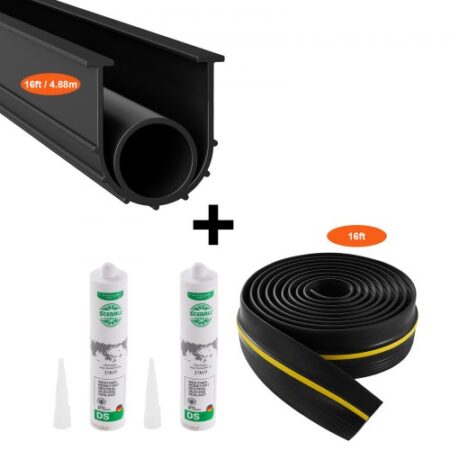
VEVOR Garage Door Threshold and Bottom Seals Kit (20 ft)
Bottom + floor · 20 ft each · PVC
Check Price at VEVORRead the reviewBest Replacement Bottom Seal for Single Doors
Best for Water and Sloped Driveways
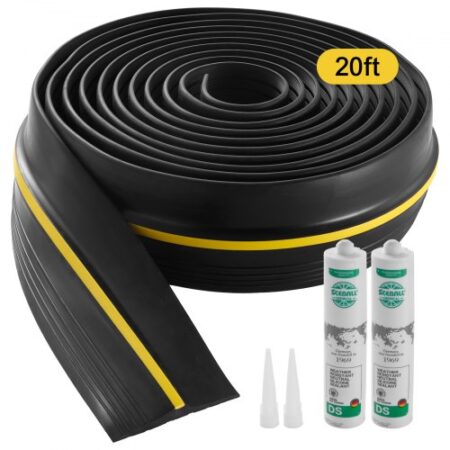
VEVOR Garage Door Threshold Seal Strip (16.5 ft)
Floor · 16.5 ft · PVC
Check Price at VEVORRead the reviewBest for Side Drafts on Single Doors: VEVOR Garage Door Top and Sides Seal Strip (20 ft, Black)Best for Double Doors and White Doors: VEVOR Garage Door Top and Sides Seal Strip (34 ft, White)Compare all 5 side by side
Best Garage Door Seals: Full Reviews
At a glance
- Where It Goes
- Bottom + floor
- Length
- 20 ft each
- Material
- PVC
- Size
- Bottom seal plus 3.5 in threshold
1. VEVOR Garage Door Threshold and Bottom Seals Kit (20 ft): Best Overall
Most garages that leak have two problems at the same time. The rubber on the door has worn flat, and the floor under the door has settled or crowned so the seal only touches in spots. This kit goes after both. You get a U plus O bottom seal that attaches to the bottom of the door and a separate raised threshold strip that glues to the floor, so the door closes onto a raised hump instead of bare, uneven concrete. VEVOR says the pair together fills a gap of up to 12 mm, a little under half an inch.
Both pieces are thick PVC that VEVOR rates from -40°F to 284°F, a range that covers anything a US garage will see. The threshold half shares its MH1925 model code with VEVOR’s standalone threshold seal strip, reviewed below. The bottom seal has an adhesive backing and screws for a firmer hold, and VEVOR lists it for wood, metal and aluminum doors on sectional, solid panel, roll-up and tilt designs.
Each piece is 20 feet long, enough for a standard 16 ft double door with a few feet to spare, and you trim both to length with a utility knife. The kit weighs 20.76 lb. Adhesive and fit problems usually come down to floor prep, so clean and dry the slab before the threshold goes down.
Key Features
- 20 ft U+O bottom seal and 20 ft threshold strip in one order
- Thick PVC rated from -40°F to 284°F
- Fills gaps of up to 12 mm under the door
- Adhesive backing plus screws for the bottom seal
- Fits wood, metal and aluminum doors
- Both pieces trim to length with a utility knife
- Model DTMH1925-MXBTMH1591-20ft, 20.76 lb
What We Like
- Fixes both the door side and the floor side of the gap
- The threshold gives rainwater a raised edge to stop against
- The U+O profile cushions low spots in old concrete
- One order, no guessing which parts work together
- Long enough for a double door without splicing
What We Don’t Like
- There’s no aluminum retainer in the box, so a bent or corroded track has to be replaced separately.
Overall
If you’re not sure exactly where the water or cold air is getting in, start here. It covers both sides of the gap on a standard double door, and it’s the setup we’d put on most attached garages.
VEVOR Black Friday
Up to 50% off, plus an extra 8% with code VVOTD (Nov 19 to Nov 30).
At a glance
- Where It Goes
- Bottom
- Length
- 10 ft
- Material
- Rubber
- Size
- 3 3/4 in, 5/16 in T-ends
2. VEVOR U+O Garage Door Bottom Seal (10 ft): Best Replacement Bottom Seal for Single Doors
On most doors the retainer is fine and only the rubber is shot. The track is straight, but the seal has gone hard, flat or split at the ends. All you need is new rubber, and on a single door you don’t need a long roll to get it.
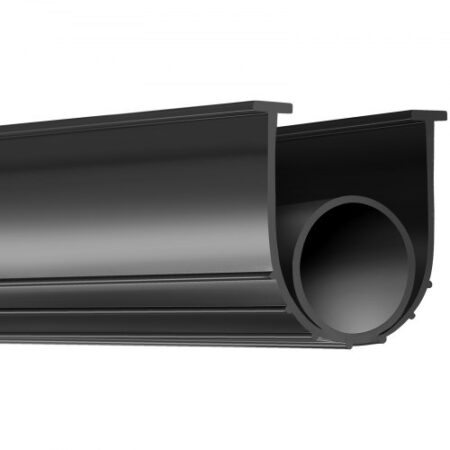
This is a U plus O profile in rubber, 3 3/4 inches wide with 5/16 inch T-ends (model JN-10FT). The U-shaped body slides into the retainer track, and the round tube along the bottom squashes into dips and cracks in the floor. VEVOR describes a multi-layer, ring-shaped insulation design inside the tube, aimed at blocking drafts, moisture, dust and insects. The 10 ft length covers an 8 ft or 9 ft single door with a little to spare, and it weighs just 3.15 lb.
Installation is the classic two-person job: one person feeds the T-ends into the slots while the other pulls from the far end, with a little soapy water or silicone spray in the track to help it slide. VEVOR gives a working range of 40°F to 140°F, so in cold climates install it on a mild day and expect the rubber to firm up a bit in deep winter. Make sure your door uses 5/16 inch T-ends before you order; it won’t fit a 1/4 inch track.
Key Features
- 10 ft of U+O bottom seal rubber
- 3 3/4 in wide
- 5/16 in T-ends
- Slides into existing T-style retainer tracks
- Cut to length with a utility knife
- Rated for 40°F to 140°F
- Model JN-10FT, 3.15 lb
What We Like
- The cheapest fix when the retainer is still in good shape
- Right length for a single door, with little waste
- O-ring bottom fills small dips in the floor
- No tools beyond a knife and something slippery for the track
- Common size fits most residential steel doors
What We Don’t Like
- Ten feet will not reach across a 16 ft double door, and it only fits 5/16 inch T-end tracks, so measure both before you order.
Overall
For a single door with a straight, healthy retainer and tired rubber in it, this is all you need. It’s the most direct way to close a bottom gap on a typical steel sectional door.
At a glance
- Where It Goes
- Floor
- Length
- 16.5 ft
- Material
- PVC
- Size
- 3.5 in wide, 0.5 in tall
3. VEVOR Garage Door Threshold Seal Strip (16.5 ft): Best for Water and Sloped Driveways
A bottom seal can only do so much when the driveway pitches toward the house. Wind-driven rain runs downhill, pools against the door and finds its way under. A threshold seal changes the geometry: it glues to the floor right where the door lands and gives the water a raised edge to stop against, while the door’s bottom seal presses down on top of it.
VEVOR’s strip (model MH1925-16.5ft) is 3.5 inches wide and half an inch tall, made of PVC rated from -40°F to 284°F. The underside is serrated so the adhesive has more to grab, the top has anti-slip ridges, and one edge carries a yellow stripe so you can see the bump at night. It bonds to concrete, asphalt and painted or treated floors, and VEVOR says it’s built to stand up to vehicle pressure. The roll weighs 12.43 lb.
At 16.5 feet it covers a standard 16 ft double door with a little left to trim, and any single door with plenty to spare. Cut it to length with a utility knife and dry-fit it with the door closed before you glue anything down.
Key Features
- 16.5 ft long, 3.5 in wide, 0.5 in tall
- PVC rated from -40°F to 284°F
- Serrated base for a stronger adhesive bond
- Anti-slip ridges and a yellow safety edge
- Bonds to concrete, asphalt, painted and treated floors
- Trims to length with a utility knife
- Model MH1925-16.5ft, 12.43 lb
What We Like
- Stops runoff from a sloped driveway better than a bottom seal alone
- Works with whatever bottom seal you already have
- Yellow edge is easy to see in a dark garage
- Built to take car tires rolling over it
- Right length for a 16 ft door without much waste
What We Don’t Like
- Half an inch is a small speed bump, so rolling tool chests, floor jacks and creepers will feel it every time.
Overall
If water is your problem rather than drafts, this is the fix. Pair it with a decent bottom seal and most wind-driven rain stops at the door.
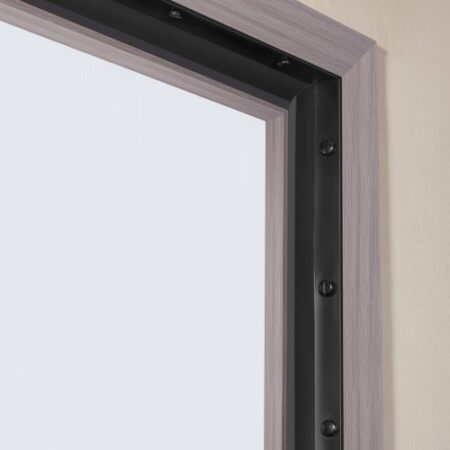
4. VEVOR Garage Door Top and Sides Seal Strip (20 ft, Black): Best for Side Drafts on Single Doors
Close the door, turn off the lights on a sunny afternoon and look at the edges. If you see a thin line of daylight down the sides or across the top, that’s where your cold air is coming from, and no bottom seal will touch it. That gap belongs to the stop molding, the flexible flap that runs along the door jambs and header.
This strip (model MH1400-20ft) is a soft and hard composite TPE: a firm base that mounts to the frame and a soft flap that lies against the face of the door. It’s 2.2 inches wide and 0.1 inch thick, and VEVOR says it stays flexible in extreme cold, which is where cheap vinyl stop molding cracks. It mounts with 3M adhesive backing, and the included screws lock it in place so it doesn’t peel off after a few hot summers.
The thing to plan around is length. Twenty feet covers both sides of a standard 7 ft tall door with about 6 feet to spare, but a full top and both sides of a 9 by 7 door needs roughly 23 feet. On a single door, plan on sides only, which is where most drafts come from anyway.
Key Features
- 20 ft of top and side stop molding
- Soft and hard composite TPE
- 2.2 in wide, 0.1 in thick
- 3M adhesive backing plus screws
- Stays flexible in cold weather
- Black finish
- Model MH1400-20ft, 2.16 lb
What We Like
- Seals the side gaps that bottom seals can’t reach
- Screws keep it from peeling in heat
- Flexible flap tolerates doors that sit slightly out of plane
- Light and easy to cut
- Works on swing and sliding doors too
What We Don’t Like
- At 20 ft it won’t cover the top and both sides of a 9 by 7 door, so measure before you count on full perimeter.
Overall
For a single door with drafts at the jambs, this is a quick, inexpensive fix. If you want the header sealed too, step up to the 34 ft roll.
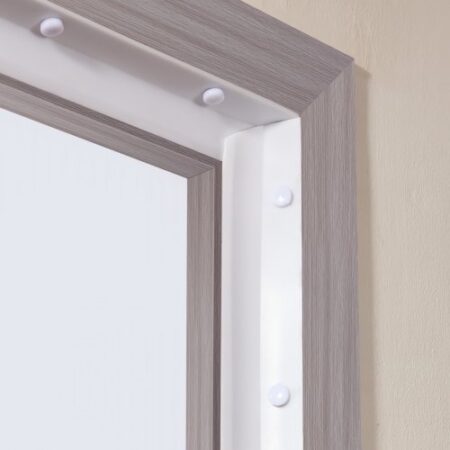
5. VEVOR Garage Door Top and Sides Seal Strip (34 ft, White): Best for Double Doors and White Doors
Most garage doors in the US are white, and so is most of the trim around them. Black stop molding on a white frame looks like a repair. This is the same TPE strip as the 20 ft black top and sides seal in white and in a longer 34 ft roll, which is the more useful size for most people.
A 16 by 7 double door needs about 30 feet to cover the header and both jambs (16 plus 7 plus 7), and this roll gives you 34. A 9 by 7 single door needs about 23 feet, so you’d have enough left for a side door or a shed. Specs match the black version: 2.2 inches wide, 0.1 inch thick, soft and hard composite TPE, 3M adhesive backing and reinforcing screws. The roll weighs 3.7 lb.
Install it with the door closed and the flap pressed lightly against the door face, and the door glides past without dragging.
Key Features
- 34 ft roll, enough for a full 16 by 7 perimeter
- White finish to match most doors and trim
- Soft and hard composite TPE
- 2.2 in wide, 0.1 in thick
- 3M adhesive backing plus screws
- Fits garage, swing and sliding doors
- Model MH1400-34ft, 3.7 lb
What We Like
- Seals the full top and sides of a double door in one roll
- Blends in on white doors and trim
- Leftover length covers a single door with spare
- Same cold-flexible TPE as the black version
What We Don’t Like
- White shows tire dust and grime faster than black, so plan on wiping it down a couple of times a year.
Overall
For a double door, or any white door where looks matter, this is the stop molding to buy. It’s the only roll here long enough to do a full double door perimeter.
Side-by-Side Comparison
| Seal | Where It Goes | Length | Material | Size | Mounting | Includes | Price |
|---|---|---|---|---|---|---|---|
| Threshold and Bottom Kit | Bottom + floor | 20 ft each | PVC | Bottom seal plus 3.5 in threshold | Bottom seal adhesive plus screws; threshold glued | Screws | Check price |
| U+O Bottom Seal | Bottom | 10 ft | Rubber | 3 3/4 in, 5/16 in T-ends | Slides into retainer | Seal only | Check price |
| Threshold Seal Strip | Floor | 16.5 ft | PVC | 3.5 in wide, 0.5 in tall | Glued to floor | Adhesive | Check price |
| Top and Sides (Black) | Jambs and header | 20 ft | TPE | 2.2 in wide | Adhesive plus screws | Screws | Check price |
| Top and Sides (White) | Jambs and header | 34 ft | TPE | 2.2 in wide | Adhesive plus screws | Screws | Check price |
Specs can change, so confirm the details before you buy.
Which Garage Door Seal Do You Need?
A garage door has three separate gaps, and each one has its own part. Figure out which gap is letting in water, air or bugs before you buy anything.
- Bottom seal: the rubber strip on the bottom edge of the door. On steel sectional doors it slides into an aluminum retainer track; on older wood doors it’s often nailed or screwed on. It handles small gaps and the normal unevenness of a concrete floor.
- Threshold seal: a raised strip glued to the floor where the door lands. It’s the fix for a sloped driveway, a settled slab or wind-driven rain, and it works together with the bottom seal rather than replacing it.
- Top and side seal (stop molding): the flexible flap that runs along the jambs and header and lies against the outside face of the door. It’s the fix when you can see daylight around the edges.
The quickest diagnosis takes five minutes. Close the door on a bright day, turn off the garage lights and look. Light under the door means a bottom problem; light at the edges means stop molding. For water, hose the driveway and watch where it comes in. If it seeps under a seal that touches the floor everywhere, you need a threshold, not new rubber.
How to Measure for a Garage Door Bottom Seal
Three measurements decide whether a replacement seal will fit:
- Door width. Measure the bottom edge of the door. Single doors are usually 8 or 9 feet; doubles are usually 16 feet. Buy a little extra, since you can always trim.
- T-end size. Look at the edge of the old seal where it slides into the track. The bead on each side is typically 5/16 inch or 1/4 inch on residential doors. Take a piece of the old seal to the tape measure, or measure the slot opening on the retainer.
- Seal width. Measure the old seal laid flat from bead to bead. VEVOR’s 10 ft U+O seal is 3 3/4 inches, which suits the common residential retainer.
Installation Tips That Make a Seal Last
- Warm the rubber first. Lay a new bottom seal in the sun or a warm room for an hour. Cold rubber is stiff and fights you the whole way down the track.
- Lubricate the track. A little dish soap and water or silicone spray inside the retainer slots lets the T-ends slide. Two people help: one feeds, one pulls.
- Clean the floor for a threshold. Sweep, vacuum, then wipe the slab and let it dry completely. Most threshold failures are adhesive on dust. Close the door on the strip to mark the line, then glue it just inside that line.
- Give adhesive time. Keep cars off a new threshold for at least a day, or as long as the adhesive label says.
- Stop molding goes on with the door closed. Press the flap lightly against the door face. Too tight and the door drags; too loose and air slips past.
If the door sits crooked or rubs in its tracks, fix that first. Our guide on getting a garage door back on track walks through the common causes.
Do Garage Door Seals Really Save Energy?
On a detached, unheated garage, a seal is mostly about water, leaves and mice. On an attached garage, the garage is a buffer between the house and the weather, and a leaky door turns that buffer into an outdoor room. Sealing it takes some chill off the shared wall and the door into the house.
It matters most if you heat the space. Running an electric garage heater or one of the diesel garage heaters we’ve covered against a door with daylight around it is like heating with a window open. Seal first, then size the heater. And don’t forget the door between the garage and the house; a heavy-duty under-door draft stopper handles that gap for very little money.
A Scenario Worth Knowing About
You put a fresh bottom seal on the door on a Saturday morning. It looks great. Then you hit the opener button and the door comes down, touches the floor, and immediately reverses back up. You try again. Same thing.
Nothing is broken. A new seal is taller and firmer than the flattened one it replaced, so the door now meets the floor a little earlier in its travel. The opener feels that resistance before it expects to and reads it as an obstruction, which is exactly what its safety reverse is designed to do. The same thing can happen after you add a threshold strip.
The fix is to adjust the opener’s down travel limit, usually a dial or a pair of buttons on the motor unit, so it stops a touch sooner. Don’t fix it by cranking up the close force; that setting is what keeps the door from crushing something. After any adjustment, run the reversal test: lay a 2×4 flat on the floor under the door and close it. The door should reverse within a couple of seconds of touching the board. Check the photo eyes too, since a raised threshold can sit close to the beam on some installs. If you can’t get it to pass, call a garage door pro before using it again.
Frequently Asked Questions
What is the best garage door seal for an uneven floor?
Use a U+O bottom seal plus a threshold strip. The O-ring bead on the bottom seal squashes into small dips, and the threshold gives the door a level surface to land on. If the slab has settled badly, the VEVOR threshold and bottom kit covers both in one order.
How do I know what size garage door bottom seal I need?
Measure the door width, the seal width laid flat and the T-end bead that slides into the retainer. Most residential steel doors use a 5/16 inch T-end, but 1/4 inch is also common. Matching the T-end to the track is what decides whether the seal fits.
Can I install a threshold seal without replacing the bottom seal?
Yes, as long as the bottom seal still touches the floor and isn’t torn. A threshold works with whatever bottom seal you have. If the old rubber is hard or split, though, replace it at the same time so both surfaces meet cleanly.
How long does a garage door seal last?
Several years in most garages, depending on sun, cold and how often the door cycles. Check every fall: cracked or stiff rubber, or light under the door, means it’s time.
Will a threshold seal stop all water from getting in?
It stops most wind-driven rain and normal driveway runoff. It won’t stop a driveway that sends a river toward the door during heavy storms. In that case the long-term fix is drainage, such as a driveway trench drain across the slope.
Do garage door seals keep out mice?
They help. Mice slip through gaps of about a quarter inch, often at a worn bottom seal or the door corners. Tight bottom and side seals remove the easy entry points, though a determined rodent can still chew rubber.
The Bottom Line
If you’re not sure where the problem is, get the VEVOR threshold and bottom seals kit. It covers the door side and the floor side of the gap in one order and handles most leaky, drafty garages. If only the rubber is worn on a single door, the 10 ft U+O bottom seal is the cheapest fix. Water from a sloped driveway calls for the threshold strip, and daylight at the edges means stop molding, with the 34 ft roll covering a full double door.
Measure the T-end before you order, clean the floor before you glue, and adjust the opener after you install. Do those three things and a weekend afternoon gets you a drier, warmer garage that stays that way for years.