Every car owner eventually meets the scissor jack that came in the trunk. It wobbles, it takes forever to crank, and you would not want to slide a hand under a car held up by one. A proper floor jack changes how you work on a car: the vehicle goes up in a few smooth strokes, the jack rolls into position, and it holds steady while you set jack stands.
The best floor jacks match your vehicle in three ways: capacity, minimum height and maximum lift. A low sports car needs a jack that starts around 3 inches. A pickup needs one that reaches close to 20 inches. And either way, you want plenty of capacity in reserve.
We picked six heavy duty floor jacks from VEVOR: a 3 ton steel jack that covers most vehicles, a lighter aluminum and steel 3 ton, a 2 ton aluminum jack for low cars, a high-reach 3 ton for SUVs and trucks, a compact 2.5 ton and a 22 ton air hydraulic jack for heavy trucks and RVs. After the reviews, we cover how to choose capacity and lift height, single or dual piston, and how to lift a car safely.
Our Quick Picks
Best Overall Floor Jack
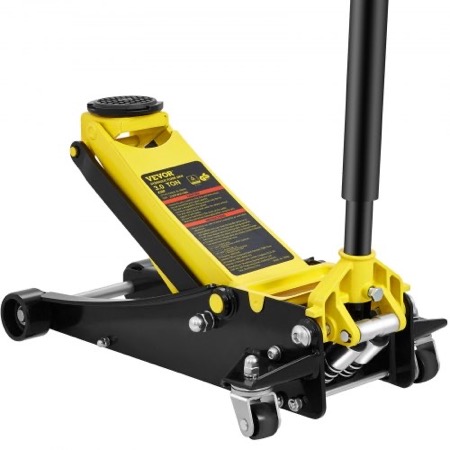
VEVOR 3 Ton Low Profile Steel Floor Jack, Dual Piston (K500)
3 ton · About 3.35 to 19.5 in · Dual piston
Check Price at VEVORRead the reviewBest Lighter 3 Ton Jack
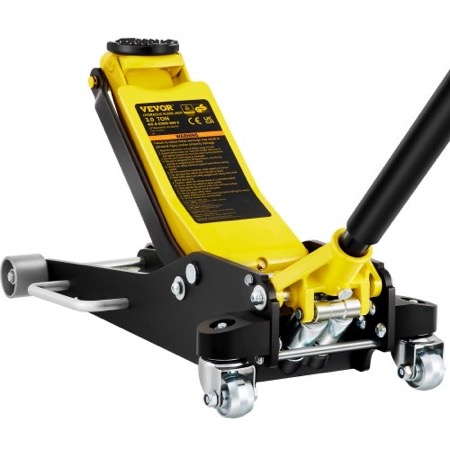
VEVOR 3 Ton Aluminum and Steel Racing Floor Jack
3 ton · About 3.54 to 19.7 in · Dual piston
Check Price at VEVORRead the reviewBest for Sports Cars and Track Days
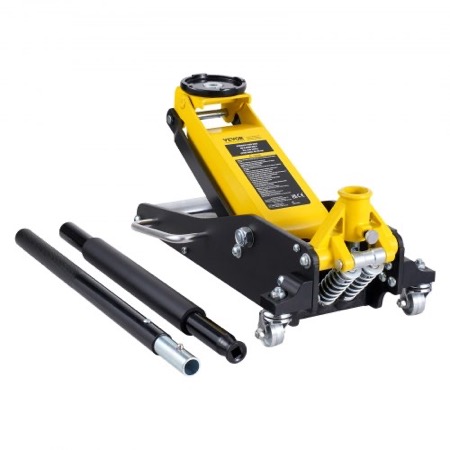
VEVOR 2 Ton Aluminum Low Profile Floor Jack
2 ton · 3.2 to 14.6 in · Dual piston
Check Price at VEVORRead the reviewBest for SUVs and Light Trucks: VEVOR 3 Ton Steel Floor Jack, Single Piston (S508)Best Compact Floor Jack: VEVOR 2.5 Ton Compact Steel Floor Jack (S385)Best for Heavy Trucks and RVs: VEVOR 22 Ton Air Hydraulic Floor JackCompare all 6 side by side
Best Heavy Duty Floor Jacks: Full Reviews
At a glance
- Capacity
- 3 ton
- Lift range
- About 3.35 to 19.5 in
- Pump
- Dual piston
- Build
- Steel
1. VEVOR 3 Ton Low Profile Steel Floor Jack, Dual Piston (K500): Best Overall Floor Jack
A good floor jack should slide under a lowered car and still lift a pickup high enough to get a wheel off the ground. This VEVOR 3 ton jack does both. Its saddle sits about 3.35 inches off the floor at its lowest and rises to roughly 19.5 inches, which covers everything from a sedan with a front lip to a half-ton truck.
It is rated for 3 tons (6,600 lb). The dual piston pump moves more fluid per stroke, so it reaches the vehicle quickly; VEVOR says it gets to full height in about 7 strokes. The 45.3 inch handle gives good leverage and reach, and a foam bumper on the handle protects paint. The rubber saddle pad turns 360 degrees and lifts off for replacement.
The frame is all steel and the jack weighs 73 lb, so it stays put while you pump and feels solid under a load. That weight is also the tradeoff: it is a garage jack, not one to throw in the trunk. A tool tray on the frame holds lug nuts and sockets while you work.
Key Features
- 3 ton (6,600 lb) capacity
- About 3.35 to 19.5 in lift range
- Dual piston quick lift pump
- 45.3 in handle with foam bumper
- 360 degree removable rubber saddle pad
- All steel, 27.6 x 13.5 x 6.2 in
- 73 lb, tool tray
What We Like
- Fits under low cars
- Lifts high enough for pickups and SUVs
- Fast dual piston lift
- Very stable steel frame
- Long handle for leverage
What We Don’t Like
- At 73 lb it is heavy to lift into a truck bed or carry up steps.
Overall
The best floor jack for most home garages. One jack covers low cars, family SUVs and light trucks.
VEVOR Black Friday
Up to 50% off, plus an extra 8% with code VVOTD (Nov 19 to Nov 30).
At a glance
- Capacity
- 3 ton
- Lift range
- About 3.54 to 19.7 in
- Pump
- Dual piston
- Build
- Aluminum and steel
2. VEVOR 3 Ton Aluminum and Steel Racing Floor Jack: Best Lighter 3 Ton Jack
If you like the reach of a 3 ton jack but not the weight of an all-steel one, this VEVOR hybrid uses aluminum and steel to bring the weight down to 66.2 lb while keeping the 3 ton (6,600 lb) capacity. It lifts from about 3.5 inches to 19.7 inches, so it still slides under low cars and reaches truck frame points.
It has a dual piston pump, a 45 inch handle that comes apart for storage, a rubber saddle that rotates 360 degrees, and a foam handle bumper. Side handles make it easier to carry. VEVOR says it meets CE, UKCA and ASME PALD safety standards and has a built-in overload valve.
Compared with the all-steel K500 it is a few pounds lighter and slightly lower at its minimum height. Either is a good 3 ton choice; pick this one if you move your jack around a lot or share it between a garage and a driveway.
Key Features
- 3 ton (6,600 lb) capacity
- About 3.54 to 19.7 in lift range
- Aluminum and steel construction
- Dual piston pump
- 45 in two-piece handle
- CE, UKCA and ASME PALD per VEVOR, overload valve
- 66.2 lb
What We Like
- Lighter than an all-steel 3 ton jack
- Low entry height
- Side carry handles
- Handle comes apart for storage
- Safety standards and overload valve
What We Don’t Like
- It is still a 66 lb jack, so it is lighter, not light.
Overall
The pick for a 3 ton jack that is a little easier to move around the garage.
At a glance
- Capacity
- 2 ton
- Lift range
- 3.2 to 14.6 in
- Pump
- Dual piston
- Build
- Aluminum and steel
3. VEVOR 2 Ton Aluminum Low Profile Floor Jack: Best for Sports Cars and Track Days
Lowered cars, sports cars and anything with a front splitter need a jack that starts very low. This VEVOR aluminum jack starts at 3.2 inches and lifts to 14.6 inches, which is enough to get a car’s wheels off the ground for tire changes, brake jobs and track-day swaps.
It is rated for 2 tons (about 4,400 lb), plenty for sedans, coupes and small SUVs, and weighs just 35.8 lb, half the weight of the steel 3 ton jacks. The dual parallel pump lifts most vehicles in about 3 and a half pumps, according to VEVOR, and a safety release valve opens if the jack is overloaded.
The frame combines aluminum with an iron base for stability, and the handle comes apart for storage. It is light enough to carry to the track or keep in the trunk of a weekend car. It will not reach truck frame points, though, so it is a car jack, not an all-purpose one.
Key Features
- 2 ton (about 4,400 lb) capacity
- 3.2 to 14.6 in lift range
- Dual parallel pump, about 3.5 pumps to lift
- Overload safety valve
- Aluminum alloy 6061 with steel
- Two-piece handle
- 35.8 lb
What We Like
- Very low entry height
- Lightweight for its capacity
- Fast lifting
- Easy to carry to the track
- Overload protection
What We Don’t Like
- The 14.6 inch maximum height is too low for most trucks and lifted SUVs.
Overall
The best floor jack for low sports cars, track days and anyone who wants a light car jack.
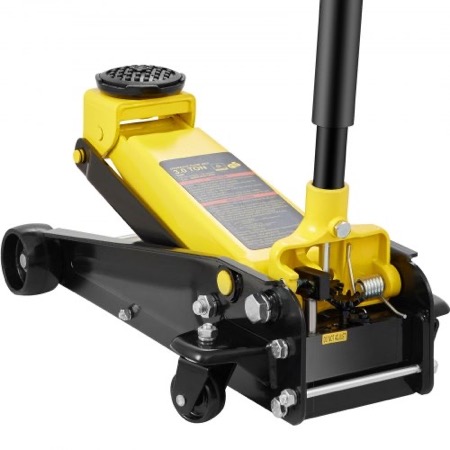
4. VEVOR 3 Ton Steel Floor Jack, Single Piston (S508): Best for SUVs and Light Trucks
Trucks and SUVs sit high, and a jack that starts very low often runs out of height before the wheel clears the ground. This VEVOR 3 ton jack trades a little low-end clearance for reach: it starts at 5.12 inches and lifts to 19.7 inches, with a large 4.8 inch saddle that spreads the load on frame rails and axles.
It is rated for 3 tons (6,600 lb) and built from heavy steel, weighing 71.2 lb. The single piston pump is a little slower than a dual piston design but simple and reliable. The 37.8 inch handle comes apart in two pieces, and a foam bumper protects paint. VEVOR says it meets CE, UKCA and ASME PALD-2014 standards, with a built-in safety load system.
At 5.12 inches it will not slide under many lowered cars, but most SUVs, pickups and minivans have plenty of clearance. If your garage is mostly trucks and SUVs, this is a strong, straightforward choice.
Key Features
- 3 ton (6,600 lb) capacity
- 5.12 to 19.7 in lift range
- 4.8 in saddle
- Single piston hydraulic pump
- 37.8 in two-piece handle with foam bumper
- CE, UKCA and ASME PALD-2014 per VEVOR
- 71.2 lb, all steel
What We Like
- Large saddle for frame rails and axles
- High maximum lift
- Solid steel build
- Simple single piston design
- Safety standards met
What We Don’t Like
- The 5.12 inch minimum height is too tall for many lowered cars.
Overall
The pick for SUVs, pickups and minivans, where reach matters more than low clearance.
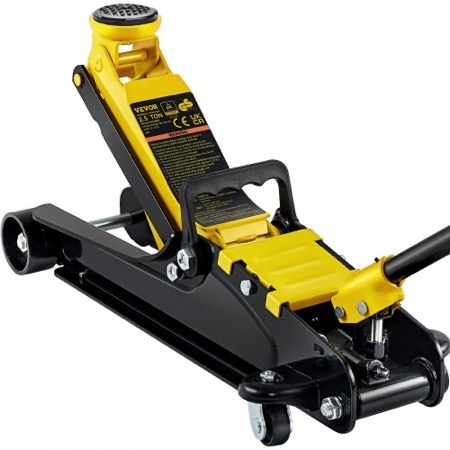
5. VEVOR 2.5 Ton Compact Steel Floor Jack (S385): Best Compact Floor Jack
Not everyone needs a 70 lb jack. For a small garage, an apartment parking spot or a jack that rides in the trunk, this VEVOR 2.5 ton jack weighs just 27.1 lb and has a top carry handle. It is rated for 2.5 tons (5,500 lb) and lifts from 3.35 to 14.96 inches.
It has a steel frame, steel wheels with two swiveling rear casters, a rubber saddle that rotates 360 degrees, and a 31.5 inch two-piece handle with a foam bumper. VEVOR says it meets CE, UKCA and ASME PALD-2014 standards and has a built-in safety load system that stops it from lifting beyond its capacity.
The small 2.4 inch saddle and 15 inch maximum height make it best for cars and small SUVs. It is a big step up from the scissor jack that came with your car, and it costs far less in storage space than a full-size garage jack.
Key Features
- 2.5 ton (5,500 lb) capacity
- 3.35 to 14.96 in lift range
- Single piston pump
- Steel frame, swivel rear casters
- 31.5 in two-piece handle, top carry handle
- CE, UKCA and ASME PALD-2014 per VEVOR
- 27.1 lb
What We Like
- Light and easy to carry
- Low entry for cars
- Compact for storage
- Big upgrade over a scissor jack
- Safety load system
What We Don’t Like
- The small saddle and 15 inch reach limit it to cars and small SUVs.
Overall
The best compact floor jack for small garages and for keeping in the trunk.
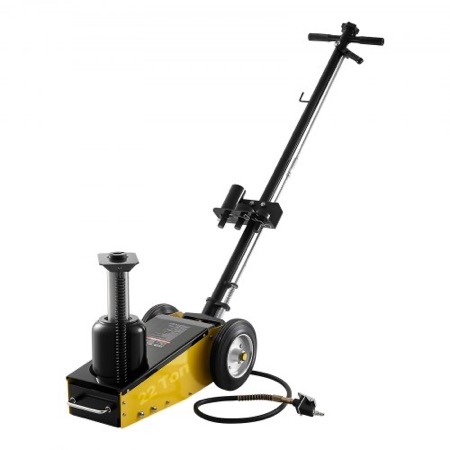
6. VEVOR 22 Ton Air Hydraulic Floor Jack: Best for Heavy Trucks and RVs
Heavy pickups, RVs, box trucks and farm equipment need more than a 3 ton jack. This VEVOR air hydraulic jack is rated for 22 tons (48,501 lb). It connects to an air compressor at up to 145 psi, so you lift with an air valve instead of pumping a handle, and lower it with a knob-style release valve.
It lifts from 10.4 to 16.1 inches, and a screw extension raises the maximum to 21.3 inches. Three steel extension posts (0.8, 1 and 3.9 inches) help reach high lift points on trucks and RVs. The 44.5 inch handle adjusts from 0 to 70 degrees to steer the jack under the vehicle, and two 7.9 inch wheels roll over asphalt and gravel.
At 10.4 inches minimum height it will not fit under cars; it is built for high-clearance vehicles. It weighs 87.2 lb, and it needs an air compressor that can supply 145 psi. For shops and anyone with a heavy truck or RV, it does work no hand-pumped floor jack can.
Key Features
- 22 ton (48,501 lb) capacity
- 10.4 to 16.1 in lift, up to 21.3 in with screw extension
- Air powered, up to 145 psi
- 3 extension posts: 0.8, 1 and 3.9 in
- 44.5 in handle, 0 to 70 degree angle
- Two 7.9 in wheels
- 87.2 lb
What We Like
- Lifts heavy trucks and RVs
- No hand pumping
- Extension posts for high lift points
- Big wheels for rough surfaces
- Adjustable handle angle
What We Don’t Like
- It needs an air compressor and will not fit under cars or most SUVs.
Overall
The pick for heavy trucks, RVs and shop use, where only a high-capacity jack will do.
Side-by-Side Comparison
| Floor jack | Capacity | Lift range | Pump | Build | Weight | Price |
|---|---|---|---|---|---|---|
| VEVOR 3 Ton K500 | 3 ton | About 3.35 to 19.5 in | Dual piston | Steel | 73 lb | Check price |
| VEVOR 3 Ton Aluminum/Steel | 3 ton | About 3.54 to 19.7 in | Dual piston | Aluminum and steel | 66.2 lb | Check price |
| VEVOR 2 Ton Aluminum | 2 ton | 3.2 to 14.6 in | Dual piston | Aluminum and steel | 35.8 lb | Check price |
| VEVOR 3 Ton S508 | 3 ton | 5.12 to 19.7 in | Single piston | Steel | 71.2 lb | Check price |
| VEVOR 2.5 Ton S385 | 2.5 ton | 3.35 to 14.96 in | Single piston | Steel | 27.1 lb | Check price |
| VEVOR 22 Ton Air Hydraulic | 22 ton | 10.4 to 21.3 in | Air hydraulic | Steel | 87.2 lb | Check price |
Specs are VEVOR’s own figures as of November 2026. Where VEVOR gives two slightly different lift figures, we show the more conservative one.
How Much Capacity Do You Need?
A floor jack lifts one end or one corner of a vehicle, not the whole thing, so it never carries the full curb weight. Even so, choose a jack rated well above what you will lift. Extra capacity means the jack works less hard, lifts more smoothly and lasts longer.
- Small cars and sedans: a 2 to 2.5 ton jack is enough.
- Midsize SUVs, minivans and half-ton pickups: 3 tons gives a comfortable margin.
- Heavy-duty pickups, vans and RVs: look at higher capacities, or a dedicated truck jack like the 22 ton air hydraulic model.
For roadside use or tight spots, bottle jacks pack a lot of capacity into a small body, but they start higher and are less stable than a floor jack for garage work.
Minimum and Maximum Height
Minimum height is how low the saddle sits when the jack is fully down. Measure from the floor to your car’s jacking point, then subtract an inch for clearance. Lowered and sports cars often need 3 to 3.5 inches. Most sedans are fine at 4 to 5 inches, and trucks are not a concern.
Maximum height is how high the saddle can reach. For a tire change you need enough lift to get the wheel off the ground plus room for the jack stand. Cars usually need 14 to 15 inches; SUVs and pickups often need 18 to 20 inches. A jack that falls short leaves the wheel on the ground.
Single or Dual Piston?
A floor jack’s pump pushes hydraulic fluid into the main cylinder. A dual piston pump moves more fluid per stroke, so the saddle rises to the car quickly, often in just a few strokes. It is the better choice if you use your jack often. A single piston pump takes more strokes but is simpler, often cheaper and just as strong once it reaches the load.
How to Lift a Car Safely with a Floor Jack
- Work on flat, solid ground. Concrete is best. Never jack on gravel, grass or a slope.
- Set the parking brake and chock the wheels on the opposite end from the one you are lifting.
- Use the correct jacking point. Your owner’s manual shows the reinforced points on the frame or pinch weld. Lifting on the oil pan or floor pan can damage the car.
- Lift, then support. Raise the vehicle just high enough, place jack stands under the frame or axle, then lower the jack until the car rests on the stands.
- Never get under a car held only by a jack. Hydraulic jacks are for lifting, not holding. Seals can leak and valves can slip.
- Lower slowly. Turn the release valve gently so the car comes down under control.
With the car safely on stands, a good mechanic tool set covers most of the work, from tire rotations to brake jobs.
Floor Jack Care and Maintenance
Store the jack with the saddle fully lowered to protect the ram and seals. Check the hydraulic fluid level once or twice a year and top up with hydraulic jack oil only, never brake fluid or motor oil. If the jack feels spongy or will not lift to full height, it may need its air bled out; most manuals explain the steps. Wipe the ram clean after use so grit does not damage the seals, and lightly oil the wheels and pivot points.
A Scenario Worth Knowing About
Someone buys a new low profile jack, rolls it under their SUV, and pumps until the jack stops rising. The rear wheel is still sitting on the ground, just barely unloaded. They reach for a block of wood to put under the saddle for extra height, and the stack slips sideways as the weight comes on.
Low profile jacks are designed to start low, and some of them do not reach as high as a truck or SUV needs. Stacking wood or bricks under a jack or saddle is one of the most dangerous fixes in a garage, because the stack can split or slide under load.
Check the jack’s maximum height against your vehicle before you buy. If you have both low cars and tall SUVs, choose a jack with a wide range like the 3 ton K500, or keep a second jack with more reach. If you are short on height, lift at a different point closer to the wheel, never on improvised blocks, and always finish on proper jack stands.
Frequently Asked Questions
What size floor jack do I need for an SUV?
A 3 ton jack with a maximum lift of around 19 to 20 inches covers most midsize and full-size SUVs. The 3 ton K500, the aluminum and steel 3 ton and the S508 all reach close to 20 inches.
Is a 2 ton floor jack enough for a car?
For most sedans and small cars, yes, because the jack only lifts one corner or end. A 3 ton jack gives more margin and usually more lift height, which helps if you also work on SUVs.
What is the difference between a floor jack and a bottle jack?
A floor jack is long and low, rolls on wheels and slides under a vehicle to reach jacking points. A bottle jack is compact and upright, with high capacity for its size, but it starts higher and has a smaller base. Floor jacks are easier and more stable for garage work; bottle jacks are great for trucks and roadside kits.
Can I leave a car on a floor jack?
No. Use a floor jack only to lift and lower. Always support the vehicle on jack stands before working on or under it.
Why won’t my floor jack lift to full height?
Low hydraulic fluid or air in the system are the usual causes. Check the fluid with the jack fully lowered, top up with hydraulic jack oil, and bleed the air following the manual.
Do I need an air compressor for a floor jack?
Only for air hydraulic jacks like the 22 ton model. The other five jacks here are manual: you pump the handle to lift.
The Bottom Line
For most home garages, the VEVOR 3 Ton Low Profile Steel Floor Jack (K500) is the one to buy. It starts low enough for most cars, reaches close to 20 inches for SUVs and pickups, and its dual piston pump lifts quickly. If you want the same reach with a bit less weight, the aluminum and steel 3 ton is the alternative.
Choose the 2 ton aluminum jack for low sports cars and track days, the S508 for SUVs and trucks, the compact 2.5 ton for small garages and trunks, and the 22 ton air hydraulic jack for heavy trucks and RVs. Pair any of them with good jack stands, and see our guides to trailer jacks and more in our tool guides.