
Nobody buys gutter guards because they’re excited about gutters. You buy them the weekend after you spent three hours on a ladder pulling black, rotten leaf sludge out of a downspout with your hand, or the morning you noticed water running over the front edge of the gutter and straight down the foundation.
The best gutter guards don’t make gutters maintenance-free. Nothing does, whatever the door-to-door salesman says. What a good guard does is turn a messy twice-a-year cleanout into a quick brush-off every so often, and stop the clogs that cause overflow, ice dams, and wet basements.
We focused on DIY guards you can install yourself in an afternoon, all from VEVOR, which sells every major style: stainless micro-mesh, perforated aluminum, powder-coated steel screen, and brush inserts. Below are the six we’d actually put on a house, how to tell which style your roof needs, and the install mistake that ruins more gutter guards than anything else.
Guide Navigation Table of Contents
Our Quick Picks
- Best overall: VEVOR 5″ Micro-Mesh Gutter Guard (100 ft)
- Best for 6-inch gutters: VEVOR 6″ Micro-Mesh Gutter Guard (100 ft)
- Best for dark roofs and snow country: VEVOR 6″ Powder-Coated Steel Screen (120 ft)
- Best value per foot: VEVOR 6″ Perforated Aluminum Guard (104 ft)
- Best for problem spots: VEVOR 5″ Perforated Aluminum Guard (32 ft)
- Easiest install, no tools: VEVOR Gutter Brush (120 ft)
Best Gutter Guards: Full Reviews
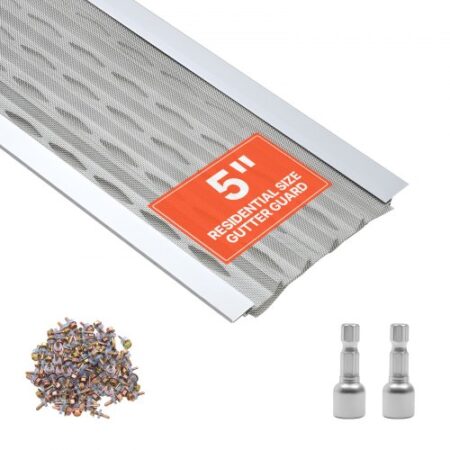
1. VEVOR 5-Inch Stainless Micro-Mesh Gutter Guard (100 ft): Best Overall
Micro-mesh is the style professional installers charge thousands for, and this is the DIY version of it. A rigid aluminum frame holds a fine 304 stainless steel mesh that stops leaves, maple seeds, shingle grit, and most pine needles while rain soaks straight through. If you only want to put guards on once, this is the style to buy.
What makes VEVOR’s version worth a look is the build. The panels are 0.04 inches thick, roughly twice the thickness of the cheap perforated guards, and the frame is 6061 aluminum. That matters more than you’d think. Thin guards sag under a wet mat of leaves or a load of snow, and once a guard dips into the gutter it starts collecting debris instead of shedding it.
This kit covers 100 feet in 20 panels, each just over 5 feet long, which is enough for the perimeter of a typical single-story home. Screws and a driver bit are included. If you only need to cover a garage or one side of the house, VEVOR sells the same guard in a 48-foot, 12-panel set.
Key Features
- Fits 5-inch K-style gutters
- 6061 aluminum frame with 304 stainless steel micro-mesh
- 0.04 in thick panels
- 100 ft total in 20 panels (about 60.4 in each)
- Screws and driver bit included
- Also sold as a 48 ft, 12-panel kit
- 32.6 lb for the full set
What We Like
- Stops fine debris that perforated guards let through
- Thick panels stay flat under snow and wet leaves
- Enough for a whole single-story house in one box
- Stainless mesh won’t rust
- Excellent owner ratings on VEVOR’s store
What We Don’t Like
- Cutting stainless mesh takes good tin snips and some patience at corners and end caps.
Overall
For most homes with 5-inch gutters, this is the guard we’d install. It handles the widest range of debris and it’s built thick enough to last.
2. VEVOR 6-Inch Stainless Micro-Mesh Gutter Guard (100 ft): Best for 6-Inch Gutters
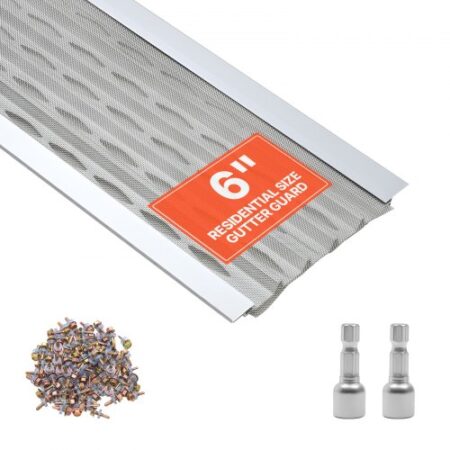
Newer homes, houses with big roof areas, and anywhere that gets heavy downpours often have 6-inch gutters instead of 5-inch. They move a lot more water, which also means a lot more leaves land in them. This is the same micro-mesh design as our top pick, sized for the wider gutter.
Each panel is 60.39 inches long and 5.9 inches wide, so it spans the full opening of a 6-inch K-style gutter without leaving gaps along the edges, which is where debris usually sneaks in. The 0.04-inch aluminum frame and 304 stainless mesh are the same heavy-duty spec.
You get 20 panels covering 100 feet. The whole set weighs about 42 pounds, so plan on carrying a few panels up the ladder at a time rather than the whole box.
Key Features
- Fits 6-inch K-style gutters
- 6061 aluminum frame with 304 stainless steel micro-mesh
- 0.04 in thick panels
- 100 ft total in 20 panels (60.39 x 5.9 in each)
- Screws included
- Also sold as a 48 ft kit
- 42.1 lb for the full set
What We Like
- Sized correctly for wide gutters, no side gaps
- Same heavy-duty build as the 5-inch version
- Handles big roofs and heavy rain
- Stainless mesh resists rust and corrosion
- Strong owner ratings
What We Don’t Like
- It’s the heaviest kit here at about 42 pounds, so it takes more trips up and down the ladder.
Overall
If your gutters measure 6 inches across the top, this is the guard to buy. Don’t try to make a 5-inch guard work on a 6-inch gutter.
3. VEVOR 6-Inch Powder-Coated Steel Gutter Screen (120 ft): Best for Dark Roofs and Snow Country
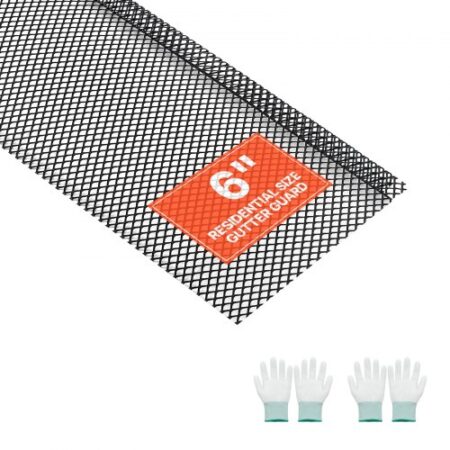
Silver aluminum guards stand out on a house with dark shingles and black or bronze gutters. This black powder-coated steel screen disappears from the ground, which is why a lot of people pick it for the front of the house.
It’s also stiff. The screen is 0.04-inch Q235 steel, so it shrugs off the weight of snow and ice better than thin aluminum. The trade-off is that steel relies on its powder coating to resist rust, so if you cut it, a dab of black rust-proof paint on the cut edges is a smart five-minute job.
The kit is generous: 40 pieces, 3 feet each, for 120 feet of 6-inch gutter. Shorter pieces are easier to handle on a ladder and easier to fit around downspouts. It’s one of the highest-rated gutter guards in VEVOR’s store.
Key Features
- Fits 6-inch standard gutters
- 0.04 in Q235 steel, black powder coat
- 120 ft total in 40 pieces (36 in each)
- Installation accessories included
- Cuts with snips for corners and downspouts
- 25.4 lb for the full set
What We Like
- Black finish blends with dark roofs and gutters
- Stiff steel handles snow loads well
- Most coverage per kit on this list
- Short pieces are easy to handle on a ladder
- Near-perfect owner ratings
What We Don’t Like
- Cut edges need touch-up paint, since bare steel can rust where the coating is broken.
Overall
If curb appeal matters or you get real winters, the black steel screen is the best-looking and toughest option here.
4. VEVOR 6-Inch Perforated Aluminum Gutter Guard (104 ft): Best Value Per Foot
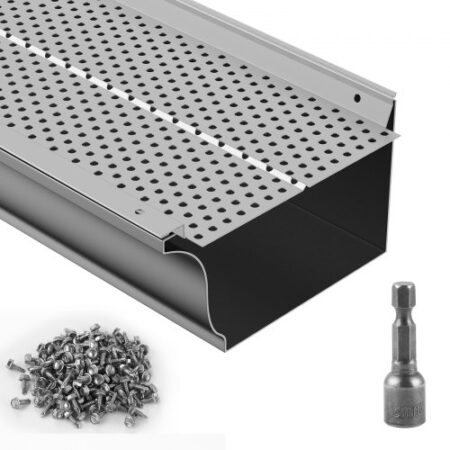
Perforated aluminum is the classic budget gutter guard: a solid aluminum sheet punched with small holes. This one uses 4 mm (0.157-inch) holes, which is fine for broad leaves like oak and maple and lets rain through fast.
The value here is coverage. You get 26 panels, each 48 inches long, for 104 feet of 6-inch gutter. Pre-drilled holes on the front and back folds make it quicker to screw down, and VEVOR includes the screws and a magnetic driver bit. From the ground, the low profile is practically invisible.
It’s thinner than the micro-mesh at 0.02 inches, so it’s best for homes without heavy snow loads. Where it really shines is a house surrounded by hardwoods: leaves sit on top, dry out, and blow off.
Key Features
- Fits 6-inch gutters
- Aluminum, 0.02 in thick
- 4 mm (0.157 in) holes
- 104 ft total in 26 panels (48 x 6 in each)
- Pre-drilled holes, screws, and magnetic bit included
- 15.4 lb for the full set
What We Like
- Covers a whole house for less than micro-mesh
- Pre-drilled holes speed up installation
- Handles broad leaves and heavy rain well
- Light and easy to work with on a ladder
- Bends easily around corners
What We Don’t Like
- Pine needles can poke through the 4 mm holes and pile up, so pick micro-mesh if you have pines.
Overall
For a house with 6-inch gutters and mostly hardwood trees, this kit gets you full coverage for the least money.
5. VEVOR 5-Inch Perforated Aluminum Gutter Guard (32 ft): Best for Problem Spots
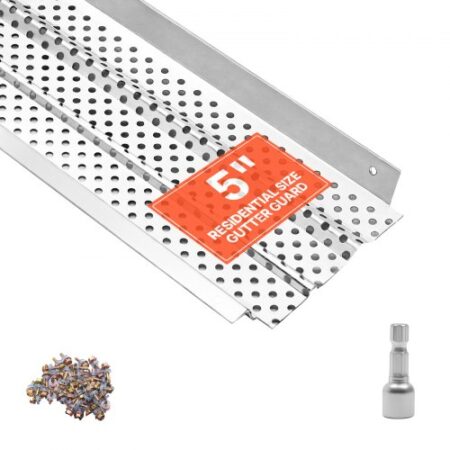
Most houses don’t clog everywhere. They clog under the one big tree, at the inside corner where two roof valleys dump into the same gutter, or over the garage. This 32-foot kit is made for exactly that: cover the trouble spots now and see if you need more.
It’s a 6061 aluminum panel, 0.02 inches thick, with 4 mm holes, sized for standard 5-inch K-style gutters. The eight 48-inch panels weigh just over 4 pounds total, so one person can do the whole job with a ladder and a drill.
It’s also a good way to test the idea of gutter guards before committing to a whole house. If it solves your problem, add more panels later.
Key Features
- Fits 5-inch K-style gutters
- 6061 aluminum, 0.02 in thick
- 4 mm holes
- 32 ft total in 8 panels (48 in each)
- Screws included
- 4.2 lb for the full set
What We Like
- Small kit for just the spots that clog
- Very light and easy to install alone
- Natural aluminum blends with mill-finish gutters
- Lets you try guards without a big spend
- Strong owner ratings across hundreds of reviews
What We Don’t Like
- At 32 feet it won’t cover a whole house, so most people will need more than one box for full coverage.
Overall
If one section of gutter is the problem, start here. It’s the cheapest way to fix the clog without guarding every foot of the house.
6. VEVOR Gutter Brush Leaf Guard (120 ft): Easiest Install
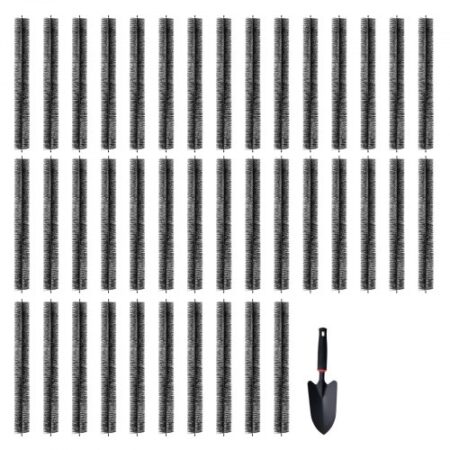
Gutter brushes look like giant pipe cleaners, and they’re the only guard on this list that needs no screws, no cutting, and no tools. You slide them into the gutter, end to end, and you’re done. Renters, people with odd gutter hangers, and anyone who doesn’t want to drill into their roof edge love them for that.
Each brush is 4.33 inches across, sized for standard 5-inch gutters, with polypropylene bristles on a galvanized steel wire core. Water runs down through the bristles while leaves and twigs sit on top and blow away. The wire core bends, so the brushes follow corners easily.
This pack has 40 brushes for 120 feet. When they need a cleaning, you just lift a brush out, shake it, and drop it back in.
Key Features
- Fits 5-inch gutters (4.33 in brush diameter)
- Polypropylene bristles, galvanized steel wire core
- 120 ft total in 40 brushes
- No tools or fasteners needed
- Bends around corners, can be trimmed
- 13.1 lb for the full set
What We Like
- Installs in minutes with zero tools
- No holes drilled in your gutters or fascia
- Works with gutter hangers that block flat guards
- Easy to lift out and clean
- Wire core bends to follow corners
What We Don’t Like
- Small seeds and pine needles can lodge in the bristles, so plan on pulling and shaking them out once or twice a year.
Overall
If you want the simplest possible fix, or you can’t screw into your gutters, the brush guard is the one to get.
Side-by-Side Comparison
| Guard | Type | Gutter Size | Coverage | Thickness | Best Against |
|---|---|---|---|---|---|
| 5″ Micro-Mesh | Stainless mesh on aluminum | 5 in | 100 ft | 0.04 in | Leaves, seeds, needles, grit |
| 6″ Micro-Mesh | Stainless mesh on aluminum | 6 in | 100 ft | 0.04 in | Leaves, seeds, needles, grit |
| 6″ Steel Screen | Powder-coated steel | 6 in | 120 ft | 0.04 in | Leaves, twigs, snow load |
| 6″ Perforated Aluminum | Aluminum, 4 mm holes | 6 in | 104 ft | 0.02 in | Broad leaves |
| 5″ Perforated Aluminum | Aluminum, 4 mm holes | 5 in | 32 ft | 0.02 in | Broad leaves, spot fixes |
| Gutter Brush | Polypropylene brush | 5 in | 120 ft | n/a | Leaves and twigs |
Specs are from VEVOR’s US product listings.
Which Type of Gutter Guard Do You Need?
Start with what’s growing over your roof, because that decides more than anything else.
- Pine needles, maple seeds, or shingle grit: Go with micro-mesh. Anything with bigger holes will let needles through or trap them standing up like a pincushion.
- Oak, maple, and other broad leaves: Perforated aluminum or steel screen works well and costs less. Broad leaves can’t fit through the holes and blow off once they dry.
- Heavy snow: Choose a thick guard (0.04 in micro-mesh or steel) and install it flat. Thin guards that sag become ice trays.
- Can’t or won’t drill: A gutter brush slides in with no fasteners.
Then measure your gutters. Run a tape across the open top from the back edge to the front lip. Most US homes have 5-inch K-style gutters, but larger and newer homes often have 6-inch. Buying the wrong width is the most common return reason for gutter guards.
Finally, measure the length. Walk the house and add up every run of gutter, then add about 10% for cutting waste around corners and downspouts.
How to Install DIY Gutter Guards
- Clean and flush first. Guards on top of a dirty gutter just hide the problem. Scoop it out, then run a hose through every downspout to confirm water flows.
- Check the slope and hangers. Fix any sagging sections or loose hangers before the guard goes on. Water should run toward the downspouts.
- Start at a corner or end cap. Work toward the downspouts, overlapping panels slightly in the direction water flows.
- Fasten to the front lip. Most of these guards screw to the outer lip of the gutter. Keep the back edge resting on or just under the drip edge so water runs onto the guard, not behind it.
- Cut carefully at corners. Use tin snips, wear gloves, and test-fit before you fasten. A gap at a corner is where leaves will get in.
Work safely. Set a sturdy ladder on level ground, keep three points of contact, and never lean out past the rails. Our guide to industrial ladders covers options that are much steadier than a cheap step ladder.
A Scenario Worth Knowing About
You install a full set of gutter guards in October. All winter they work great: no clogs, no overflow. Then a heavy spring rain hits and water sheets right over the front of the gutter like the guards aren’t even there.
This usually isn’t a clog. It’s the install angle. When the back of a guard sits too high, often because it was pushed up under the shingles at too steep a pitch, water running off the roof picks up speed and shoots across the guard instead of dropping through it. Micro-mesh is especially sensitive to this because water has to cling to the mesh to drain.
Keep the guard close to the pitch of the roof, or slightly flatter, and make sure the back edge sits under the drip edge without lifting the shingles. And give the guards a quick sweep or a blast with a leaf blower once or twice a year. A thin film of pollen and roof grit can build up on fine mesh and slow drainage. A soft brush or a gentle rinse fixes it in minutes.
Frequently Asked Questions
What is the best type of gutter guard?
For most homes, stainless micro-mesh is the best all-around gutter guard because it stops almost everything, including pine needles and roof grit. Perforated aluminum and steel screen are cheaper and work well under broad-leaf trees.
Do gutter guards really work?
Yes, when they’re the right type for your trees and installed at the right angle. They don’t eliminate maintenance, but they cut it down to a quick top-side cleaning instead of digging out packed gutters.
Do gutter guards cause ice dams?
Gutter guards don’t cause ice dams. Ice dams come from heat escaping through the roof and melting snow that refreezes at the cold edge. A sturdy, flat guard can actually help by keeping the gutter clear so meltwater drains, but it won’t fix an attic insulation problem.
Can I put gutter guards on myself?
Yes. Every guard on this list is designed for DIY installation with basic tools (or no tools, for the brush). A one-story house is typically a one-day job for one person.
Do you still need to clean gutters with guards?
Less often, and it’s easier. Expect to brush debris off the top once or twice a year and flush the downspouts. Brush guards need to be lifted out and shaken.
How long do gutter guards last?
Stainless steel mesh and aluminum don’t rust, so a well-installed guard can last as long as the gutters themselves. Powder-coated steel lasts well as long as the coating stays intact, which is why we recommend painting cut edges.
The Bottom Line
If you’re not sure which to buy, get the 5-inch micro-mesh (or the 6-inch version for wide gutters). It handles the widest range of debris and it’s built thick enough to last. Under oaks and maples on a budget, the perforated aluminum kit covers the most gutter for the money, and if you never want to pick up a drill, the gutter brush is the easy way out.
Clean the gutters first, match the guard to your trees and gutter width, and set it at the right angle. Do that once, and the worst job of the fall becomes a five-minute check from the ladder.