The worst ice of the winter is usually the thin, clear kind that forms overnight after a thaw. You cannot see it, a shovel will not lift it, and throwing salt by the handful leaves bare patches next to piles that burn the lawn. A salt spreader puts down an even layer in a few minutes, uses less product than hand tossing, and lets you treat the whole driveway before the morning rush instead of just the spot where someone already slipped.
This guide covers five spreaders from VEVOR. One is a tow behind spreader that VEVOR builds specifically for salt and ice melt. The other four are broadcast spreaders that VEVOR sells for seed and fertilizer as well as for salt and ice melt, so they earn their keep all year. We have flagged where that matters, because salt is tough on any spreader made of steel, and the care section below explains how to keep one going. More brands will be added to this page as we review them.
For each spreader you get capacity, spread width, flow settings, weight and one honest drawback. After the reviews, the buying guide covers tow behind versus push spreaders, rock salt versus other ice melts, how much to spread, and how to clean a spreader so salt does not eat it.
Our Quick Picks
Best Overall Salt Spreader
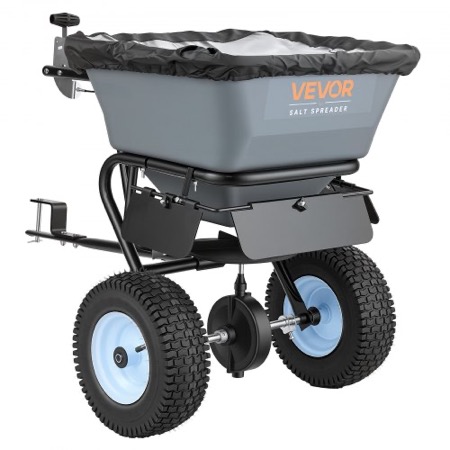
VEVOR 85 lb Tow Behind Salt Spreader (TC2034K)
Tow behind, made for salt · 85 lb / 10.1 gal · 0 to 9.8 ft
Check Price at VEVORRead the reviewBest Tow or Push Spreader
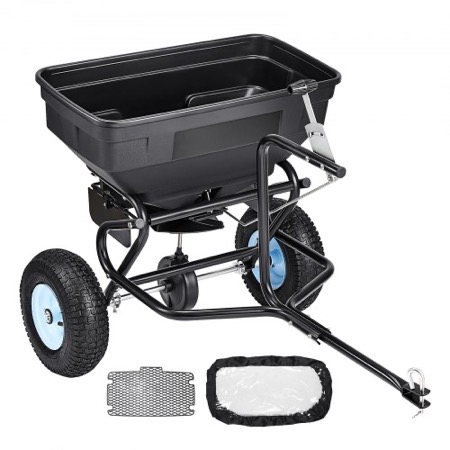
VEVOR 130 lb Tow/Push Broadcast Spreader (TC2029A)
Tow or push · 130 lb · 0 to 9.8 ft
Check Price at VEVORRead the reviewBest Walk-Behind for Long Driveways
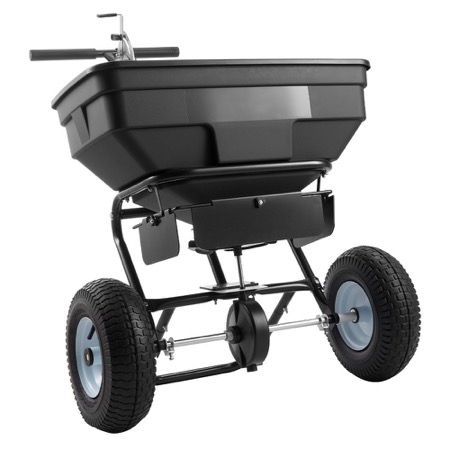
VEVOR 130 lb Walk-Behind Broadcast Spreader (2036)
Walk-behind · 130 lb · 0 to 12 ft
Check Price at VEVORRead the reviewBest for Clumpy Rock Salt: VEVOR 100 lb Push Spreader with Hopper Grate (TC2034B)Best Lightweight Push Spreader: VEVOR 80 lb Push Broadcast Spreader (TC2136)Compare all 5 side by side
Best Salt Spreaders: Full Reviews
At a glance
- Type
- Tow behind, made for salt
- Capacity
- 85 lb / 10.1 gal
- Spread width
- 0 to 9.8 ft
- Flow settings
- 2
1. VEVOR 85 lb Tow Behind Salt Spreader (TC2034K): Best Overall Salt Spreader
This is the only spreader in the lineup that VEVOR built and labels as a salt spreader, and that is why it gets the top spot. Everything about it is set up for winter work: an agitator inside the hopper keeps ice melt moving toward the opening so it clogs less, there are baffles on all four sides of the hopper, and a cover comes in the box to keep snow and freezing rain off the load while you work.
The hopper holds 10.1 gallons, or 85 pounds by weight, which is enough for a long driveway, a farm lane or a small parking area on one fill. It spreads anywhere from a narrow band up to 9.8 feet wide. A universal hitch and tow bar connect it to a lawn tractor, an ATV or a UTV, and the frame is steel with 12 inch rubber tires that grip on packed snow.
The trade-off is control. It has just 2 flow settings, fully open and half open, where the lawn spreaders below have 15 to 30. That is less of a problem with salt than with grass seed, because you mostly want a steady, generous flow, but you will adjust your driving speed more than the gate. At 30 pounds empty it is also the lightest tow behind spreader here, so it is easy to lift into a shed when spring arrives.
Key Features
- Model TC2034K, labeled by VEVOR as a salt spreader
- 10.1 gal hopper, 85 lb load capacity
- 0 to 9.8 ft spread width
- 2 flow settings: fully open and half open
- Built-in agitator for smoother flow
- Baffles on all four sides and a hopper cover
- Universal hitch and tow bar
- 12 x 4.33 in rubber tires, steel frame
- 30 lb, 38.98 x 25.59 x 28.74 in
What We Like
- Purpose built for salt and ice melt
- Agitator helps fight clogging
- Cover keeps the load dry in falling snow
- Tows behind a tractor, ATV or UTV
- Light enough to store easily
What We Don’t Like
- Only 2 flow settings, so you control the rate mostly with your speed.
Overall
The best salt spreader for most people with a tow vehicle. It is the one model in this lineup made for de-icing material, it holds enough for big jobs, and the agitator and cover solve the two problems that make salting miserable: clogs and wet salt. Pick it if you salt a long driveway, a lane or a lot.
VEVOR Black Friday
Up to 50% off, plus an extra 8% with code VVOTD (Nov 19 to Nov 30).
2. VEVOR 130 lb Tow/Push Broadcast Spreader (TC2029A): Best Tow or Push Spreader
If you want one spreader that does salt in winter and seed or fertilizer the rest of the year, and you want the choice of towing or pushing it, this is the one. The 130 pound hopper is the largest in the lineup along with the walk-behind model below, and the tow bar lets you hook it to a lawn tractor or ATV for big areas or push it by hand when you only need to do the walks.
Control is much finer than on the dedicated salt model. There are 30 adjustable settings and a spread of up to 9.8 feet, so you can run a light flow for a sidewalk and a heavy flow for an icy slope. The frame is powder-coated Q195 steel, the hopper is PP plastic, the gears are aluminum, and the 13 inch pneumatic tires roll over gravel and snow. Check that the hopper grate and rain cover are in the box when it arrives.
One detail to know: the flow gate is set by hand with the rate lever, and VEVOR confirms it does not close by itself when you stop. Close it before you turn around at the end of a pass or park, or you will leave a pile of salt on the pavement. It weighs 31.53 pounds and measures 44.48 x 30.70 x 29.52 inches.
Key Features
- Model TC2029A, tow or push
- 130 lb load capacity
- 30 adjustable settings
- 0 to 9.8 ft spread width
- 13 in pneumatic tires
- Powder-coated Q195 steel frame, PP hopper
- Aluminum gears
- 31.53 lb, 44.48 x 30.70 x 29.52 in
What We Like
- Tow it or push it
- Largest hopper, fewer refills
- 30 settings for fine rate control
- Big tires for gravel and snow
- Year-round use for seed and fertilizer
What We Don’t Like
- It is sold as a lawn spreader first, so salt is hard on its steel frame and gears; rinse and dry it after every use, and follow the manual if it limits salt use.
Overall
The best pick if you want flexibility: tow it behind a tractor for the driveway, push it for the walks, and use it on the lawn in spring. The flow gate is manual, so close it at every stop.
3. VEVOR 130 lb Walk-Behind Broadcast Spreader (2036): Best Walk-Behind for Long Driveways
This walk-behind spreader matches the tow/push model on capacity at 130 pounds, but it throws farther: up to 12 feet per pass. On a long driveway or a small lot that you salt on foot, that extra width means fewer passes and less walking in the cold. The hopper measures 28.54 x 15.75 x 13.19 inches, so a full 50 pound bag of ice melt drops in without spilling over the sides.
It has 30 flow settings, 13 inch pneumatic tires and a powder-coated steel frame with a UV-resistant, impact-resistant hopper. VEVOR says the gears are aluminum and come lubricated from the factory. It is made to roll on grass, gravel and snow-covered pavement, and the big tires do make a difference on a driveway with ruts and ridges of packed snow.
The handle and hopper detach for storage, which helps if your garage is short on floor space. At 33.07 pounds it is the heaviest push spreader here, and with a full 130 pound load it takes some effort on an uphill driveway. Keep the load to what you need for the job.
Key Features
- Model 2036, walk-behind
- 130 lb load capacity
- 0 to 12 ft spread width
- 30 flow settings
- 13 in pneumatic tires
- Powder-coated steel frame, UV and impact resistant hopper
- Aluminum gears, lubricated from the factory
- Detachable handle and hopper
- 33.07 lb, 39.76 x 30.71 x 28.35 in
What We Like
- Widest spread in the lineup at 12 ft
- Holds a full bag of ice melt with room to spare
- Big tires roll over packed snow
- Fine control with 30 settings
- Breaks down for storage
What We Don’t Like
- It is sold as a lawn spreader first, so salt is hard on its steel frame and gears; rinse and dry it after every use, and follow the manual if it limits salt use.
Overall
The best walk-behind choice for long driveways, wide walks and small lots. The 12 foot spread saves passes, and the large tires handle rough winter surfaces. Just do not overfill it if your driveway has a hill.
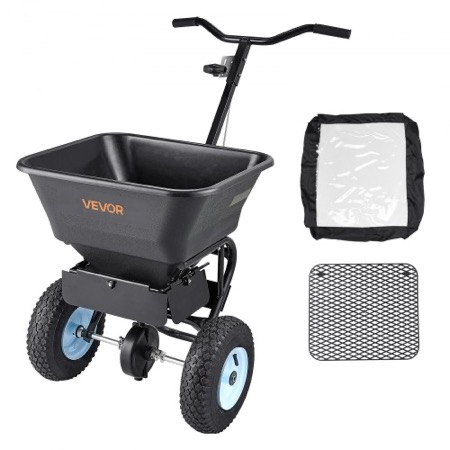
At a glance
- Type
- Walk-behind with grate
- Capacity
- 100 lb / 56 L
- Spread width
- 0 to 9.8 ft
- Flow settings
- 30, stepless
4. VEVOR 100 lb Push Spreader with Hopper Grate (TC2034B): Best for Clumpy Rock Salt
Rock salt clumps. It sits in a cold garage, picks up moisture, and turns into chunks that jam the hole at the bottom of the hopper. This VEVOR push spreader comes with a hopper grate that sits on top of the hopper and catches those chunks before they get to the opening, which is the simplest fix there is for clogging. A cover is pictured with it too.
It holds 100 pounds in a 56 liter hopper with a trapezoid shape that funnels material toward the opening. The rate control has 30 marked settings with stepless adjustment in between, and the spread runs up to 9.8 feet. VEVOR notes that the faster you push, the wider it spreads, which is true of every broadcast spreader and worth keeping in mind on ice.
The frame is powder-coated carbon steel, the hopper is rust resistant, and the gearbox is sealed, which matters with salt because a sealed box keeps brine away from the gears. It has 13 inch pneumatic tires and baffles on four sides, and many parts come pre-installed. It weighs 27.78 pounds and measures 23.62 x 37.00 x 37.40 inches.
Key Features
- Model TC2034B, walk-behind
- 100 lb load capacity, 56 L hopper
- Hopper grate to catch clumps
- 0 to 9.8 ft spread width
- 30 settings with stepless adjustment
- Sealed gearbox and rust-resistant hopper
- 13 in pneumatic tires, 4-sided baffles
- 27.78 lb, 23.62 x 37.00 x 37.40 in
What We Like
- Grate stops salt clumps before they clog
- Sealed gearbox keeps brine out
- Fine, stepless rate control
- Big tires for snowy surfaces
- Many parts pre-installed
What We Don’t Like
- It is sold as a lawn spreader first, so salt is hard on its steel frame and gears; rinse and dry it after every use, and follow the manual if it limits salt use.
Overall
The best pick if you use bagged rock salt and are tired of clogs. The grate and the sealed gearbox are exactly the features you want for salt, and 100 pounds is plenty for most homes.
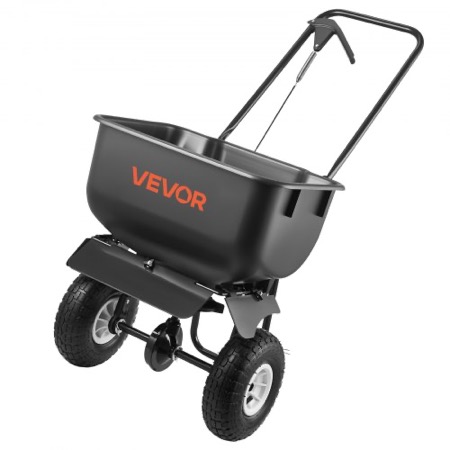
5. VEVOR 80 lb Push Broadcast Spreader (TC2136): Best Lightweight Push Spreader
Not everyone needs 100 pounds of capacity. If you salt a normal driveway, a front walk and some steps, this 80 pound VEVOR spreader is the easiest to live with. At 15.43 pounds it is half the weight of the others, so you can carry it down the porch steps or lift it onto a shelf without straining your back.
It still spreads up to 12 feet wide, which matches the biggest walk-behind model, and it has 15 flow settings. That is fewer than the 30 on the larger push spreaders, but plenty for ice melt, where you are usually choosing between a light coat before a storm and a heavier one on ice. VEVOR confirms a rain cover is included.
The frame is powder-coated steel and the hopper is impact-resistant ABS. It rolls on 10 inch pneumatic tires, smaller than the 13 inch tires on the bigger push models, so it is happiest on cleared or lightly covered pavement rather than deep slush. The handle and hopper come apart for storage.
Key Features
- Model TC2136, walk-behind
- 80 lb load capacity
- 0 to 12 ft spread width
- 15 flow settings
- 10 in pneumatic tires
- Powder-coated steel frame, ABS hopper
- Rain cover included
- Detachable handle and hopper
- 15.43 lb, 34.25 x 20.47 x 32.28 in
What We Like
- Lightest spreader here by far
- 12 ft spread despite its size
- Cover included
- Easy to carry up and down steps
- Small storage footprint
What We Don’t Like
- It is sold as a lawn spreader first, so salt is hard on its steel frame and gears; rinse and dry it after every use, and follow the manual if it limits salt use.
Overall
The best choice for a typical home driveway and walks, and for anyone who wants a spreader that is easy to carry. Choose a bigger model if you salt a long lane or deal with deep slush.
Side-by-Side Comparison
| Spreader | Type | Capacity | Spread width | Flow settings | Tires | Weight | Price |
|---|---|---|---|---|---|---|---|
| 1. VEVOR 85 lb (TC2034K) | Tow behind, made for salt | 85 lb / 10.1 gal | 0 to 9.8 ft | 2 | 12 in rubber | 30 lb | Check price |
| 2. VEVOR 130 lb (TC2029A) | Tow or push | 130 lb | 0 to 9.8 ft | 30 | 13 in pneumatic | 31.53 lb | Check price |
| 3. VEVOR 130 lb (2036) | Walk-behind | 130 lb | 0 to 12 ft | 30 | 13 in pneumatic | 33.07 lb | Check price |
| 4. VEVOR 100 lb (TC2034B) | Walk-behind with grate | 100 lb / 56 L | 0 to 9.8 ft | 30, stepless | 13 in pneumatic | 27.78 lb | Check price |
| 5. VEVOR 80 lb (TC2136) | Walk-behind | 80 lb | 0 to 12 ft | 15 | 10 in pneumatic | 15.43 lb | Check price |
Specs are VEVOR’s own figures. Spread width on any broadcast spreader depends on walking or driving speed and on the material, so treat the maximum width as a best case with dry, free-flowing ice melt.
How to Choose a Salt Spreader
Tow behind or push?
A tow behind spreader makes sense when you already own a lawn tractor, ATV or UTV and you salt a long driveway, a farm lane or a lot. You sit, the machine does the work, and a big hopper means fewer trips back to the bag. A push spreader is better for normal driveways, sidewalks and anywhere a vehicle cannot go. If you are not sure, the tow/push model in this lineup gives you both. If you clear snow with an ATV, the same machine that pulls a spreader can push an ATV snow plow before you salt.
Capacity
Ice melt usually comes in 50 pound bags. A hopper that holds 80 to 130 pounds takes a full bag with room to spare, which saves you from wrestling a half-used bag back into the garage. For a typical two-car driveway and front walk, 80 pounds is more than enough. For long lanes and lots, look at 100 to 130 pounds or the tow behind models.
Spread width and flow settings
A wider spread means fewer passes. On salt, though, you do not always want maximum width, since throwing ice melt 12 feet across a 10 foot walk puts it on the lawn and garden beds where it does damage. More flow settings let you dial in a light coat for a sidewalk or a heavy coat for an icy slope. Thirty settings is generous; 15 is enough for ice melt; 2 settings means you control the rate with your speed.
Tires
Winter surfaces are rough: ruts, frozen ridges, slush and gravel. Bigger pneumatic tires, 12 to 13 inches, roll over that much more easily than small plastic wheels and keep the spreader from tipping and dumping salt in one spot. The 10 inch tires on the lightest model are fine on cleared pavement.
Features that matter for salt
- A hopper grate catches clumps before they jam the opening.
- An agitator keeps material moving toward the hole so it flows evenly.
- A cover keeps falling snow from wetting the load and turning it to slush in the hopper.
- A sealed gearbox keeps brine away from the gears that drive the spinner.
- Edge baffles help keep salt off the lawn when you work along the edge of the driveway.
Rock Salt or Ice Melt: What Goes in the Spreader
Plain rock salt, sodium chloride, is the cheapest option and works well down to roughly 15 degrees F. Below that it slows down a lot. Calcium chloride and magnesium chloride blends keep working at much lower temperatures and melt faster, but they cost more and some can be harder on plants. Products sold as pet friendly usually avoid plain chloride salts or blend them with other ingredients; follow the bag’s directions either way.
Whatever you use, buy granules, not powder, for a broadcast spreader. Granules flow through the opening and throw evenly. Keep bags closed and off the garage floor so they stay dry; damp salt is the main reason spreaders clog. Many ice melt bags list a spreader setting or a rate per 1,000 square feet. Start there, and if you see salt left on the pavement after the ice is gone, turn it down.
How to Spread Salt Without Wasting It
- Go before the storm when you can. A light coat before snow or freezing rain stops ice from bonding to the pavement and makes shoveling easier.
- Clear first, then salt. Salt works on the thin layer under the snow, not on six inches of it. Use a heavy duty snow shovel, a rolling snow pusher or a cordless snow blower, then spread.
- Less is more. A handful of salt can treat a surprising amount of pavement. Extra salt does not melt faster; it washes into the lawn.
- Use the edge baffles or a narrow setting near grass and beds. Salt kills turf and shrubs along driveways more than anything else.
- Close the gate at every stop. Most spreaders keep dropping material as long as the gate is open, even when you stand still.
- Keep your hands warm and dry. Salt and cold are rough on skin; a pair of leather winter work gloves helps when you fill the hopper.
Spreader Care: Keep Salt From Eating It
Salt is corrosive. It is why cars rust, and it will do the same to any spreader with a steel frame, axle or gears if you leave it caked on. A little care after each use is the difference between a spreader that lasts years and one that seizes by February.
- Empty the hopper after every use. Never leave salt sitting in it between storms; it draws moisture and hardens.
- Rinse it with fresh water, including the underside, the spinner, the gate and the axle. Let it dry completely before you put it away.
- Work the gate and lever while it dries so brine does not set up in the linkage.
- Touch up chipped paint on the frame before rust starts, and check bolts for corrosion now and then.
- Check the manual. Some spreaders sold for both lawns and ice melt have manuals that limit or warn against salt use. If yours does, follow the manual, or use the purpose-built salt spreader for winter work.
- Clean it before spring. A final wash and dry before you switch to seed or fertilizer keeps salt out of your lawn.
A Scenario Worth Knowing About
Picture someone with a 150 foot driveway who buys a lawn spreader in December, fills it with rock salt from an open bag that has been sitting on the garage floor, and spreads on a freezing morning. Halfway down the drive the flow stops. Damp chunks have jammed the opening, so they shake the spreader, the clump breaks loose, and a pile of salt lands in one spot. After the job, the spreader goes back in the garage still half full. By the next storm the leftover salt is a solid brick and the gate lever will not move.
None of that was the spreader’s fault. A hopper grate would have caught the chunks, a dry bag would have stopped them forming, and emptying and rinsing the spreader would have kept the gate free. The same spreader, used that way, would have treated the driveway in a few minutes with an even coat and been ready for the next storm.
Frequently Asked Questions
Can I use a lawn spreader for salt?
Many broadcast spreaders, including four in this guide, are sold for seed, fertilizer and ice melt. The key is care: empty and rinse it after every use so salt does not corrode the frame and gears. Check the manual too, and follow it if it limits salt use.
What is the difference between a salt spreader and a fertilizer spreader?
A purpose-built salt spreader usually adds features for de-icing material, such as an agitator to keep salt flowing and a cover to keep it dry. A fertilizer spreader puts more focus on fine rate control. The design is otherwise very similar: a hopper, a gate and a spinning plate that throws material out.
How wide does a salt spreader throw?
The spreaders here list 9.8 to 12 feet at most. Real width depends on speed and material. Walking or driving faster throws farther, and dense, damp salt throws less than dry granules.
Should I put salt down before or after it snows?
Both have a place. A light coat before a storm keeps ice from bonding to the pavement. After snow, clear it first, then salt the thin layer that is left.
Will salt damage my concrete?
Salt can speed up surface flaking on concrete, especially new concrete. Many concrete contractors advise against salting concrete in its first winter. Use the least salt that does the job, and consider a gentler ice melt on new slabs.
How do I stop my spreader from clogging?
Keep the salt dry, break up clumps or use a hopper grate, and choose a spreader with an agitator if clogging is a regular problem. Empty the hopper after each use so leftover salt cannot harden inside.
The Bottom Line
If you have a lawn tractor, ATV or UTV, the VEVOR 85 lb tow behind salt spreader is the best salt spreader in this lineup: it is the only one built for salt, and its agitator and cover deal with clogs and wet loads. If you want to tow or push, or use the same spreader on the lawn in spring, choose the 130 lb tow/push model.
For salting on foot, the 130 lb walk-behind covers the most ground per pass, the 100 lb model with a hopper grate is the cure for clumpy rock salt, and the 80 lb push spreader is the light, easy choice for a typical home. Whichever you pick, keep the salt dry, spread less than you think you need, and rinse the spreader after every storm.