Two inches of fresh snow on a long driveway is not hard work, it is just slow work. A regular shovel means scoop, lift, toss, repeat, and by the end of the drive your lower back is doing most of the talking. A rolling snow pusher changes the motion. The wheels carry the blade, you walk behind it like a lawn mower, and the snow piles up at the edge instead of on your spine.
The best heavy duty rolling snow pushers do that job on smooth pavement with very little effort. They are less good on gravel, deep drifts or heavy wet snow, and we say so for each pick. This page covers two VEVOR wheeled pushers plus one no-wheel pusher for surfaces where wheels get in the way.
VEVOR is the only brand on this page for now, and more brands will be added as they are reviewed.
Our Quick Picks
Best Overall for Wide Driveways
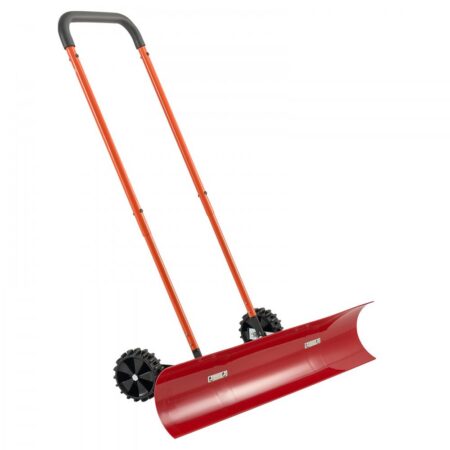
VEVOR 37.8 in Snow Pusher Shovel with Wheels
37.8 in · PC and ABS, no metal edge · PP wheels
Check Price at VEVORRead the reviewBest for Single-Car Drives and Wide Walks
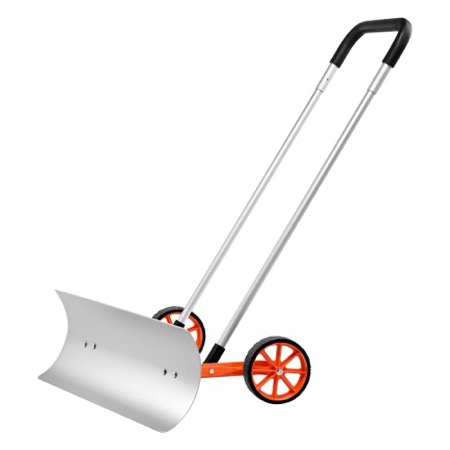
VEVOR 30 in Metal Snow Pusher with Wheels
30 in · T5052 aluminum, reversible · 7 in ABS, no inflation
Check Price at VEVORRead the reviewBest for Gravel and Uneven Surfaces
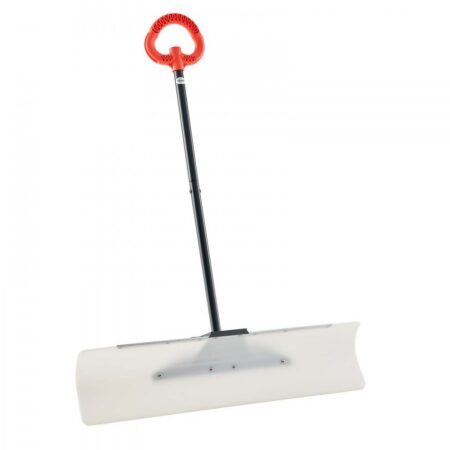
VEVOR 36 in Snow Pusher Shovel, No Wheels
36 in · HDPE with metal edge · None
Check Price at VEVORRead the reviewBest Heavy Duty Rolling Snow Pushers: Full Reviews
At a glance
- Blade width
- 37.8 in
- Blade material
- PC and ABS, no metal edge
- Wheels
- PP wheels
- Weight
- 10.05 lb
1. VEVOR 37.8 in Snow Pusher Shovel with Wheels: Best Overall for Wide Driveways
At 37.8 inches wide and 8.27 inches tall, this blade clears roughly a car-width strip with each pass, which is what makes a rolling pusher worth having on a two-car driveway. The blade is set at a 72 degree dual angle so it throws snow to one side, and the handle tilts through 90 degrees so you can stand upright while you push. VEVOR lists the full unit at 10.05 pounds.
The blade is PC and ABS plastic, not metal, and there is no metal wear strip on the edge. That keeps it quiet and gentle on pavers and stamped concrete, but it also means it rides over packed snow and ice rather than cutting through it. The frame uses a steel tube, an aluminum support rod and PP wheels, with a foam-padded U-shaped handle.
It is made for light snow, not heavy snow, and it works poorly on uneven or loose surfaces. Skip it for gravel driveways.
Key Features
- 37.8 in wide, 8.27 in tall blade
- 72 degree dual-angle blade throws snow to the side
- 90 degree adjustable handle with foam padding
- PC and ABS blade, steel tube and aluminum support rod
- PP wheels
- Model H955, 10.05 lb
- About 37.6 x 16.5 x 53 in assembled
What We Like
- Widest wheeled blade here
- Angled blade sends snow to the side, not just forward
- Upright pushing posture
- Plastic edge will not gouge pavers or decks
What We Don’t Like
- No metal edge, so it struggles with packed snow and ice
Overall
The best pick for wide, paved driveways that get regular light to moderate snow. Clear early, before cars pack it down.
VEVOR Black Friday
Up to 50% off, plus an extra 8% with code VVOTD (Nov 19 to Nov 30).
At a glance
- Blade width
- 30 in
- Blade material
- T5052 aluminum, reversible
- Wheels
- 7 in ABS, no inflation
- Weight
- 10.1 lb
2. VEVOR 30 in Metal Snow Pusher with Wheels: Best for Single-Car Drives and Wide Walks
This pusher sits between the two extremes on the page. The blade is 30 inches wide and made of T5052 aluminum alloy, so it is stiffer than a plastic blade and resists rust and corrosion. VEVOR reverses it for different conditions and sets it at a 15 degree slope, which keeps the edge in solid contact with the pavement and pushes snow off to the side as you walk.
It rides on two 7 inch ABS wheels that never need air, so it rolls over expansion joints and small cracks more easily than smaller wheels. The U-shaped handle is T6061 aluminum tube with padding at the grip, and the handle can be locked in place with screws. VEVOR lists the full unit at 10.1 pounds and 47.2 by 29.3 by 9.8 inches.
Assembly is four steps: bracket, pole, handle, wheels. It comes apart the same way for storage or cleaning. VEVOR rates it for light to moderate snow, and like every wheeled pusher it does its best work on smooth, solid surfaces rather than gravel or broken ground.
Key Features
- 30 in reversible T5052 aluminum alloy blade
- 15 degree sloped blade angle
- 7 in ABS wheels, no inflation needed
- U-shaped T6061 aluminum handle with padding
- Four-step assembly, comes apart for storage
- Model CY-SL24, 10.1 lb
- About 47.2 x 29.3 x 9.8 in
What We Like
- Metal blade at a manageable width
- Largest wheels here for rolling over cracks
- Rust-resistant aluminum build
- Reversible blade
- Breaks down for storage
What We Don’t Like
- Rated for light to moderate snow only, so deep or heavy storms still need a blower
Overall
A good fit for single-car driveways, wide sidewalks and patios. It covers more ground than a narrow shovel and is easier to steer than a 38 inch blade.
At a glance
- Blade width
- 36 in
- Blade material
- HDPE with metal edge
- Wheels
- None
- Weight
- About 6.3 lb
3. VEVOR 36 in Snow Pusher Shovel, No Wheels: Best for Gravel and Uneven Surfaces
Wheeled pushers have one weakness that keeps coming up in reviews: rough, loose or uneven ground. On gravel the wheels sink and the blade either skips or digs. That is where a plain push-style pusher wins, and this 36 inch HDPE model is the one we would pair with any of the picks above.
The blade is 36 x 8.66 inches of HDPE with a reinforced metal edge strip, so unlike the 37.8 inch wheeled pusher it can scrape packed snow. VEVOR says it moves about 66 to 88 pounds of snow per push, has a textured anti-slip grip and a detachable segmented handle, and weighs about 6.3 pounds (2.84 kilograms), the lightest tool on this page.
The trade-offs are a two-piece handle, blade wear over time and fatigue over long sessions. Because it has no wheels, you need to keep the blade flat on the ground yourself, which takes more effort on long, smooth runs than a wheeled model.
Key Features
- 36 x 8.66 in HDPE blade
- Reinforced metal edge strip
- Moves about 66 to 88 lb of snow per push, per VEVOR
- Textured anti-slip grip
- Detachable segmented handle for storage
- Model H915, about 6.3 lb
- No wheels
What We Like
- Works on gravel and uneven ground where wheels fail
- Metal edge scrapes packed snow
- Lightest tool on the page
- Wide 36 in blade
- Handle comes apart for storage
What We Don’t Like
- The two-piece handle is less solid than a one-piece shaft
Overall
Pick this if your driveway is gravel or broken asphalt, or keep it alongside a wheeled pusher for the patches the wheels cannot handle.
Side by Side Comparison
| Pick | Blade width | Blade material | Wheels | Weight | Best for | Price |
|---|---|---|---|---|---|---|
| 1. 37.8 in wheeled (H955) | 37.8 in | PC and ABS, no metal edge | PP wheels | 10.05 lb | Wide paved driveways | Check price |
| 2. 30 in wheeled (CY-SL24) | 30 in | T5052 aluminum, reversible | 7 in ABS, no inflation | 10.1 lb | Single-car drives, wide walks | Check price |
| 3. 36 in no wheels (H915) | 36 in | HDPE with metal edge | None | About 6.3 lb | Gravel and uneven ground | Check price |
Specs come from VEVOR.
When a Rolling Snow Pusher Makes Sense
A rolling pusher shines on flat, paved surfaces with light to moderate snow: asphalt driveways, concrete sidewalks, patios and parking pads. The wheels take the weight of the blade, so you walk instead of lift, and the wide blade means fewer passes. If your snow usually falls a few inches at a time and you clear it the same day, a wheeled pusher can replace most of your shoveling.
It makes less sense on gravel, steep slopes, or after a storm that dumps a foot of heavy, wet snow. Wheels sink in loose stone, a wide blade fills up fast in deep snow, and none of these tools are meant to throw snow over a tall bank. For big storms, a powered option like the ones in our cordless snow blower guide does the heavy lifting, and a pusher handles the cleanup passes.
Blade Width: Wider Is Not Always Better
A 36 to 38 inch blade clears a two-car driveway in far fewer passes, but it also fills with snow faster, which makes it harder to push in deeper snow. It is also harder to steer around cars, planters and narrow gaps. A 30 inch blade takes a few more passes on open pavement but stays easier to push when the snow is deeper, and a narrow shovel is still the tool for tight paths. If you clear both a driveway and a walkway, the widest blade for the drive plus a regular shovel for steps is a sensible pair.
Blade Material and Edges
Plastic blades (PC, ABS or HDPE) are light and quiet, and they will not scratch pavers or stamped concrete. They are weaker against packed snow and ice. A metal edge strip, like the one on the 36 inch no-wheel pusher, scrapes much better. Aluminum blades, like the 30 inch pusher’s, are stiffer than plastic and resist rust, but bare metal is harder on soft pavers and wood decks than plastic, so take it slowly on decorative surfaces. If your driveway gets packed down by cars before you clear it, choose an edged blade or plan to spread ice melt first.
Wheels, Handles and Your Back
Bigger wheels roll more easily over cracks and joints. The 30 inch pusher’s 7 inch wheels are the largest here. A handle that tilts or extends lets you stand upright, which is the point of a pusher in the first place. Push with your legs, keep your back straight, and let the blade fill partway before you angle it to the side. On long runs, two shorter pushes are easier than one heavy one.
Clear Early, Clear Often
Rolling pushers work best on fresh snow. Every time a car drives over a snowy driveway, it packs the snow into a layer that plastic blades ride over. Clearing in two or three short passes during a storm is easier than one long session afterward. If you need light for early morning clearing, a bright heavy duty flashlight or headlamp helps you spot edges and drains.
Assembly, Bolts and Season-Long Care
Wheeled pushers ship flat and go together with a handful of bolts, so a few minutes of care at the start saves a wobbly handle later. Lay the parts out on a towel, follow the order in the manual, and snug every bolt before you take the first pass. Check them again after the first snowfall, because the blade bracket takes most of the shock when the edge hits a raised joint or the lip of the garage slab. A loose blade bolt is the most common reason a pusher starts to rattle or twist.
Keep a spare bolt or two of the right size in a coffee can in the garage. VEVOR lists the blade bolt on its 30 inch pusher as M8 by 30 mm, which any hardware store carries. A drop of thread locker on the blade bolts is cheap insurance on a tool that gets shaken all winter.
At the end of the season, hose off salt and grit, let the pusher dry fully, and store it out of the sun. Plastic wheels and blades get brittle with long UV exposure, and salt left on aluminum or steel parts eats at the bolts and brackets. Spin the wheels to make sure they turn freely, and if they squeak, a little dry lubricant on the axle helps.
A Scenario Worth Knowing About
Picture a homeowner with a long gravel driveway who buys the widest wheeled pusher they can find after a snowy week. On the first morning the wheels sink into the stone, the blade catches on a high spot, and the handle jerks to a stop against their ribs. A few passes later the plastic blade has scooped up a pile of gravel and spread it across the lawn. The reviews they skipped said exactly this: wheeled pushers need smooth, solid surfaces.
The fix is to match the tool to the surface. On gravel, use a no-wheel pusher like the 36 inch model and leave a thin layer of snow on the stones, or use a snow blower with the skids raised. Save the wheeled pusher for paved paths and the patio. If part of the driveway is paved and part is gravel, owning both is cheaper than replacing a bent blade mid-season.
Frequently Asked Questions
Do rolling snow pushers work on gravel driveways?
Not well. Wheels sink into loose stone and the blade can scoop up gravel. Use a plain pusher like the 36 inch no-wheel pusher on gravel and leave a thin layer of snow over the stones.
Can a rolling snow pusher handle heavy, wet snow?
Only in small bites. These are best for light to moderate snow. In heavy wet snow, push half-blade loads, angle the blade so snow rolls off the side, and consider a snow blower for big storms.
What blade width should I buy?
For a two-car paved driveway, 36 to 38 inches saves the most time. For single-car drives and wide sidewalks, about 30 inches is easier to steer and push when the snow gets deeper. For narrow side paths, a regular shovel is often simpler.
Will a plastic blade scratch my pavers or deck?
Plastic blades like the 37.8 inch pusher’s are the gentlest option for pavers and decks. An aluminum blade like the 30 inch pusher’s scrapes better, but bare metal can mark soft pavers or wood, so ease off on those surfaces.
How do I store a rolling snow pusher?
Hang it by the handle or stand it blade-down in a corner of the garage. The 30 inch wheeled pusher and the 36 inch no-wheel pusher both come apart, which helps in tight spaces. Rinse off salt at the end of the season so the wheels and bolts do not corrode.
Is a rolling pusher better than a snow blower?
It is quieter, lighter, cheaper and needs no fuel or charging, so it is ideal for frequent light snow. A snow blower is better for deep snow and for throwing snow over banks. Many homeowners keep both.
How far should I push snow before angling it off?
Push until the blade is about half full, then turn it so the snow rolls off to the side. A full blade is heavy to push and spills over the top. On a long driveway, work in lanes from the middle out to the edges so you are never pushing the same snow twice.
Do I need ice melt with a rolling pusher?
Often, yes. Pushers clear loose snow well, but none of them break up a frozen layer. Spreading ice melt before a storm stops snow from bonding to the pavement, which makes the next morning’s push much easier and leaves a cleaner surface.
The Bottom Line
For a wide paved driveway, the VEVOR 37.8 in wheeled pusher is the best overall pick: it clears a lot of ground per pass and angles snow out of your way. The 30 in aluminum pusher suits single-car drives and wide walks, and it breaks down for storage. If any part of your property is gravel or broken pavement, add the 36 in no-wheel pusher, which handles the surfaces wheels cannot.
All of these work best on fresh, light snow cleared early. For bigger storms, pair one with a snow blower, and for steps and tight corners, keep a regular shovel close by; our heavy duty snow shovel guide covers those. More brands will be added here as they are reviewed.