A homeowner pressure washer cleans a patio twice a year. An industrial pressure washer strips grease off a shop floor, washes equipment every week, and runs for hours at a time without overheating. The difference is not only pressure. It is flow, pump construction, engine size and how long the machine is built to run.
The best industrial pressure washer balances PSI (the force that breaks grime loose) with GPM (the water flow that carries it away). Multiply the two and you get cleaning units, the most useful single number for comparing machines. A 4400 PSI, 4.0 GPM washer delivers far more than twice the cleaning work of a 2000 PSI, 1.8 GPM electric model.
We picked four VEVOR machines for heavy and commercial work: a 4400 PSI, 4.0 GPM gas washer with a copper pump; a 3600 PSI copper pump unit; a 3400 PSI gas washer for heavy home jobs; and a 240V triplex electric pump kit for fixed wash bays. We will add more brands as we review them. To compare any washer’s numbers, try our PSI, GPM and cleaning units calculator.
A note on ratings: we left out several compact electric models whose headline “max” pressure is far above their listed rated pressure. For industrial work, only sustained, rated output matters.
Our Quick Picks
Best Overall
VEVOR 4400 PSI 4.0 GPM Gas Pressure Washer, Copper Pump
4400 · 4.0 · About 17,600
Check Price at VEVORRead the reviewBest Value for Frequent Use
VEVOR 3600 PSI 2.6 GPM Gas Pressure Washer, Copper Pump
3600 · 2.6 · About 9,360
Check Price at VEVORRead the reviewBest for Homeowners with Heavy Jobs
VEVOR 3400 PSI 2.6 GPM Gas Pressure Washer
3400 · 2.6 · About 8,840
Check Price at VEVORRead the reviewBest for Fixed Wash Bays: VEVOR 240V 5 HP Triplex Electric Pressure Washer KitCompare all 4 side by side
Best Industrial Pressure Washers: Full Reviews
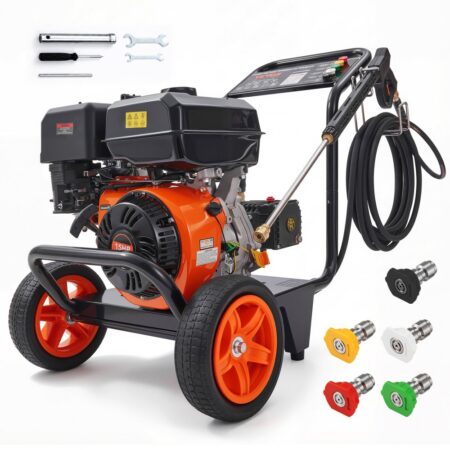
1. VEVOR 4400 PSI 4.0 GPM Gas Pressure Washer, Copper Pump: Best Overall
This is the true industrial machine of the group. VEVOR rates it at 4400 PSI and 4.0 GPM, about 17,600 cleaning units, which puts it in commercial territory for stripping oil-stained concrete, cleaning heavy equipment, prepping surfaces for paint and washing fleets. The high flow matters as much as the pressure: 4 gallons a minute rinses large areas fast instead of just etching them.
It runs on a 390cc, 15 HP four-stroke engine with a 1.7-gallon fuel tank, enough for long sessions between fill-ups, and drives a copper pump that resists heat and corrosion better than aluminum. It comes with a 50-foot, 0.6-inch high-pressure hose, the longest here, a 2.6-foot wand, five quick-connect nozzles (0, 15, 25 and 40 degrees plus soap) and 10-inch wheels for rough ground.
The criticisms are noise, occasional leaks and broken soap tanks, so check fittings when it arrives and wear hearing protection on long jobs.
Key Features
- 4400 PSI, 4.0 GPM (VEVOR max ratings)
- About 17,600 cleaning units
- 390cc 15 HP four-stroke engine
- Copper pump
- 50 ft, 0.6 in high-pressure hose
- 1.7 gal fuel tank, 10 in wheels
- Five quick-connect nozzles, model BSG250A
What We Like
- Highest pressure and flow here
- Copper pump for heavy use
- Longest hose on the page
- Big tank for long sessions
What We Don’t Like
- Loud, and too much power for delicate surfaces
Overall
The pick for contractors, farms, fleets and anyone who needs real commercial output.
VEVOR Black Friday
Up to 50% off, plus an extra 8% with code VVOTD (Nov 19 to Nov 30).
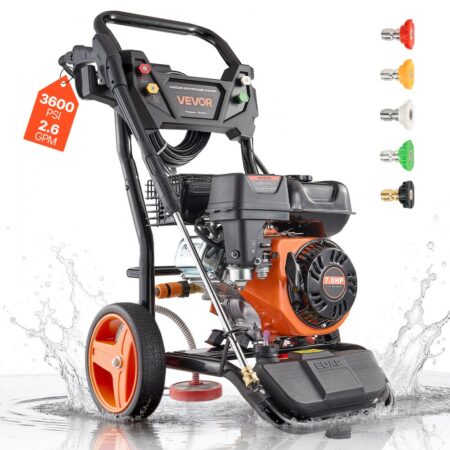
2. VEVOR 3600 PSI 2.6 GPM Gas Pressure Washer, Copper Pump: Best Value for Frequent Use
Pump construction is what separates a washer that lasts a season from one that lasts years. This VEVOR unit uses a full copper pump, which VEVOR says sheds heat better and holds its shape through repeated start-stop cycles, reducing leaks and pressure loss. It is rated at 3600 PSI and 2.6 GPM, about 9,360 cleaning units.
It has a 0.8-gallon fuel tank, a separate oil reservoir and low-oil shutdown, which stops the engine before it can damage itself. A 26.3-foot hose, a 33.5-inch spray gun, five stainless nozzles and a 0.45-gallon foam bottle are included, and 10-inch wheels move its 61 lb across gravel and grass. VEVOR says it can draw water from a tank as well as a faucet, useful on remote sites.
Inspect it on delivery, since a heavy gas washer can be damaged in shipping.
Key Features
- 3600 PSI, 2.6 GPM (VEVOR max ratings)
- About 9,360 cleaning units
- Full copper pump
- Low-oil shutdown and thermal protection
- 26.3 ft hose, five nozzles, foam bottle
- 10 in wheels, 61 lb
- Model 180D
What We Like
- Copper pump for daily use
- Low-oil shutdown protects the engine
- Can draw from a water tank
- Easy starting
What We Don’t Like
- Heavy unit that can be damaged in shipping, so inspect on arrival
Overall
The smart buy for small businesses and heavy weekly use where durability matters more than peak power.
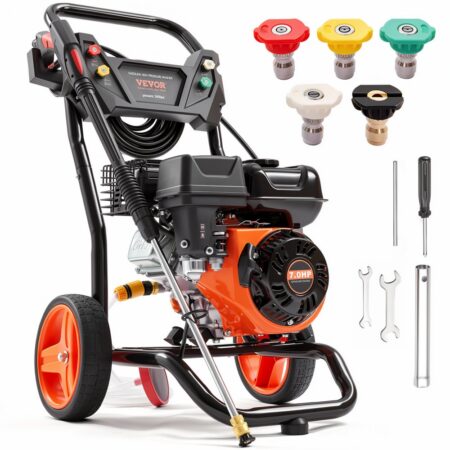
3. VEVOR 3400 PSI 2.6 GPM Gas Pressure Washer: Best for Homeowners with Heavy Jobs
Not every heavy job needs a commercial machine. For a homeowner with a long driveway, a moss-covered brick patio, a deck to strip or farm equipment to wash a few times a year, this 3400 PSI, 2.6 GPM gas washer covers the work at about 8,840 cleaning units.
It runs on a 210cc, 7 HP four-stroke engine with a 0.8-gallon tank. VEVOR describes the pump as a swash plate triplex type in an aluminum housing; aluminum is lighter and fine for occasional use, but copper pumps cope better with heavy, daily use. It comes with a 26-foot, 0.5-inch hose, a 2.6-foot wand, five quick-connect nozzles and 10-inch wheels.
Some report assembly hiccups and minor defects in hoses or tanks, which is worth checking when you unpack it.
Key Features
- 3400 PSI, 2.6 GPM (VEVOR max ratings)
- About 8,840 cleaning units
- 210cc 7 HP four-stroke engine
- Aluminum pump housing
- 26 ft, 0.5 in hose, 2.6 ft wand
- 0.8 gal tank, 10 in wheels
- Five nozzles, model BS170D-SP
What We Like
- Plenty of power for heavy home jobs
- Lighter than the copper pump units
- Easy to use
- Big wheels
What We Don’t Like
- Aluminum pump is better suited to occasional than daily use
Overall
The right choice for big home and property jobs a few times a year, not daily commercial work.
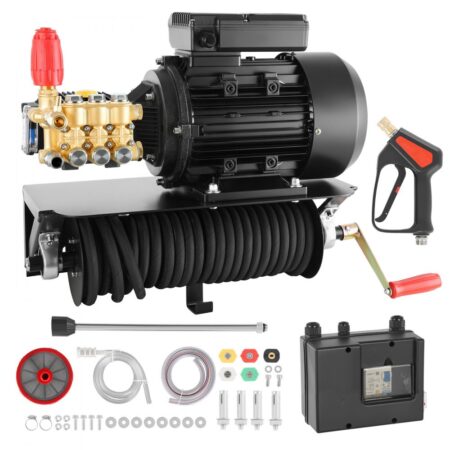
4. VEVOR 240V 5 HP Triplex Electric Pressure Washer Kit: Best for Fixed Wash Bays
Gas washers are the default for mobile work, but a shop, car wash bay, farm dairy or detailing garage that cleans in one place every day is better served by a wall-mounted electric system. No fuel, no exhaust indoors, and far less noise. This VEVOR kit pairs a 240V, 5 HP motor with a crankshaft-driven triplex pump rated at 1950 PSI and 3.2 GPM, about 6,240 cleaning units, with the high flow suiting rinsing and washing over long shifts.
The pump has ceramic plungers and a brass head for sealing and rust resistance, plus an unloader valve for steady pressure and adjustable output. The kit includes a wall-mount bracket, spray gun, wand, hose and five nozzles, and VEVOR says the pump’s G 3/4 inch inlet and M22 outlet fit standard fittings, so it can also replace a worn pump in an existing system. The whole kit weighs 121.54 lb, and it needs a 240V circuit sized for a 5 HP motor, installed by an electrician.
Inspect it carefully on delivery for shipping damage. Inspect everything before installation and keep the packaging until it is running.
Key Features
- 1950 PSI, 3.2 GPM
- About 6,240 cleaning units
- 240V, 5 HP electric motor
- Crankshaft triplex pump, ceramic plungers, brass head
- Unloader valve, adjustable pressure
- Wall-mount bracket, gun, wand, hose, 5 nozzles
- 121.54 lb, model BZ04
What We Like
- No fuel or exhaust indoors
- Triplex pump built for long runs
- High flow for rinsing
- Can replace a pump in an existing system
- Quieter than gas
What We Don’t Like
- Inspect carefully on delivery for shipping damage
Overall
A good fit for a fixed indoor wash station, if you inspect it carefully on arrival and have 240V power in place.
Side-by-Side Comparison
| Machine | PSI | GPM | Cleaning units | Power | Price |
|---|---|---|---|---|---|
| VEVOR 4400 PSI Gas | 4400 | 4.0 | About 17,600 | 390cc gas | Check price |
| VEVOR 3600 PSI Copper Pump | 3600 | 2.6 | About 9,360 | Gas | Check price |
| VEVOR 3400 PSI Gas | 3400 | 2.6 | About 8,840 | 210cc gas | Check price |
| VEVOR 240V Triplex Kit | 1950 | 3.2 | About 6,240 | 5 HP electric | Check price |
Specs come from VEVOR as of November 2026. Gas unit figures are VEVOR’s maximum ratings.
PSI, GPM and Cleaning Units Explained
PSI (pounds per square inch) is the force of the water, which loosens dirt, paint and grime. GPM (gallons per minute) is the volume, which rinses it away and determines how fast you cover ground. Cleaning units (PSI times GPM) combine both. For industrial work, flow is often the more important number: a 3000 PSI, 4 GPM machine cleans faster than a 4000 PSI, 2.5 GPM one on large flat surfaces.
- Under 5,000 cleaning units: cars, patio furniture, light decks and siding.
- 5,000 to 10,000: driveways, brick and stone, heavy decks, farm and yard equipment.
- Over 10,000: commercial concrete, graffiti and paint stripping, heavy equipment, fleets.
Gas or Electric for Industrial Use?
- Gas delivers the highest PSI and GPM and goes anywhere, from job sites to farms. It is louder, needs fuel and oil, and must never run indoors or in enclosed spaces.
- Electric (240V, stationary) suits fixed wash bays and indoor use: no exhaust, less noise and lower running costs, but it needs proper wiring and stays in one place.
- Compact 120V electrics are fine for light jobs, but check the rated pressure, not just the “max” figure, before relying on one for heavy work.
Pump Types: Copper, Aluminum and Triplex
The pump is the heart of a pressure washer and usually the first part to wear out. Copper or brass pump heads tolerate heat, chemicals and long run times better than aluminum, which is lighter and cheaper but better suited to occasional use. Triplex (three-plunger) pumps with a crankshaft drive, like the one in the VEVOR 240V kit, are the commercial standard for long daily use, because they run cooler and can be serviced rather than replaced.
What to Look for in an Industrial Pressure Washer
- Rated output, not just max. Look for flow of 3 GPM or more for commercial cleaning.
- Pump construction. Copper, brass or a triplex design for frequent use.
- Engine or motor size. Bigger engines sustain pressure under load; a 390cc engine is in commercial territory.
- Hose length and diameter. A 50-foot, wider hose means less moving the machine and less pressure loss.
- Wheels and frame. 10-inch pneumatic or solid wheels and a steel frame handle job sites.
- Protection features. Low-oil shutdown and thermal relief valves prevent costly damage.
- Water supply. High-GPM machines need a faucet that can keep up, or a tank they can draw from.
Safety Tips for High-Pressure Washing
- Never point the wand at people or pets. A 0-degree jet at over 3000 PSI can cut skin and inject water under it.
- Wear eye and ear protection, plus sturdy boots and long sleeves.
- Start with a wide nozzle (25 or 40 degrees) and move closer gradually to avoid etching concrete or stripping paint.
- Gas engines outdoors only. Carbon monoxide builds up quickly in garages and barns.
- Release pressure before changing nozzles or disconnecting the hose.
- Keep electric units on GFCI-protected circuits and away from standing water.
A Scenario Worth Knowing About
A small detailing shop buys a compact electric washer advertised at “4000 PSI max” to clean customer trucks and the shop floor. Within a week, it is clear it is not keeping up: the floor takes an hour, the motor trips its thermal cutoff on long washes, and the actual pressure feels far lower than the box suggested. Its rated working pressure turns out to be well under half the headline number.
For daily commercial use, the shop needed sustained output, not a peak figure. A fixed 240V triplex system, like the VEVOR kit, would run all day without fumes inside the bay, while a 4400 PSI, 4.0 GPM gas unit would handle the outdoor and fleet work. Check rated pressure and GPM, and calculate cleaning units, before buying for business use.
Maintenance That Keeps a Pressure Washer Running
- Change engine oil after the break-in period and then at the intervals in the manual.
- Check pump oil on units with an oil-filled pump.
- Clean the inlet filter regularly to protect the pump from grit.
- Never run the pump dry. Turn on the water supply before starting.
- Winterize. Drain water from the pump and hoses, or use pump antifreeze, before freezing weather. VEVOR also recommends draining fuel before long storage.
- Inspect hoses and fittings for cracks or leaks before each use.
Frequently Asked Questions
What PSI do I need for commercial pressure washing?
Most commercial work uses 3000 to 4400 PSI, but flow matters as much. Aim for 3 GPM or more and over 9,000 cleaning units for heavy concrete and equipment.
Is gas or electric better for industrial pressure washing?
Gas for mobile and outdoor jobs with the highest output. Stationary 240V electric for indoor wash bays where fumes and noise are a problem.
What are cleaning units?
PSI multiplied by GPM. It is the best single number for comparing how much cleaning work a machine does. Our calculator works it out for you.
Is a copper pump better than aluminum?
For frequent, heavy use, yes. Copper resists heat and chemical wear better. Aluminum is fine for occasional home use.
Can a pressure washer draw water from a tank?
Some can. VEVOR says its 3600 PSI copper pump model can draw from a tank or a faucet. Check the manual before trying it on other models.
How long do industrial pressure washers last?
With regular oil changes, clean water and proper winterizing, a good gas unit can last many years. Triplex pumps can be rebuilt instead of replaced.
The Bottom Line
For real commercial output, the VEVOR 4400 PSI, 4.0 GPM gas washer is the one to buy: a 390cc engine, copper pump and 50-foot hose. The 3600 PSI copper pump unit is the best value for frequent use, the 3400 PSI gas washer suits heavy home jobs, and the 240V triplex kit is built for fixed indoor wash bays.
Compare machines on rated PSI, GPM and cleaning units, choose a pump built for how often you will use it, and always follow high-pressure safety basics. For accessories, see our guide to pressure washer wands.