A slow shower drain is a nuisance. A floor drain backing up into the basement while the washing machine runs is an emergency, and a plunger will not touch it. That is where a drain snake earns its keep: a coiled steel cable that spins its way through hair, grease, wipes and sludge until water runs again. The right one depends almost entirely on the size of the pipe and how far away the clog is.
We went through VEVOR’s US range of drain augers and drain cleaning machines and picked five that cover the jobs homeowners and small contractors actually face, from a 3 lb hand auger for a bathroom sink to a 100 foot machine for 4 to 8 inch sewer lines. Our picks are based on VEVOR’s published specs, its product Q&A and what owners say in reviews. We have not run these machines ourselves, and we will add more brands to this page as we review them.
Before you buy, know two numbers: the diameter of the pipe you are clearing and the distance from where you can get in, such as a drain opening or cleanout, to where the clog probably is. The buying guide below explains how to match a cable to both.
Our Quick Picks
Best Overall
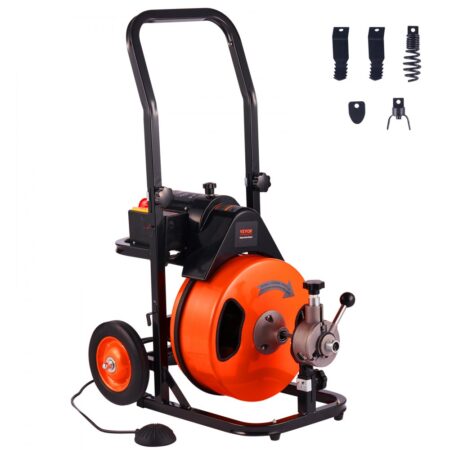
VEVOR 100 ft x 3/8 in Auto Feed Drain Cleaning Machine
100 ft x 3/8 in · 2 to 4 in · Automatic
Check Price at VEVORRead the reviewBest for Sinks, Tubs and Showers
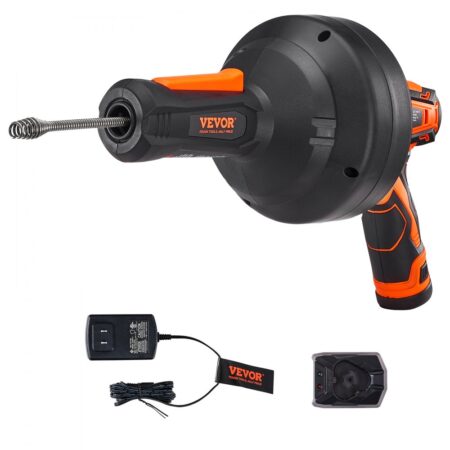
VEVOR 12V Cordless 25 ft Drain Auger
25 ft x 0.27 in · 3/4 to 2 in · Automatic
Check Price at VEVORRead the reviewBest Budget Hand Auger
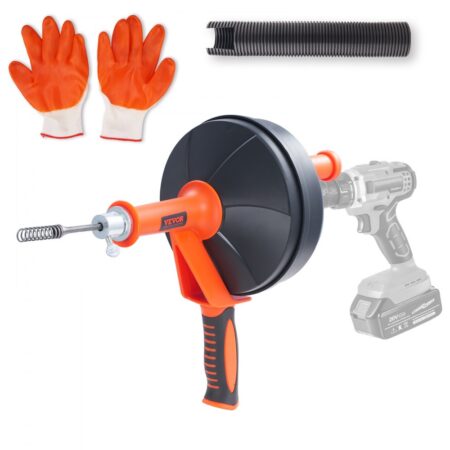
VEVOR 25 ft Drum Drain Auger With Drill Adapter
25 ft x 0.23 in · Sinks, tubs, toilets · Manual
Check Price at VEVORRead the reviewBest for Long Runs: VEVOR 120 ft x 5/8 in 370W Drain Cleaner MachineBest for Main Sewer Lines: VEVOR 100 ft x 3/4 in Sewer Drain Cleaning MachineCompare all 5 side by side
Best Drain Snakes: Full Reviews
At a glance
- Cable
- 100 ft x 3/8 in
- Pipe Size
- 2 to 4 in
- Feed
- Automatic
- Power
- Corded, 1800 RPM no-load
1. VEVOR 100 ft x 3/8 in Auto Feed Drain Cleaning Machine: Best Overall
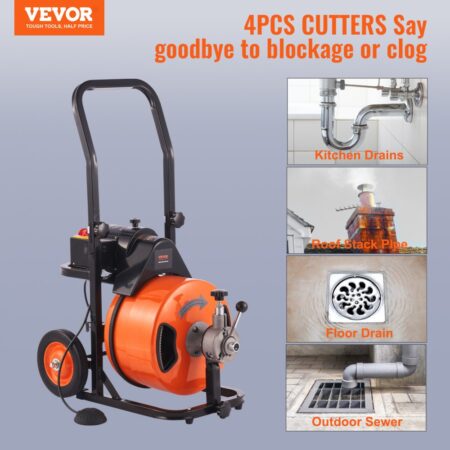
For a homeowner who keeps fighting the same kitchen line or laundry drain, this is the machine to own. It pairs 100 feet of 3/8 inch solid core cable with an automatic feed, so the machine drives the cable in and pulls it back out while you control direction with a CW, OFF and CCW knob and start and stop it with an air-activated foot switch. Your hands stay off the spinning cable, which is the single biggest safety upgrade over a basic drum snake.
VEVOR’s title lists it for 1 to 4 inch pipes, while its feature list says the 3/8 inch cable suits 2 to 4 inch pipes. We would plan on the narrower range: kitchen and laundry lines, floor drains and smaller branch lines. VEVOR is clear that it is not meant for tree root blockages. It comes with four interchangeable cutters (arrow, spade, C-cutter and boring bulb), and the drum is semi-enclosed so you can see how much cable is left.
The frame is coated steel on 8 inch shock-absorbing wheels that VEVOR says make stairs and rough ground easier, and the listing gives a no-load speed of 1800 RPM and IP20 protection. Owners rate this family of machines 4.3 stars across a few hundred reviews, praising the power and the auto feed. The repeated complaint is the assembly instructions, which many owners found hard to follow.
Key Features
- 100 ft x 3/8 in solid core cable
- Automatic feed with CW, OFF and CCW control
- Air-activated foot switch
- Four cutters: arrow, spade, C-cutter, boring bulb
- Semi-enclosed drum shows remaining cable
- 8 in shock-absorbing wheels on a coated steel frame
- 1800 RPM no-load speed, IP20 protection
What We Like
- Auto feed keeps hands away from the spinning cable
- 100 ft reach covers most household branch lines
- Foot switch makes one-person operation easy
- Wheels make it manageable on stairs
- Large owner review base
What We Don’t Like
- Owners say the assembly instructions are confusing, so budget extra setup time.
Overall
If you want one powered machine for the drains in a house, this is it. The auto feed, foot switch and 100 foot reach handle almost every clog short of the main sewer, and the cable size suits the pipes most homes actually have.
VEVOR Black Friday Pre-Sale
Up to 50% off, plus an extra 8% with code VVOTD (Nov 9 to Nov 18).
At a glance
- Cable
- 25 ft x 0.27 in
- Pipe Size
- 3/4 to 2 in
- Feed
- Automatic
- Power
- 12V battery, 0 to 560 RPM
2. VEVOR 12V Cordless 25 ft Drain Auger: Best for Sinks, Tubs and Showers
Most household clogs are not deep in the wall. They are hair in a shower drain, soap and gunk in a bathroom sink trap or food in a kitchen line a few feet past the strainer. This cordless auger is sized for exactly those jobs: 25 feet of 0.27 inch cable for 3/4 to 2 inch pipes, driven by a 12 volt motor that spins from 0 to 560 RPM.
It feeds the cable forward and back automatically, so you squeeze the trigger and steer rather than cranking by hand. The kit includes a 2.0Ah battery and charger, and VEVOR says the battery recharges in about 70 minutes. With no cord to manage, it is easy to use under a sink, in a tub surround or outdoors.
At 7.8 lb and 15 x 9.8 x 6.7 inches, it is heavier than a hand auger but far lighter than a drum machine. Owners give it 4.7 stars, the highest score on this page, praising the power and how much it saves on plumber calls. The complaints mention durability, the weight in one hand and the odd design flaw.
Key Features
- 25 ft x 0.27 in cable
- For 3/4 to 2 in pipes
- 12V motor, 0 to 560 RPM
- Automatic forward and reverse feed
- 2.0Ah battery and charger included, about 70 minute charge
- Cordless design for indoor and outdoor use
- 7.8 lb, model CDC504-12A
What We Like
- Right size for the most common household clogs
- Powered feed without a cord
- Highest owner rating of our picks
- Battery and charger in the box
- Compact enough for tight cabinets
What We Don’t Like
- At 7.8 lb it is tiring to hold at arm’s length for long jobs.
Overall
For bathroom and kitchen clogs, this is the most convenient tool here. It handles the small pipes where most clogs happen and saves you from feeding cable by hand.
At a glance
- Cable
- 25 ft x 0.23 in
- Pipe Size
- Sinks, tubs, toilets
- Feed
- Manual
- Power
- Hand or your drill
3. VEVOR 25 ft Drum Drain Auger With Drill Adapter: Best Budget Hand Auger
Every house should have a simple hand auger, and this one costs little and does a lot. It holds 25 feet of spring steel cable in a plastic drum with a non-slip handle. You feed the cable by hand, lock it at the length you want with a thumb screw and crank. For tougher clogs, an integrated adapter lets you drive it with most electric drills you already own.
VEVOR includes a protective hose for toilets so the cable does not scratch the bowl, plus work gloves. The 0.23 inch cable with its spiral head is good at grabbing hair, which makes it a natural fit for shower and tub drains, bathroom sinks and floor drains. The whole tool weighs 3 lb and measures 13 x 6.49 x 11.41 inches, so it lives easily under a sink.
Owners rate it 4.3 stars from about 140 reviews, mostly for ease of use and value. Some report trouble matching it to their drill and a few question the build quality, which is fair for a tool at this price. Treat it as a first response for small clogs rather than a machine for main lines.
Key Features
- 25 ft x 0.23 in spring steel cable
- Manual feed with thumb screw lock
- Drill adapter for powered use
- Toilet protection hose included
- Work gloves included
- Enclosed drum keeps the cable tidy
- 3 lb, model RC-2005F
What We Like
- Very low cost for a useful tool
- Hand or drill power
- Toilet hose protects the bowl
- Light and easy to store
- Good at pulling out hair clogs
What We Don’t Like
- Some owners had trouble fitting it to their drill, and powered use needs a drill you supply.
Overall
Buy this first if you only deal with the occasional slow drain. It is cheap, simple and often enough, and if it is not, you will know you need one of the powered machines.
At a glance
- Cable
- 120 ft x 5/8 in plus 23 ft x 3/8 in
- Pipe Size
- 1.6 to 4 in
- Feed
- Manual
- Power
- 370W motor
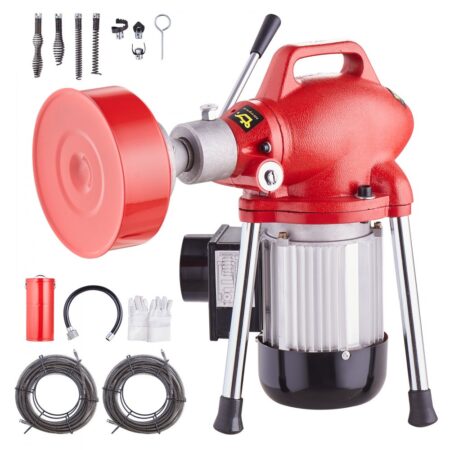
4. VEVOR 120 ft x 5/8 in 370W Drain Cleaner Machine: Best for Long Runs
When the clog is far down the line, cable length matters more than anything. This machine ships with two steel cables: a 120 foot x 5/8 inch cable for the long reach and a 23 foot x 3/8 inch cable for smaller lines, both made from 65Mn steel with surface hardening that VEVOR says resists breakage, twisting and corrosion. It is rated for 1.6 to 4 inch pipes.
A 370W copper wire motor drives the cable, and CW and CCW control lets you reverse direction to back out of a snag. Unlike the auto feed machines above, this one is manual feed, so you control how hard and fast the cable goes in. That takes a bit more skill, but it also gives you more feel for what is happening inside the pipe. Seven interchangeable cutters come in the kit.
The machine measures 10.24 x 10.24 x 17.52 inches and weighs 83.6 lb with all its accessories. Owners give it 4.6 stars from nearly 180 reviews, praising how well it works for the money. The complaints are worth knowing: some reviewers questioned durability, some felt the cable length description was misleading, and others wanted clearer instructions.
Key Features
- Two steel cables: 120 ft x 5/8 in and 23 ft x 3/8 in
- For 1.6 to 4 in pipes
- 370W copper wire motor
- Manual feed with CW and CCW control
- Seven interchangeable cutters
- 65Mn steel cables with surface hardening
- 83.6 lb with accessories
What We Like
- Longest reach on this page
- Two cable sizes for different lines
- Seven cutters cover most clog types
- Manual feed gives good control
- Strong owner rating
What We Don’t Like
- Some owners report durability problems and found the cable length description misleading.
Overall
For long branch lines and laterals where a 50 or 75 foot cable falls short, this machine gives the most reach. Learn the manual feed on an easy clog before tackling a stubborn one.
At a glance
- Cable
- 100 ft x 3/4 in
- Pipe Size
- 4 to 8 in
- Feed
- Automatic
- Power
- 120V, 1800 RPM no-load
5. VEVOR 100 ft x 3/4 in Sewer Drain Cleaning Machine: Best for Main Sewer Lines
Main sewer lines are a different job. They are usually 4 inches or larger, and the clogs in them can be dense: wipes, grease buildup or debris packed over years. This machine steps up to a 3/4 inch steel core cable, 100 feet long, rated for 4 to 8 inch pipes. Thinner cables tend to coil up in a large pipe instead of pushing through, which is why cable diameter matters so much here.
It shares the auto feed design of our top pick: the machine powers the cable in and out, with a CW, OFF and CCW knob and an air-activated foot switch. VEVOR lists a 120V motor with an 1800 RPM no-load speed and 4 amp no-load current, 8 inch wheels and four cutters. It also adds an integrated GFCI to protect against electric shock, which matters when you are working in a wet cleanout.
Owners rate it 4.3 stars across roughly 480 reviews pooled with its sister sizes, and several say it paid for itself compared with renting a machine. As with the 3/8 inch version, the most common complaint is unclear assembly instructions. VEVOR does not give a clear weight for this model, so plan how you will get it to the cleanout before it arrives.
Key Features
- 100 ft x 3/4 in steel core cable
- For 4 to 8 in pipes
- Automatic feed with CW, OFF and CCW control
- Air-activated foot switch
- Integrated GFCI protection
- 120V, 1800 RPM no-load, 4 A no-load current
- Four cutters and 8 in wheels
What We Like
- Cable size suited to main sewer lines
- Auto feed reduces effort and risk
- GFCI adds shock protection in wet areas
- Can replace repeated rental fees
- Large owner review base
What We Don’t Like
- Owners say the assembly instructions are hard to follow.
Overall
If you deal with a backed-up main line more than once, this machine is the right tool. It has the cable diameter and feed system the job needs, plus the GFCI protection you want around wastewater.
Side-by-Side Comparison
| Model | Cable | Pipe Size | Feed | Power | Weight | Price |
|---|---|---|---|---|---|---|
| VEVOR 100 ft x 3/8 in | 100 ft x 3/8 in | 2 to 4 in | Automatic | Corded, 1800 RPM no-load | Not listed | Check price |
| VEVOR 12V cordless | 25 ft x 0.27 in | 3/4 to 2 in | Automatic | 12V battery, 0 to 560 RPM | 7.8 lb | Check price |
| VEVOR 25 ft hand auger | 25 ft x 0.23 in | Sinks, tubs, toilets | Manual | Hand or your drill | 3 lb | Check price |
| VEVOR 120 ft x 5/8 in | 120 ft x 5/8 in plus 23 ft x 3/8 in | 1.6 to 4 in | Manual | 370W motor | 83.6 lb with accessories | Check price |
| VEVOR 100 ft x 3/4 in | 100 ft x 3/4 in | 4 to 8 in | Automatic | 120V, 1800 RPM no-load | Not listed | Check price |
Specs come from VEVOR’s US product listings at the time of writing.
How a Drain Snake Works
A drain snake is a long, flexible steel cable with a cutter or spiral head on the end. Spinning the cable lets it worm through bends and either bore a hole through the clog, break it up or hook it so you can pull it back out. Hand augers spin the cable when you crank the drum. Powered machines use a motor, and auto feed models add a mechanism that pushes the cable in and draws it out for you.
The cutter makes a difference. A spiral or bulb head grabs hair and soft debris. A spade or arrow cutter bores through packed grease and paper. A C-cutter scrapes buildup from the pipe wall. That is why the larger machines here include several cutters.
Matching Cable Size to the Pipe
Cable diameter needs to suit the pipe. Too thick and it will not turn the tight bends in a sink trap. Too thin in a big pipe and it can whip, kink or coil up instead of pushing forward. As a rough guide, thin cables around 1/4 inch suit 1 1/4 to 2 inch sink, tub and shower drains. A 3/8 inch cable suits 2 to 4 inch lines such as kitchen, laundry and floor drains. Main sewer lines of 4 inches and up need a heavier cable such as the 3/4 inch on our sewer pick.
Length is the other half. Measure or estimate the distance from your access point to the likely clog, then add some margin. A 25 foot cable reaches past most sink traps. Branch lines inside the house often need 50 to 75 feet, and the run from a basement cleanout to the street can need 100 feet or more.
Auto Feed or Manual Feed?
Auto feed machines push and retract the cable for you. They are faster, need less strength and keep your hands away from the spinning cable, which is the main safety risk with drain machines. Manual feed machines ask you to guide the cable with a gloved hand. They take more practice but give you a better feel for the clog and are often simpler mechanically.
For most homeowners, auto feed is the safer and easier choice. Manual feed suits people who want maximum reach and are comfortable learning the technique.
Drain Snake Safety
- Wear the gloves that come with the machine, and never grab a spinning cable with a bare hand. A cable that catches and twists can injure fingers and wrists.
- Plug corded machines into a GFCI-protected outlet, especially in basements, garages and near standing water. The 3/4 inch machine has GFCI protection built in.
- Do not use a drain snake right after pouring chemical drain cleaner into the line. The cable can splash caustic water back at you.
- Let the cable do the work. Forcing it when it stops turning can kink or break the cable.
- Reverse slowly when you feel a snag, then feed again rather than pushing harder.
- Clean and lightly oil the cable before storing it, and dry the drum to slow rust.
- Call a plumber for tree roots, collapsed pipe or repeated backups in the main line, since those point to a problem a snake cannot fix.
Have the cleanup gear ready before you start. A heavy duty shop vacuum handles standing water and debris, and a good work flashlight makes it much easier to see inside a cleanout or under a sink. For long runs from a basement outlet, use a properly rated heavy duty extension cord.
Where Clogs Come From and How to Prevent Them
Most kitchen clogs are grease and food scraps that harden in the pipe. Bathroom clogs are mostly hair and soap scum. Main line clogs often come from wipes that are sold as flushable, combined with grease and paper. Prevention is mostly habit: scrape plates into the trash, use hair catchers in showers and only flush toilet paper.
Restaurants and busy commercial kitchens have a bigger version of the same problem, which is why many are required to use a grease interceptor. Our guide to commercial grease traps covers those, and a deep utility sink with a strainer helps keep debris out of laundry and shop drains.
A Scenario Worth Knowing About
Here is a common way a homeowner wastes a Saturday. The basement floor drain backs up whenever the washer drains. They grab a 25 foot hand auger, push it in, crank for an hour and pull back a little hair. Water drains briefly, then backs up again the next laundry day. The real clog is in the main line, 40 or 50 feet away, well past the reach of a small auger and in a pipe too big for its thin cable.
The clue is the location. When a floor drain or the lowest fixture in the house backs up, especially when other fixtures drain at the same time, the problem is usually downstream in the main line rather than in the drain you can see. That job needs enough cable to reach and a cable thick enough for a 4 inch pipe, which means a machine like the 100 ft x 3/4 inch model, going in from the main cleanout rather than the floor drain. If a main line machine still cannot clear it, roots or a damaged pipe are likely, and a camera inspection by a plumber is the next step.
Frequently Asked Questions
What size drain snake do I need?
Match the cable to the pipe. Around 1/4 inch cable suits sink, tub and shower drains. A 3/8 inch cable suits 2 to 4 inch kitchen, laundry and floor drains. Main sewer lines of 4 inches and up need a thicker cable, such as 3/4 inch.
How long should a drain snake be?
Long enough to reach the clog with some to spare. A 25 foot cable handles most sink and tub clogs. Branch lines often need 50 to 75 feet, and main lines from a basement cleanout to the street may need 100 feet or more.
Can a drain snake damage pipes?
It can if it is forced or the wrong size. Use a cable sized for the pipe, let it turn rather than pushing hard, and take extra care with old or fragile pipes. Use the toilet guard hose on porcelain fixtures.
Can a drain snake remove tree roots?
Small household machines are not meant for roots, and VEVOR says its 100 ft x 3/8 inch machine is not suitable for tree root blockages. Root problems usually need a heavy root-cutting machine and a camera inspection.
Is an auto feed drain machine worth it?
For powered machines, usually yes. Auto feed moves the cable for you, saves effort and keeps your hands away from the spinning cable. Manual feed is fine if you are comfortable with the technique and want more feel.
Should I use chemical drain cleaner before snaking?
It is better not to. Chemicals sitting in the pipe can splash back when the cable spins. If you already used one, flush the line well with water and wear eye protection and gloves before snaking.
The Bottom Line
For most homes, the VEVOR 100 ft x 3/8 inch auto feed machine is the drain snake to buy. Its auto feed, foot switch and 100 feet of cable handle kitchen, laundry and floor drain clogs without putting your hands near the spinning cable. For quick bathroom and kitchen sink jobs, the 12V cordless auger is the most convenient tool, and the 25 foot hand auger is a cheap first line of defense.
Choose the 120 ft x 5/8 inch machine when you need the most reach, and the 100 ft x 3/4 inch machine when the problem is the main sewer line. Match the cable to the pipe, wear gloves and know when a backup is a job for a plumber’s camera instead.