A fire built straight on the firebox floor smolders, smokes and burns out early, because air cannot reach the wood from below. A grate fixes that. It lifts the logs a few inches, lets air flow underneath, gives ash somewhere to fall, and keeps logs from rolling toward the screen. A good one is the single biggest upgrade you can make to how a wood fire burns.
The best fireplace grate fits your firebox with room to spare, is thick enough not to sag after a winter of hot fires, and has enough legs to stay level under a full load of wood. Thin bar grates from a hardware store often bow in the middle within a season, which is the main weakness of cheap grates.
We picked five VEVOR grates: four solid steel bar log grates from 21 to 30 inches, built from 3/4-inch square bar on six legs, and a 20-inch wagon wheel grate for wood stoves and fire pits. We will add more brands as we review them. If you specifically want cast iron, see our heavy-duty cast iron grate guide.
Our Quick Picks
Best Overall
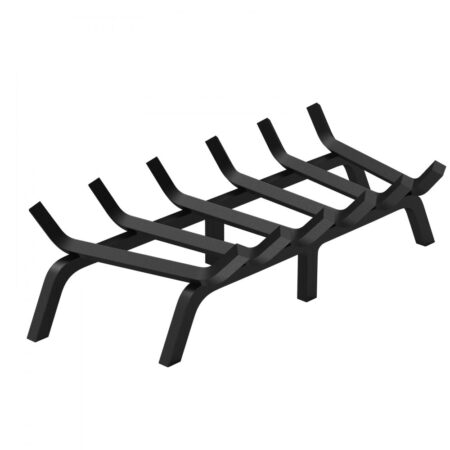
VEVOR 27 in Solid Steel Fireplace Log Grate
About 27 x 13.4 in · 3/4 in solid steel · 6
Check Price at VEVORRead the reviewBest for Large Fireplaces
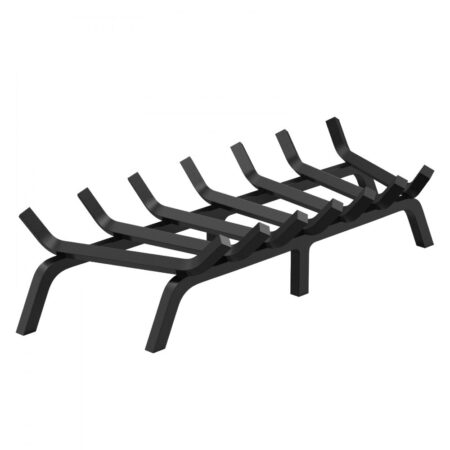
VEVOR 30 in Solid Steel Fireplace Log Grate
About 30 x 13.4 in · 7 x 3/4 in solid steel · 6
Check Price at VEVORRead the reviewBest for Standard Fireplaces
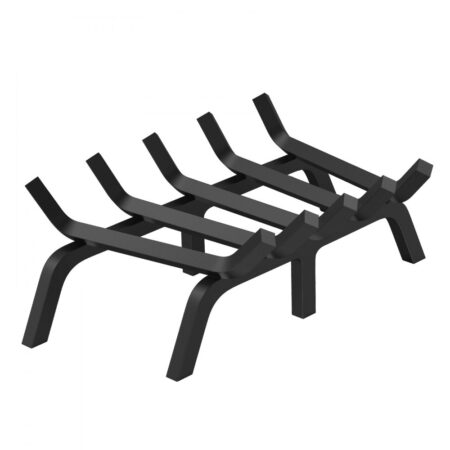
VEVOR 24 in Solid Steel Fireplace Log Grate
About 24 x 11 in · 5 x 3/4 in solid steel · 6
Check Price at VEVORRead the reviewBest for Small Fireplaces: VEVOR 21 in Solid Steel Fireplace Log GrateBest for Wood Stoves and Fire Pits: VEVOR 20 in Wagon Wheel Fire GrateCompare all 5 side by side
Best Fireplace Grates: Full Reviews
1. VEVOR 27 in Solid Steel Fireplace Log Grate: Best Overall
For most wood-burning fireplaces, a 27-inch grate is the sweet spot: wide enough for a proper three or four log fire, small enough to leave space at the sides of a typical firebox. This VEVOR grate measures about 27 inches long and 13.4 inches deep, built from solid 3/4-inch square steel bars with a black powder-coated finish.
Six legs spread the load across the bottom, including a support in the middle, which is what stops the sag that ruins thinner grates. The bars curve up at the back to cradle logs and keep them from rolling forward, and the grate lifts wood 3.9 inches off the floor for airflow. At 23.14 lb it is heavy enough to stay put while you work the fire with a poker.
Another notes the simple design has center supports built specifically to prevent collapse.
Key Features
- About 27 in long x 13.4 in deep
- Solid 3/4 x 3/4 in square steel bars
- Six support legs, including center support
- Lifts logs 3.9 in off the floor
- Curved bars keep logs in place
- Black powder-coated finish
- 23.14 lb, model H230-E
What We Like
- Right size for most fireplaces
- Center legs prevent sagging
- Heavy and stable
- Deeper than the smaller sizes
What We Don’t Like
- Wide bar spacing lets small kindling drop through when starting a fire
Overall
The grate to buy for a standard to large wood-burning fireplace: solid, deep and built not to sag.
VEVOR Black Friday
Up to 50% off, plus an extra 8% with code VVOTD (Nov 19 to Nov 30).
2. VEVOR 30 in Solid Steel Fireplace Log Grate: Best for Large Fireplaces
Big, older fireplaces need a big grate, and a small one sitting in the middle of a wide firebox wastes space and heat. VEVOR’s 30-inch model is the largest in this family, about 30 inches long and 13.4 inches deep, with seven steel bars instead of five on the smaller sizes, so it holds more and larger logs.
It shares the same build as the 27-inch: solid 3/4-inch square steel, six legs, curved bars, 3.9 inches of lift and a powder-coated finish. At 26.01 lb it is the heaviest grate here. Because of its size, measure your firebox carefully, including the rear width, since many fireboxes taper toward the back.
If kindling falls between the bars while the fire gets going, a small piece of screen across the middle fixes it.
Key Features
- About 30 in long x 13.4 in deep
- Seven solid 3/4 in square steel bars
- Six support legs
- Lifts logs 3.9 in off the floor
- Curved bars keep logs in place
- Black powder-coated finish
- 26.01 lb, model H230-F
What We Like
- Largest capacity on the page
- Seven bars hold big loads
- Heaviest, most stable build
- Handles very hot fires
- Fills wide fireboxes properly
What We Don’t Like
- Too large for many standard fireboxes, so measure first
Overall
The pick for wide, deep or older fireplaces where a big fire is the whole point.
3. VEVOR 24 in Solid Steel Fireplace Log Grate: Best for Standard Fireplaces
Many modern wood-burning fireplaces have fireboxes around 30 to 36 inches wide at the front and narrower at the back. A 24-inch grate fits these neatly with clearance on each side. This VEVOR model is about 24 inches long and 11 inches deep, with five solid 3/4-inch steel bars on six legs.
It has the same lift, curved bars and powder coating as the larger sizes, and weighs 18.07 lb. The shallower 11-inch depth is the thing to know: it fits fireboxes that are not very deep, but it holds fewer logs at once than the 13.4-inch-deep 27 and 30-inch models.
Check the depth against your firebox before ordering, since it is on the shallow side.
Key Features
- About 24 in long x 11 in deep
- Five solid 3/4 in square steel bars
- Six support legs
- Lifts logs 3.9 in off the floor
- Curved bars keep logs in place
- Black powder-coated finish
- 18.07 lb, model H230-D
What We Like
- Fits most standard fireboxes
- Same sturdy six-leg build
- Works in fire pits too
- Lifts logs 3.9 in for better airflow
- Lighter and easier to move
What We Don’t Like
- 11 in depth holds less wood than the larger grates
Overall
The safe fit for a standard fireplace, as long as you are happy with a slightly smaller fire.
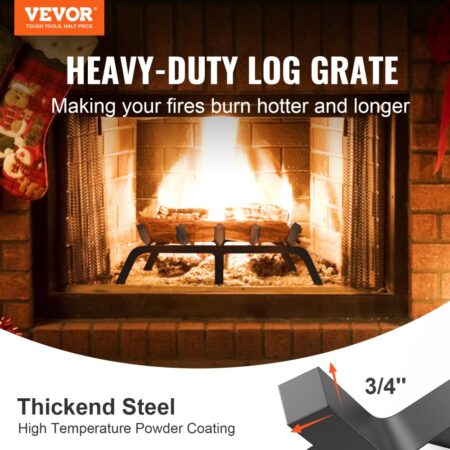
4. VEVOR 21 in Solid Steel Fireplace Log Grate: Best for Small Fireplaces
Small fireplaces, bedroom fireplaces and shallow Rumford designs need a compact grate, and an oversized one can push logs too close to the opening. VEVOR’s 21-inch grate is about 21 inches long and 11 inches deep, with the same five solid 3/4-inch steel bars, six legs, curved bars and 3.9 inches of lift as the larger sizes.
At 17.19 lb it is still heavy for its size, and the weight helps it sit steady when you stack wood. Because it shares the build of the 24 and 27-inch grates, it offers the same anti-sag design in a smaller footprint.
Measure the rear width of your firebox, since small fireplaces often taper sharply toward the back.
Key Features
- About 21 in long x 11 in deep
- Five solid 3/4 in square steel bars
- Six support legs
- Lifts logs 3.9 in off the floor
- Black powder-coated finish
- 17.19 lb, model H230-B
What We Like
- Sized for small fireboxes
- Same anti-sag six-leg design
- Heavy for its size
- Keeps logs back from the opening
- Simple, clean look
What We Don’t Like
- Five bars and an 11 in depth limit it to small fires
Overall
The compact choice for smaller fireplaces that still deserve a solid grate.
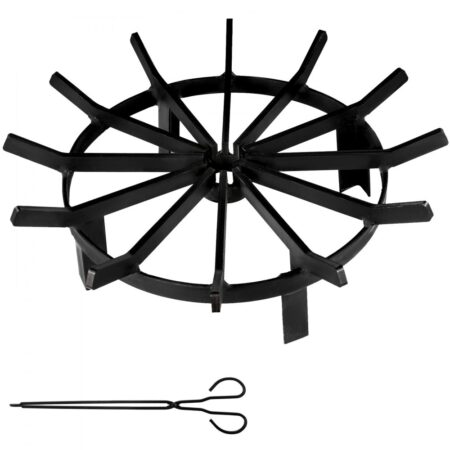
5. VEVOR 20 in Wagon Wheel Fire Grate: Best for Wood Stoves and Fire Pits
Not every fire burns in a rectangular firebox. A round wagon wheel grate suits square-ish wood stove interiors, round fire pits and corner fireplaces, and its curved rim holds logs in a tidy pile that burns hot and evenly. This VEVOR grate is 20 inches across, with 12 closely spaced iron bars on four legs.
The tight bar spacing is the useful detail here: smaller gaps mean less burning wood falls through, and kindling stays put while the fire gets going, which solves the main problem with wide-bar grates. It lifts the wood 3 inches off the floor for airflow, has a black powder-coated finish, and comes with a 20-inch fire tong. The grate and tong together weigh 10.8 lb.
VEVOR sells the same design from 12 to 40 inches if you need a different size.
Key Features
- 20 in diameter, round
- 12 iron bars, closely spaced
- Four support legs, 3 in lift
- Curved rim keeps logs together
- Black powder-coated finish
- 20 in fire tong included
- 10.8 lb with tong
What We Like
- Tight bars hold kindling
- Fits stoves, pits and corner fireplaces
- Tong included
- Other sizes available
What We Don’t Like
- Round shape wastes space in a wide rectangular firebox
Overall
The best pick for wood stoves, fire pits and any fire that is wider than it is deep.
Side-by-Side Comparison
| Grate | Size | Bars | Legs | Weight | Price |
|---|---|---|---|---|---|
| VEVOR 27 in Steel | About 27 x 13.4 in | 3/4 in solid steel | 6 | 23.14 lb | Check price |
| VEVOR 30 in Steel | About 30 x 13.4 in | 7 x 3/4 in solid steel | 6 | 26.01 lb | Check price |
| VEVOR 24 in Steel | About 24 x 11 in | 5 x 3/4 in solid steel | 6 | 18.07 lb | Check price |
| VEVOR 21 in Steel | About 21 x 11 in | 5 x 3/4 in solid steel | 6 | 17.19 lb | Check price |
| VEVOR 20 in Wagon Wheel | 20 in round | 12 iron bars | 4 | 10.8 lb with tong | Check price |
Specs can change, so confirm the details before you buy.
How to Measure for a Fireplace Grate
Measure three things inside the firebox: the front width, the rear width and the depth from front to back. Fireboxes usually taper, so the rear width is often several inches narrower than the front. The grate should fit inside the rear width as well as the front.
- Width: choose a grate about 6 to 8 inches narrower than the front opening, leaving roughly 3 to 4 inches on each side for air and ash.
- Depth: the grate should be a few inches shallower than the firebox, so logs sit well back from the opening.
- Height: make sure logs stacked on the grate stay below the damper and the top of the opening.
- Rule of thumb: a firebox about 30 to 36 inches wide at the front usually takes a 24 to 27 inch grate; 36 to 42 inches takes 27 to 30 inches; under 30 inches suits 21 inches.
Steel Bar, Cast Iron or Wagon Wheel?
- Solid steel bar grates are strong, resist sagging when the bars are thick (3/4 inch is solid) and handle hot fires well. All four VEVOR log grates here are this type.
- Cast iron grates are heavy and hold heat well, but can crack if dropped or shocked with cold water. See our cast iron grate guide for those.
- Wagon wheel grates are round, with closely spaced bars that hold kindling and small pieces. Best for stoves, fire pits and corner fireplaces.
What to Look for in a Fireplace Grate
- Bar thickness. Thin bars bow over time. Solid 3/4-inch bars, like VEVOR uses, hold their shape under heavy loads.
- Number and placement of legs. Center support is what prevents sagging. Six legs beats four on longer grates.
- Lift. About 3 to 4 inches of clearance gives good airflow and room for an ash bed.
- Curved or raised back. Keeps logs from rolling forward toward the screen.
- Bar spacing. Wide gaps let ash fall freely but drop kindling; tight spacing holds small pieces but clogs sooner.
- Finish. Powder coating protects the grate in storage and slows rust, though it will discolor in a hot fire, which is normal.
How to Build a Fire on a Grate
- Leave an ash bed. A thin layer of ash under the grate insulates the firebox floor and helps the fire light.
- Kindling and tinder first. Place crumpled paper or fire starters under the grate and small kindling on top. On wide-bar grates, lay a few kindling sticks crosswise so small pieces do not fall through.
- Two logs, then a third. Lay two split logs front and back on the grate with a small gap, then add a third across the top once the kindling catches.
- Keep it back. Push the fire toward the back of the grate so embers fall inward.
- Feed it, do not overload it. Add one or two logs at a time with tongs. Stacking wood above the curved back bars risks logs rolling out.
Good tools make this easier. See our iron fireplace tool set guide for sets with tongs and a poker, and pair the grate with a mesh screen from our fireplace screen picks.
A Scenario Worth Knowing About
Someone measures the front of their fireplace at 36 inches and orders a 30-inch grate, figuring bigger means more fire. It does not fit. The back of the firebox is only 24 inches wide, so the grate sits wedged at an angle near the front, logs end up close to the opening, and smoke rolls into the room on the first fire.
The grate was not the problem; the measurement was. Fireboxes taper, and the rear width matters as much as the front. A 24 or 27-inch grate would have sat level, well back from the opening, with room for air on both sides. Measure front width, rear width and depth before ordering, and size the grate to the smallest of them.
Care and Maintenance
Scoop out excess ash regularly, leaving a thin bed, so the grate’s lift is not buried and air can still flow. At the end of the season, remove the grate, brush off soot and check the bars and legs for bending or cracks. Light surface rust can be wire-brushed and touched up with high-temperature stove paint. Store it dry, or leave it in a dry firebox with the damper closed to keep moisture out.
Frequently Asked Questions
What size fireplace grate do I need?
Choose a grate about 6 to 8 inches narrower than the front of the firebox, and make sure it fits within the narrower rear width and depth.
Do I really need a fireplace grate?
For wood fires, yes. A grate lifts logs so air reaches them from below, which means easier lighting, a hotter fire and less smoke.
Why does my fireplace grate sag?
Thin bars and too few legs soften under repeated hot fires. Thick solid bars and a center support, like the six-leg VEVOR grates, resist sagging.
Is steel or cast iron better for a fireplace grate?
Both work. Thick solid steel is strong and resists cracking; cast iron is heavy and holds heat but can crack if shocked. Choose by fit and build quality.
Can I use a fireplace grate in a fire pit?
Yes. VEVOR markets these grates for outdoor use too, so the 24-inch steel grate also works in a fire pit. The round wagon wheel suits round pits best.
How high should a fireplace grate be?
About 3 to 4 inches of lift is ideal. The VEVOR steel grates raise logs 3.9 inches and the wagon wheel 3 inches.
Can I use a grate in a gas fireplace?
No. Gas fireplaces use their own burner and log sets. A wood grate is only for wood-burning fireplaces, stoves and fire pits.
The Bottom Line
For most wood-burning fireplaces, the VEVOR 27-inch solid steel grate is the one to buy: deep, heavy and built with center legs that stop sagging. Go up to the 30-inch grate for big fireboxes, down to the 24-inch or 21-inch grates for standard and small fireplaces, and choose the 20-inch wagon wheel for stoves and fire pits.
Measure front width, rear width and depth before ordering, and pair your grate with a good screen and tool set for a complete, safe setup.