A burst pipe usually starts the same way: one cold night, a stretch of supply line along an outside wall or in a crawl space, and water that stops moving long enough to freeze. The ice expands, the pipe splits, and you find out when it thaws. A length of heat tape for pipes, more properly called a pipe heating cable, prevents that for very little money and a few minutes of work.
This guide covers five heating cables from VEVOR: a 30 foot self-regulating cable with a built-in thermostat for most homes, a 9 foot version for single trouble spots, a constant-wattage 7 watt per foot cable, a 100 foot cable for long runs, and a 140 foot cable for roofs and gutters. More brands will be added to this page as we review them.
For each cable you get the type, heat output, thermostat settings, length and one honest drawback. After the reviews, the buying guide explains self-regulating versus constant wattage, how much cable you need, and how to install heat tape safely.
Our Quick Picks
Best Overall Heat Tape for Pipes
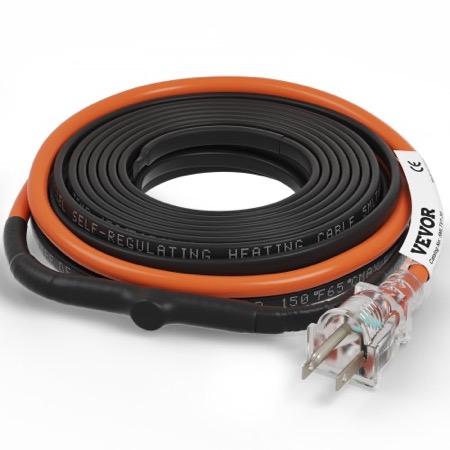
VEVOR 30 ft Self-Regulating Pipe Heat Tape with Thermostat (5MLTV1-30)
Self-regulating · 30 ft · Up to 5 W/ft
Check Price at VEVORRead the reviewBest for Short Runs, Valves and RV Lines
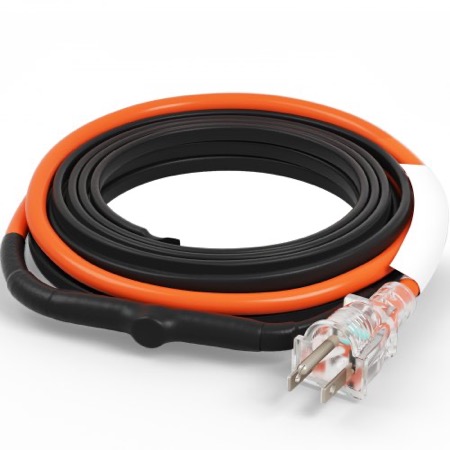
VEVOR 9 ft Self-Regulating Pipe Heat Tape (5MLTV1-9)
Self-regulating · 9 ft · Up to 5 W/ft
Check Price at VEVORRead the reviewBest Constant-Wattage Heat Cable
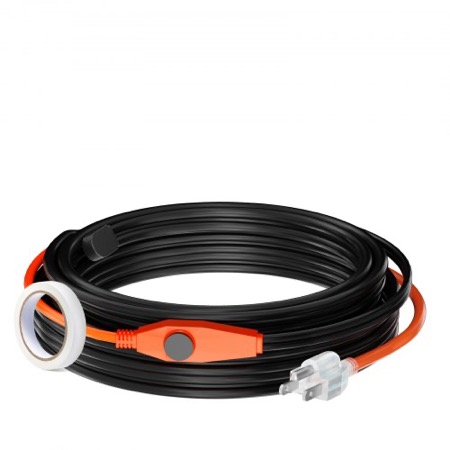
VEVOR 30 ft 7W/ft Pipe Heating Cable with Thermostat (PFPC1-1A030)
Constant wattage · 30 ft · 7 W/ft
Check Price at VEVORRead the reviewBest for Long Pipe Runs: VEVOR 100 ft Self-Regulating Pipe Heat Tape (5MLTV1-100)Best for Roofs and Gutters: VEVOR 140 ft Roof and Gutter De-Icing Cable (ETR Series)Compare all 5 side by side
Best Heat Tape for Pipes: Full Reviews
At a glance
- Type
- Self-regulating
- Length
- 30 ft
- Output
- Up to 5 W/ft
- Thermostat
- On 43 F, off 55 F
1. VEVOR 30 ft Self-Regulating Pipe Heat Tape with Thermostat (5MLTV1-30): Best Overall Heat Tape for Pipes
For most homes, 30 feet of self-regulating cable with a built-in thermostat is the right place to start. It covers a typical exposed run in a crawl space, a garage wall or a cold basement corner, and it needs no setup beyond taping it to the pipe and plugging it in. VEVOR recommends it for 1/2 to 2 inch pipe in ABS, PVC, copper, galvanized, brass and steel.
Two features do the work. The self-regulating core puts out up to 5 watts per foot and adjusts its output as the pipe warms or cools, so it is safe to spiral around a pipe or cross over itself at a valve. The thermostat is built into the cable and turns the heat on when the pipe drops to 43 degrees F and off at about 55 degrees F, so it is not running all winter for nothing. VEVOR says it protects pipes down to 0 degrees F and warms by 85 degrees F within 5 minutes.
The cable is IP68 rated, 3/10 inch wide and weighs 1.5 pounds. It has a 3 foot power cord with a grounded plug and an indicator light that shows it has power. At full output, the 30 foot length draws 150 watts, according to VEVOR, which is about the same as a few old incandescent bulbs, and only while the thermostat calls for heat.
Key Features
- Model 5MLTV1-30, 30 ft heating length
- Self-regulating, up to 5 W/ft (150 W total)
- Built-in thermostat: on at 43 F, off at 55 F
- For 1/2 to 2 in pipe: ABS, PVC, copper, galvanized, brass, steel
- Can be wrapped straight, spiral or crossed
- IP68 waterproof, protects to 0 F per VEVOR
- 3 ft cord, grounded plug with indicator light
- 1.5 lb, 3/10 in wide
What We Like
- Thermostat only runs it when needed
- Self-regulating, so overlapping is safe
- Works on plastic and metal pipe
- Indicator light confirms power
- Right length for most exposed runs
What We Don’t Like
- This cable carries CE approval rather than a UL or ETL listing.
Overall
The best heat tape for pipes for most homeowners. It covers a typical problem run, the thermostat keeps running costs low, and the self-regulating core makes installation forgiving. Measure your pipe, add a little for valves, and start here.
VEVOR Black Friday
Up to 50% off, plus an extra 8% with code VVOTD (Nov 19 to Nov 30).
At a glance
- Type
- Self-regulating
- Length
- 9 ft
- Output
- Up to 5 W/ft
- Thermostat
- On 43 F, off 55 F
2. VEVOR 9 ft Self-Regulating Pipe Heat Tape (5MLTV1-9): Best for Short Runs, Valves and RV Lines
Not every freeze problem is a long pipe. Often it is one hose bib on an outside wall, a short supply line to a well pump, the valve on a water heater in an unheated garage, or the fresh water hookup on an RV. This 9 foot cable is made for those jobs, and it is the same self-regulating design with the same built-in thermostat as the 30 foot top pick.
It turns on when the pipe reaches 43 degrees F and off at 55 degrees F, with VEVOR claiming plus or minus 1 degree accuracy, and puts out up to 5 watts per foot. VEVOR recommends it for RVs, basements, garages, gardens, water tanks, outdoor hydrants, valves and faucets, on PEX, PVC and metal pipe. It is IP68 rated and can be wrapped straight, in a spiral or crossed over valves.
VEVOR also says it can be used outdoors, but recommends covering the cable with foam or fiberglass pipe insulation in very cold weather, with the thermostat kept in contact with the pipe. At just 0.73 pounds it is easy to keep on hand for winter emergencies. If 9 feet is more than you need, VEVOR also sells this cable in 3, 6, 12, 15, 18 and 24 foot lengths.
Key Features
- Model 5MLTV1-9, 9 ft heating length
- Self-regulating, up to 5 W/ft
- Built-in thermostat: on at 43 F, off at 55 F
- Listed for RVs, hydrants, valves, faucets and tanks
- Works on PEX, PVC and metal pipe
- IP68 waterproof
- Straight, spiral or crossed installation
- 0.73 lb
What We Like
- Right size for single problem spots
- Same thermostat as the full-length cable
- Good for RV and well lines
- Light and easy to store
- Sold in many short lengths
What We Don’t Like
- Nine feet goes quickly if you spiral it around a valve or a larger pipe, so measure before you order.
Overall
The pick for one problem spot: an exposed faucet, a well line, a water heater valve or an RV hookup. It brings the same protection as the longer cables at a size that matches the job.
At a glance
- Type
- Constant wattage
- Length
- 30 ft
- Output
- 7 W/ft
- Thermostat
- On 41 F, off 64.4 F
3. VEVOR 30 ft 7W/ft Pipe Heating Cable with Thermostat (PFPC1-1A030): Best Constant-Wattage Heat Cable
Self-regulating cable is not the only kind. This VEVOR cable is constant wattage: it puts out a steady 7 watts per foot whenever its thermostat is on, rather than varying with temperature. That makes it the most powerful option per foot in the lineup, and VEVOR says it reaches 70 degrees F in about 2 minutes.
Its thermostat also runs a wider band than the self-regulating cables, switching on at 41 degrees F and off at about 64.4 degrees F. The build is solid: a fiberglass heating core, PVC insulation, a braided copper wire shield and a PVC outer jacket, with an IP68 rating. The grounded plug has an indicator light, and the power cord is 3 feet long. VEVOR recommends it for PVC, PEX and metal pipe, and pitches it for RVs and homes in freezing climates.
The big rule with constant-wattage cable is installation. It must be laid in a straight line along the pipe, and it must never cross or overlap itself, because the overlapped section would get too hot. That makes it a good fit for a long, straight run and a poor one for wrapping around valves and fittings. At 30 feet it draws about 210 watts when on, by our math, and weighs 2.2 pounds.
Key Features
- Model PFPC1-1A030, 30 ft heating length
- Constant wattage: 7 W/ft (about 210 W total)
- Built-in thermostat: on at 41 F, off at 64.4 F
- Fiberglass core, PVC insulation, braided copper shield, PVC jacket
- IP68 waterproof
- For PVC, PEX and metal pipe
- 3 ft cord, grounded plug with indicator light
- 2.2 lb
What We Like
- Most heat per foot in the lineup
- Warms quickly
- Shielded, well insulated construction
- Wide thermostat band holds pipes warmer
- Good for long straight runs
What We Don’t Like
- It must be installed straight with no crossing or overlapping, so it cannot be spiraled around valves.
Overall
The choice for straight pipe runs in very cold spots, where you want the most heat per foot. Install it exactly as the manual says, never overlapped, and use a self-regulating cable for valves and fittings.
At a glance
- Type
- Self-regulating
- Length
- 100 ft
- Output
- Up to 5 W/ft
- Thermostat
- On 43 F, off 55 F
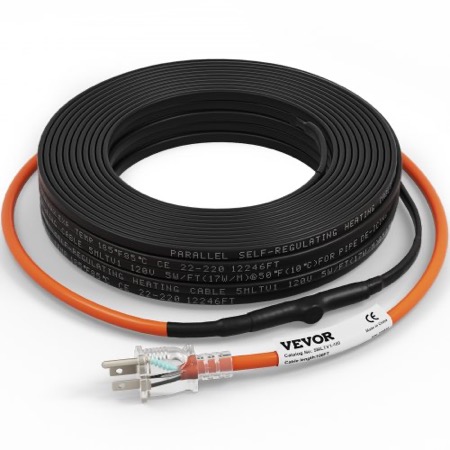
4. VEVOR 100 ft Self-Regulating Pipe Heat Tape (5MLTV1-100): Best for Long Pipe Runs
Long runs need long cable, and splicing two short ones together is not an option with plug-in heat tape. This 100 foot VEVOR cable is the same self-regulating, thermostat-controlled design as the top pick, at a length that covers a long crawl space run, a mobile home water line, a barn supply line or a long stretch along an unheated garage wall.
It heats at up to 5 watts per foot, adjusting as the pipe warms, and the built-in thermostat turns it on at 43 degrees F and off at 55 degrees F. VEVOR recommends it for 1/2 to 2 inch ABS, PVC, copper, steel and galvanized pipe, rated IP68, and says it keeps pipes from freezing down to 0 degrees F. You can run it straight, spiral it, or cross it at fittings.
VEVOR is clear that this cable goes on the outside of pipes only and is not for roofs, gutters, downspouts or drainage channels. At full output, 100 feet draws 500 watts by our math, so plug it into its own outdoor-rated GFCI outlet rather than sharing a circuit with a heater. It weighs 4.4 pounds. VEVOR also sells this cable in 40 and 120 foot lengths.
Key Features
- Model 5MLTV1-100, 100 ft heating length
- Self-regulating, up to 5 W/ft (about 500 W total)
- Built-in thermostat: on at 43 F, off at 55 F
- For 1/2 to 2 in ABS, PVC, copper, steel, galvanized pipe
- IP68, protects to 0 F per VEVOR
- Straight, spiral or crossed installation
- 3 ft cord, grounded plug with indicator light
- 4.4 lb
What We Like
- Covers long runs in one piece
- Thermostat keeps running time down
- Safe to spiral on cold, exposed sections
- Works on plastic and metal pipe
- Also sold in 40 and 120 ft lengths
What We Don’t Like
- Pipe use only: VEVOR says it is not suitable for roofs, gutters, downspouts or drainage channels.
Overall
The best option for long runs like crawl spaces, mobile homes and barn lines. Buy enough to cover the whole run plus extra for spiraling the coldest sections, and give it its own outlet.
At a glance
- Type
- Self-regulating
- Length
- 140 ft
- Output
- 5 to 8 W/ft
- Thermostat
- None listed
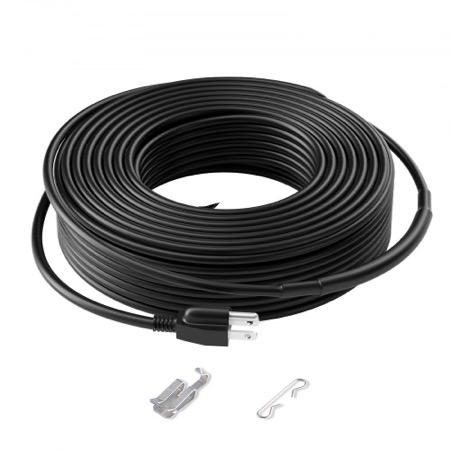
5. VEVOR 140 ft Roof and Gutter De-Icing Cable (ETR Series): Best for Roofs and Gutters
Ice dams are a different problem from frozen pipes, and they need a cable rated for the job. This 140 foot VEVOR cable is from its ETR roof and gutter series, built to run along roof edges, in gutters and down downspouts to keep a channel open so meltwater can drain instead of backing up under shingles.
It is self-regulating, putting out about 5 watts per foot at 50 degrees F and rising to about 8 watts per foot at 32 degrees F, with a maximum temperature of 150 degrees F. VEVOR recommends it for metal, rubber, wood, asphalt, clay, synthetic and composite roofs, rates it IP68, and confirms it carries ETL certification. It has a 6 foot power cord, and roof clips appear to be included, so check for them when the box arrives.
There is no built-in thermostat listed for this series, so it heats whenever it is plugged in, with output dropping as the weather warms. Many people pair roof cable with a plug-in outdoor thermostat or a timer. At 140 feet and 8 watts per foot, it can draw around 1,120 watts in freezing weather by our math, so it needs its own outdoor GFCI circuit. It weighs 6.1 pounds, and VEVOR sells the same cable in 30 to 120 foot lengths for smaller roofs.
Key Features
- ETR series, 140 ft heating length
- Self-regulating: 5 W/ft at 50 F, 8 W/ft at 32 F
- Max temperature 150 F
- For metal, rubber, wood, asphalt, clay, synthetic and composite roofs
- Gutter and downspout use
- IP68, ETL certified per VEVOR
- 6 ft power cord, roof clips shown
- 6.1 lb
What We Like
- Made for roofs, gutters and downspouts
- Long enough for a full roof edge
- More output as it gets colder
- ETL certified
- Sold in shorter lengths too
What We Don’t Like
- No built-in thermostat, so you must unplug it or add a controller when it is not needed.
Overall
The right cable if ice dams and frozen gutters are your problem, not pipes. Run it in a zigzag along the roof edge and down the downspouts, give it its own outdoor circuit, and add a thermostat or timer to save power.
Side-by-Side Comparison
| Heat cable | Type | Length | Output | Thermostat | Use | Weight | Price |
|---|---|---|---|---|---|---|---|
| 1. VEVOR 30 ft (5MLTV1-30) | Self-regulating | 30 ft | Up to 5 W/ft | On 43 F, off 55 F | Pipes | 1.5 lb | Check price |
| 2. VEVOR 9 ft (5MLTV1-9) | Self-regulating | 9 ft | Up to 5 W/ft | On 43 F, off 55 F | Pipes, valves, RVs | 0.73 lb | Check price |
| 3. VEVOR 30 ft 7W (PFPC1-1A030) | Constant wattage | 30 ft | 7 W/ft | On 41 F, off 64.4 F | Straight pipe runs | 2.2 lb | Check price |
| 4. VEVOR 100 ft (5MLTV1-100) | Self-regulating | 100 ft | Up to 5 W/ft | On 43 F, off 55 F | Long pipe runs | 4.4 lb | Check price |
| 5. VEVOR 140 ft (ETR) | Self-regulating | 140 ft | 5 to 8 W/ft | None listed | Roofs, gutters | 6.1 lb | Check price |
Specs come from VEVOR. Total wattage figures elsewhere on this page are our own math: watts per foot times length. All five cables are listed as IP68 waterproof.
How to Choose Heat Tape for Pipes
Self-regulating or constant wattage?
Self-regulating cable has a core that conducts less as it warms up, so each part of the cable adjusts its own heat. A section on a cold, exposed elbow runs hotter than a section in a warmer spot, and the cable will not overheat itself where it crosses over. That makes it the safer, more forgiving choice for most people, and the only kind you should spiral or overlap. Constant-wattage cable puts out the same heat along its whole length whenever it is on. It warms faster and gives more heat per foot, but it must be run straight and never overlapped, and it relies entirely on its thermostat to switch off.
Built-in thermostat
A thermostat that sits against the pipe and only switches the cable on near freezing saves a lot of electricity, because the cable is off on mild days and through most of the daytime. All the pipe cables here have one. The roof cable does not, which is normal for roof and gutter cable; add a plug-in outdoor thermostat or a timer if you want it to run only when needed.
How much cable you need
For a straight run, you need roughly the length of the pipe, plus extra to wrap valves, faucets and fittings, since those freeze first. Running the cable straight along the bottom of the pipe works for most plastic pipe in moderate cold. Spiraling it around the pipe puts more heat on each foot of pipe for metal pipe, larger pipe or very cold spots, but uses more cable, so buy the next size up. Plug-in heat tape comes in fixed lengths and cannot be cut or spliced, so never buy short.
Pipe size and material
VEVOR recommends its self-regulating pipe cables for 1/2 to 2 inch pipe in ABS, PVC, copper, galvanized, brass and steel, and its constant-wattage cable for PVC, PEX and metal. For plastic pipe in particular, follow the manual’s guidance on wrapping and insulation closely.
Certification
In the US, look for a UL or ETL listing on any heating product. The VEVOR roof cable carries ETL certification. The self-regulating pipe cables carry CE approval, which is a European mark, so if a US listing matters to you or your insurer, confirm the certification before you buy.
How to Install Heat Tape Safely
- Read the manual first. Each cable type has its own rules for spacing, wrapping and where the thermostat goes.
- Test it before you install it. VEVOR suggests putting the thermostat end in a bucket of ice water for a few minutes, then feeling for slight warmth on the cable.
- Keep the thermostat against the pipe. It needs direct contact to read the pipe temperature correctly.
- Never overlap constant-wattage cable. Only self-regulating cable is safe to spiral or cross.
- Tape it on properly. Use the tape the manual calls for, usually glass fiber or aluminum tape, every foot or so.
- Insulate over the cable. Foam or fiberglass pipe insulation over the cable holds the heat in and cuts running time. VEVOR advises leaving the thermostat in contact with the pipe.
- Use a GFCI outlet. Plug into a grounded, GFCI protected outlet, outdoor rated if it is outside, and avoid extension cords.
- Check it every fall. Look for cracks, cuts or scorching before the first freeze, and replace any damaged cable.
What Does Heat Tape Cost to Run?
Less than most people fear, thanks to the thermostats. A 30 foot self-regulating cable draws at most 150 watts, and only while the pipe is below about 43 degrees F. Even if it ran around the clock for a full day, that is 3.6 kilowatt hours, and in practice it cycles off much of the time. The roof cable is the big user: at around 1,120 watts in freezing weather, it is worth putting on a thermostat or timer. Insulating over pipe cable is the single best way to cut its running time. If the pipes are in an unheated garage, keeping the space above freezing with an electric garage heater or one of our diesel garage heaters protects pipes and everything else in there too.
A Scenario Worth Knowing About
Picture a homeowner with a 20 foot copper supply line running through a cold crawl space. They buy a 20 foot constant-wattage cable to match the pipe exactly, then decide to spiral it around the shutoff valve at one end for extra protection, overlapping it a few times. A few weeks later the overlapped section has scorched its jacket, and the rest of the pipe has no cable left because the spiral used up several feet.
Two easy changes would have avoided both problems. A self-regulating cable is the one to spiral or overlap around valves, because it will not overheat itself. And buying a longer length, 30 feet for a 20 foot run with a valve, leaves enough to wrap the fitting and still cover the whole pipe. Cover it with pipe insulation, keep the thermostat on the pipe, and the crawl space can get as cold as it likes. Outside, the same night calls for a heavy duty snow shovel and a salt spreader for the walks, and insulated tarps can shelter exposed equipment.
Frequently Asked Questions
Does heat tape really prevent frozen pipes?
Yes, when it is installed correctly and has power. It keeps the pipe wall above freezing so water inside cannot turn to ice. It will not help during a power outage, so very cold areas still benefit from insulation and draining exposed lines when a home is left empty.
Can I leave heat tape plugged in all winter?
Pipe cables with a built-in thermostat are designed to stay plugged in; they only heat when the pipe is near freezing. Check them now and then. Roof cable without a thermostat should be on a controller or unplugged in mild spells.
Can heat tape go on PVC and PEX pipe?
The VEVOR cables here are rated for PVC, and the 7 watt per foot cable also for PEX. Follow the manual’s directions for plastic pipe closely, especially with constant-wattage cable.
Can I put insulation over heat tape?
Yes, and you should. Pipe insulation over the cable holds in heat and cuts running time. VEVOR recommends keeping the thermostat in contact with the pipe.
Can pipe heat tape be used on a roof or in a gutter?
Not these pipe cables. VEVOR says its pipe cables are not for roofs, gutters, downspouts or drainage channels. Use a roof and gutter cable, like the ETR series cable in this guide, for ice dams.
Can I cut heat tape to length?
No. Plug-in heat tape kits are sealed at the end and come in fixed lengths. Buy a length that covers the whole run with some to spare.
The Bottom Line
For most homes, the VEVOR 30 ft self-regulating cable with a built-in thermostat is the best heat tape for pipes: it covers a typical exposed run, only heats when the pipe nears freezing, and is safe to spiral around valves. Grab the 9 ft version for a single faucet, valve or RV line, and the 100 ft version for long crawl space or barn runs.
Choose the 7 watt per foot constant-wattage cable for long, straight runs in very cold spots, installed straight and never overlapped. For ice dams and frozen gutters, the 140 ft ETR roof and gutter cable is the right tool. Whatever you buy, test it, insulate over it, and plug it into a GFCI outlet before the first hard freeze.