The stakes that come in a tent bag are usually thin aluminum or wire pins, and they are fine on soft lawn on a calm night. Then the wind picks up at 2 a.m., one guy line pops loose, and the whole fly starts flapping. In hard clay, gravel or a windy field, you need heavy duty tent stakes that go deeper, resist bending when you hammer them and hold when the line pulls sideways.
This guide covers five VEVOR rebar stakes in three shapes: J hook stakes for tents and guy lines, long straight stakes for canopies, fences and edging, and U shaped stakes for pinning tarps, netting and trampoline legs. VEVOR makes all five stakes here from HRB400E rebar steel with a galvanized core, a black powder coat and an electrophoretic coating for rust protection, a 60 degree chisel tip and a ribbed, threaded surface that bites into the soil. We will add other brands to this page as we review them.
For each set you get the length, thickness, pack size and weight, the jobs it suits and one honest drawback. After the reviews there is a buying guide on choosing stake shape and length for your ground, driving stakes at the right angle, and pulling them back out without bending them.
Our Quick Picks
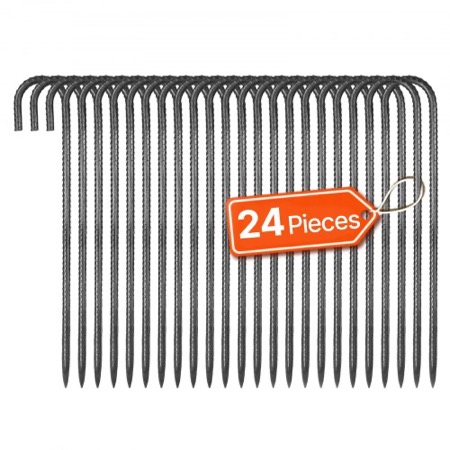
Best Overall Heavy Duty Tent Stakes
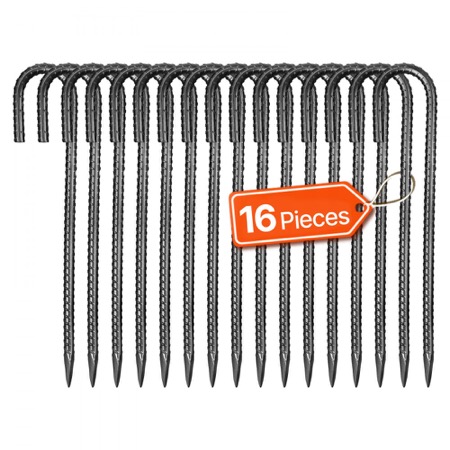
Best for Camping Tents
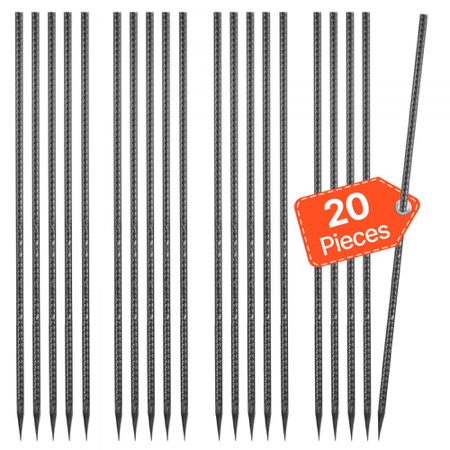
Best for High Winds and Large Canopies
Best for Fences, Edging and Timbers: VEVOR 16 in Straight Rebar StakesBest for Tarps, Netting and Trampolines: VEVOR 12 in U Shaped Rebar StakesCompare all 5 side by side
Best Heavy Duty Tent Stakes: Full Reviews
1. VEVOR 16 in J Hook Rebar Stakes: Best Overall Heavy Duty Tent Stakes
If you want one set of stakes that handles a family tent, a canopy, a trampoline and the odd fence job, this is it. Each stake is 16 inches long and 0.4 inch thick, with a J hook at the top about 2.76 inches wide. The hook is the reason J stakes are the default for tents: a guy line or tent loop drops over it and stays put, and the bend gives you something solid to hit with a hammer.
At 16 inches, these go deep enough to hold in loose or sandy soil where a 7 inch peg simply pulls out. The 60 degree chisel tip and ribbed shaft help them start in hard ground and resist working loose once they are in. VEVOR rates them for sand, grass, gravel and hard ground, and for anchoring tents, trampolines, swing sets and soccer goals.
The set has 24 stakes and weighs about 16.6 lb, roughly 0.7 lb per stake, so this is car camping and backyard gear rather than something to carry on a backpacking trip. VEVOR’s install advice is to drive them at about a 60 degree angle, leaning away from the load, and to leave about 1.5 to 2 inches of the hook above ground so you can attach lines and pull the stake later.
Key Features
- 16 in long, 0.4 in diameter, J hook about 2.76 in wide
- HRB400E rebar steel
- Galvanized core, black powder and electrophoretic coatings
- 60 degree chisel tip, ribbed threaded shaft
- 24 stakes per pack, about 16.6 lb
- Model J10-406-50-70
- For tents, canopies, trampolines, fences and yard goals
What We Like
- Deep enough for sand and loose soil
- Hook holds guy lines securely
- Thick shaft resists bending under a hammer
- 24 stakes cover a large tent, guy lines and a canopy
- Works for many yard jobs beyond camping
What We Don’t Like
- At about 0.7 lb each they are heavy to carry, and in rocky ground it can be hard to drive the full 16 inches.
Overall
The best all-round heavy duty tent stake for most people. If you camp by car and want stakes that hold in wind and poor soil, start with the VEVOR 16 inch J hooks.
VEVOR Black Friday
Up to 50% off, plus an extra 8% with code VVOTD (Nov 19 to Nov 30).
2. VEVOR 12 in J Hook Rebar Stakes: Best for Camping Tents
For most tents on normal ground, 16 inches is more stake than you need, and 12 inches is a better balance of hold and effort. These are the same 0.4 inch thick J hook stakes in a 12 inch length, with a slightly smaller hook about 2.36 inches wide. They are still far longer and stiffer than the stakes that come with most tents.
The shorter length is easier to drive fully in hard-packed campsites and gravel pads, where long stakes often stop halfway. The 60 degree chisel tip and ribbed shaft are the same as on the longer stakes, so they start cleanly and grip once seated. A 16 pack covers a large cabin tent’s corners, side loops and guy lines.
The set weighs about 8.2 lb, or around half a pound per stake, which is easier to pack for a weekend than the 16 inch version. Keep them in a separate bag from the tent body, because the chisel tips and ribbed shafts will scuff fabric.
Key Features
- 12 in long, 0.4 in diameter, J hook about 2.36 in wide
- HRB400E rebar steel
- Galvanized core, black powder and electrophoretic coatings
- 60 degree chisel tip, ribbed threaded shaft
- 16 stakes per pack, about 8.2 lb
- Model J-10-304-40-80
- For tents, tarps, canopies and garden supports
What We Like
- Easier to drive fully in hard campsites
- Lighter pack than the 16 inch set
- Same thick, stiff shaft
- Plenty of stakes for a big tent
- Hook makes guy lines simple
What We Don’t Like
- In deep sand or very loose soil, 12 inches gives less hold than the 16 or 24 inch stakes.
Overall
The pick for camping on typical ground. If your campsites are hard-packed rather than sandy, the VEVOR 12 inch J hooks are easier to drive and lighter to carry.
3. VEVOR 24 in Straight Rebar Stakes: Best for High Winds and Large Canopies
When the job is holding down a large canopy, an event tent or a shade structure in an open, windy spot, length matters more than anything. These straight stakes are 24 inches long and 0.47 inch thick, the longest and thickest in this guide, and come in a pack of 20. Driven most of the way in, they reach firmer soil below the loose top layer that lets shorter stakes rip out.
Being straight, they suit canopy legs with foot plates, fence posts and garden supports, and they work for guy lines too if you tie a secure hitch such as a clove hitch around the shaft below the top. The ribbed surface helps the rope and the soil grip. The 60 degree chisel tip makes starting them easier in hard ground.
The pack weighs about 22.4 lb, or about 1.1 lb per stake, and you will want a small sledge or a heavy hammer to drive a 24 inch stake into firm soil. Before driving stakes this long in a yard, call 811 to have buried utility lines marked, since some lines run shallower than you would expect.
Key Features
- 24 in long, 0.47 in diameter
- HRB400E rebar steel
- Galvanized core, black powder and electrophoretic coatings
- 60 degree chisel tip, ribbed threaded shaft
- 20 stakes per pack, about 22.4 lb
- Model I12-610
- For canopies, event tents, fences and supports
What We Like
- Longest, thickest stake here
- Deepest hold for wind and loose soil
- Twenty stakes covers a large canopy
- Straight shaft suits foot plates and fences
- Ribbed shaft grips soil and rope
What We Don’t Like
- There is no hook, so guy lines need a tied hitch, and driving a 24 inch stake takes a heavy hammer and some effort.
Overall
The pick for big canopies and windy, open ground. If a 10×10 canopy tent or event tent has ever tried to take off on you, these 24 inch stakes are the fix.
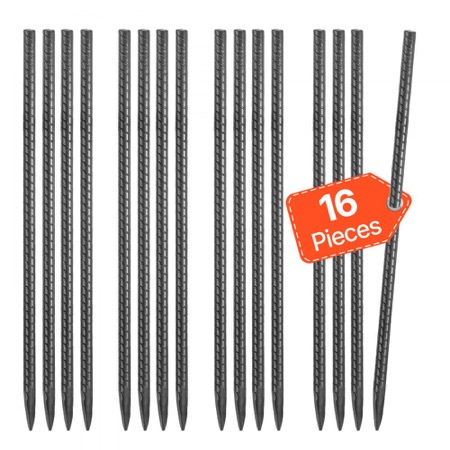
4. VEVOR 16 in Straight Rebar Stakes: Best for Fences, Edging and Timbers
Not every stake is for a tent. These 16 inch straight stakes are 0.45 inch thick and come 16 to a pack, and they are the type landscapers use for holding down timbers, railroad ties, garden borders and temporary fencing. They also work for canopy legs with foot plates and for staking garden supports.
VEVOR states that the black electrophoretic surface on this rebar is safe for direct contact with preservative-treated wood, which matters when you drive stakes through or beside treated landscape timbers. VEVOR also says they suit rolled steel landscape edging, which usually needs stakes along its length to stay in place.
The 60 degree chisel tip and ribbed shaft are the same as on the other VEVOR stakes. The pack weighs about 11.7 lb. A straight stake is easier to drive deep than a J hook because the hammer hits it squarely, but it gives a rope or tent loop nothing to catch on.
Key Features
- 16 in long, 0.45 in diameter
- HRB400E rebar steel
- Black electrophoretic coating, safe with treated wood per VEVOR
- 60 degree chisel tip, ribbed threaded shaft
- 16 stakes per pack, about 11.7 lb
- Model I12-406
- For timbers, edging, fences, canopy feet and supports
What We Like
- Thick, stiff shaft for driving deep
- Suits treated landscape timbers
- Works with steel edging
- Square hammer strike drives easily
- Doubles as canopy foot stakes
What We Don’t Like
- A straight shaft gives guy lines and tent loops nothing to hook onto, so it is a poor fit for tent pegging.
Overall
The pick for yard and landscaping jobs. If you are holding down timbers, edging or temporary fencing, the VEVOR 16 inch straight stakes are the right tool.
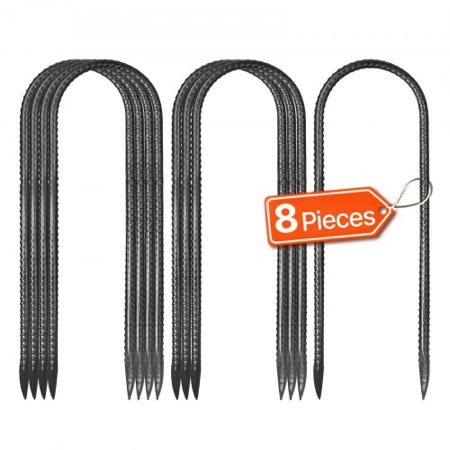
5. VEVOR 12 in U Shaped Rebar Stakes: Best for Tarps, Netting and Trampolines
U shaped stakes do a different job from J hooks. With two legs going into the ground, they pin something flat rather than holding a line under tension: a tarp edge, ground cloth, garden netting, landscape fabric, a gazebo privacy curtain or the legs of a trampoline. These VEVOR U stakes are 12 inches long, made from 0.32 inch thick HRB400E rebar, and VEVOR lists the overall size at 12 by 3.86 inches.
Two legs give more grip than one stake of the same length and stop the stake from twisting, which is why they are the usual choice for trampoline anchors when they go over the leg. At 12 inches the legs reach deeper than most garden staples, which helps in loose soil and windy yards. They share the 60 degree chisel tips, ribbed surface and galvanized core of the larger VEVOR stakes, finished in a black powder and electrophoretic coating for damp or salty soil.
The pack has 8 stakes and weighs about 4.3 lb, so it is the lightest set here, but also the thinnest. Drive them with steady blows rather than heavy swings in hard ground. For a heavy duty trampoline or a swing set, place one over each leg, and buy a second pack if you also want to pin netting or a tarp.
Key Features
- 12 in long, about 3.86 in wide overall
- 0.32 in diameter HRB400E rebar steel
- Galvanized core, black powder and electrophoretic coatings
- 60 degree chisel tips, ribbed surface
- 8 stakes per pack, about 4.3 lb
- Model U8-304-76
- For tarps, netting, fabric, curtains and trampoline legs
What We Like
- Two legs resist twisting and pull-out
- 12 inch legs reach deeper than garden staples
- Fits over trampoline and swing set legs
- Lightest pack in this guide
- Low profile once driven in
What We Don’t Like
- Eight stakes is a small pack, and the thinner 0.32 inch steel is not meant for high-tension guy lines in strong wind.
Overall
The pick for pinning things down rather than tying them off. Use the VEVOR U stakes for tarps, netting, fabric and trampoline legs, and pair them with J hooks for the tent itself.
Side-by-Side Comparison
| Stake Set | Shape | Length | Diameter | Pack | Pack Weight | Price |
|---|---|---|---|---|---|---|
| VEVOR 16 in J Hook | J hook | 16 in | 0.4 in | 24 stakes | About 16.6 lb | Check price |
| VEVOR 12 in J Hook | J hook | 12 in | 0.4 in | 16 stakes | About 8.2 lb | Check price |
| VEVOR 24 in Straight | Straight | 24 in | 0.47 in | 20 stakes | About 22.4 lb | Check price |
| VEVOR 16 in Straight | Straight | 16 in | 0.45 in | 16 stakes | About 11.7 lb | Check price |
| VEVOR 12 in U Shaped | U shape | 12 in | 0.32 in | 8 stakes | About 4.3 lb | Check price |
Specs are VEVOR’s own figures as of November 2026.
How to Choose Heavy Duty Tent Stakes
Stake Shape
J hook stakes are the all-rounder for tents and anything with a loop or guy line, because the line sits in the hook and cannot slip off the top. Straight stakes drive deepest and suit canopy foot plates, fences, timbers and edging, but need a tied hitch to hold a line. U shaped stakes pin things flat, such as tarps, netting and trampoline legs. Many people keep a mix: J hooks for the tent, a few long straight stakes for windy guy lines, and U stakes for the ground cloth.
Length for Your Ground
The looser the soil, the longer the stake you need. On firm lawn or packed campsites, 12 inches holds most tents well. In sand, loose loam or wet ground, 16 inches or more reaches firmer soil. For large canopies in open, windy spots, 24 inch stakes give the deepest hold. In very rocky ground, a shorter stake you can actually drive fully is better than a long one that stops halfway.
Thickness and Steel
Thin stakes bend when they hit a buried rock. Rebar stakes of 0.4 inch and up resist that, and the ribbed surface grips the soil better than a smooth rod. Look for a coating that resists rust, since stakes spend their lives in damp ground. All five VEVOR sets use HRB400E rebar steel with protective coatings, and the 0.32 inch U stakes are the only thin ones, which suits their job of pinning rather than pulling.
Weight and Portability
Rebar stakes are heavy. A full set for a large tent can weigh 8 to 17 lb, which is fine in a car but not in a backpack. If you hike to camp, carry lighter stakes for the tent body and use heavy stakes only where you drive in. For backyard canopies, trampolines and yard work, weight does not matter.
How to Drive and Remove Rebar Stakes
Drive tent and guy line stakes at about a 60 degree angle, with the top leaning away from the tent, so the line pulls across the stake rather than straight up it. Leave a little of the top above ground, about 1.5 to 2 inches, so you can attach lines and pull the stake later. Use a small sledge or a heavy hammer, and wear eye protection, since steel on steel can chip.
If a stake stops dead, do not keep pounding; pull it and move a few inches to miss the rock. To remove a J hook stake, put a hammer claw, a stake puller or another stake under the hook and lever it up while twisting. Rocking a straight stake side to side first loosens the soil. Before driving long stakes in a yard, call 811 to have utility lines marked. For securing loads and gear to the anchors, a set of ratchet straps is handy.
A Scenario Worth Knowing About
Picture a family setting up a pop-up canopy at a weekend soccer tournament. The ground is a dry, hard field, the stakes from the canopy bag bend on the first swing, so the canopy goes up with just its legs on the grass. By midday a gust catches it, lifts one side and tips it into the next canopy over.
A canopy is a sail with legs. The fix is long, stiff stakes through each foot plate plus a guy line from each corner to a J hook stake driven at an angle away from the canopy. Pack a few 16 or 24 inch rebar stakes and a small sledge in the car for any outdoor event, and use them even when the morning is calm.
Frequently Asked Questions
What are the best tent stakes for high winds?
Long, thick steel stakes driven at an angle away from the tent hold best. For tents, 12 to 16 inch J hook rebar stakes work well; for canopies and open, windy ground, 24 inch straight stakes with tied guy lines give the deepest hold.
How long should tent stakes be?
For firm ground, 12 inches is plenty for most tents. Use 16 inches in sand or loose soil, and 24 inches for large canopies in wind. Shorter stakes are easier to drive in rocky ground.
Are rebar stakes good for tents?
Yes, for car camping and backyard use. They are much stiffer than aluminum or wire stakes, hold better in poor soil and do not bend easily. The trade-off is weight, so they are not ideal for backpacking.
What tent stakes work in sand?
Long stakes are the key in sand, ideally 16 inches or more, driven at an angle. Burying a stake sideways as a deadman anchor, with the guy line tied around its middle, also works well in very soft sand.
Can I drive rebar stakes into rocky or frozen ground?
A chisel tip helps them start in hard or frozen ground, but no stake goes through solid rock. If a stake stops, move it a few inches. In frozen ground, shorter stakes and a heavier hammer work best.
How do I anchor a trampoline?
Use U shaped stakes over each leg, driven straight down so both legs of the stake go into the ground. Add more stakes in windy areas, and check them after storms.
The Bottom Line
For most people, the VEVOR 16 in J Hook Rebar Stakes are the heavy duty tent stakes to buy: 0.4 inch thick, long enough for sand and loose soil, with a hook that holds guy lines and a 24 pack that covers a large tent with stakes to spare. If your campsites are hard-packed, the 12 inch J hooks are easier to drive and lighter to carry.
For big canopies and windy fields, add the 24 inch straight stakes. Use the 16 inch straight stakes for timbers, edging and fences, and the 12 inch U stakes for tarps, netting and trampoline legs. Whatever you choose, drive them at an angle and leave enough of the top showing to pull them back out.