Most people buy their first welder because of one specific job. A cracked mower deck. A rusted-out floor pan. A trailer tongue that needs a gusset, or a gate that keeps sagging no matter how many hinges you throw at it. You can pay a shop to fix it, or you can spend about the same money on a machine and fix the next twenty things yourself.
For that kind of work, the best MIG welder is the one that matches your power outlet, the metal you actually weld and whether you want to deal with a gas bottle. MIG is the easiest process to learn: you pull the trigger, wire feeds out of the gun, and the machine handles most of the hard part. Modern inverter machines also weigh a fraction of what the old transformer boxes did and run on a regular household outlet.
We picked six VEVOR MIG welders, from a 12 lb gasless starter to a 250 amp pulse machine that handles aluminum with the right gun. We gave each one a clear job so you can skip straight to the one that fits.
Our Quick Picks
Best Overall
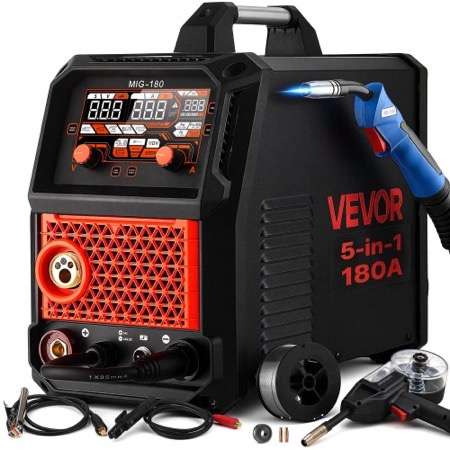
VEVOR MIG-180 5-in-1 MIG Welder with Spool Gun (180A)
180A · Gas MIG, flux, stick, lift TIG, aluminum MIG · 110V/220V
Check Price at VEVORRead the reviewBest Budget Flux Core Welder
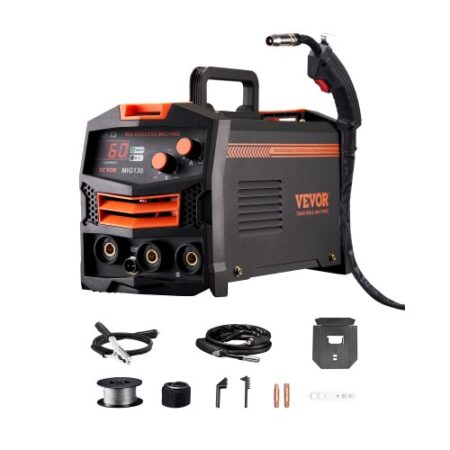
VEVOR MIG130 Gasless Flux Core Welder (130A)
130A · Flux core only · 110V
Check Price at VEVORRead the reviewBest 120V Starter That Grows Into Gas
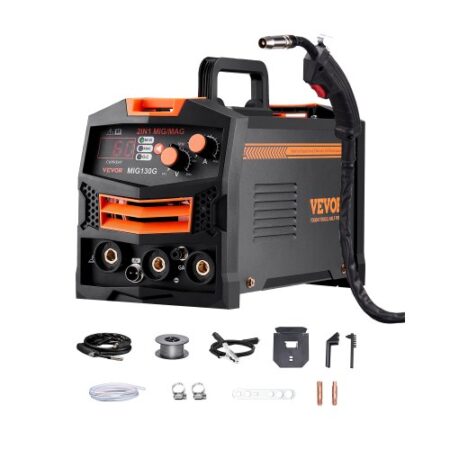
VEVOR MIG130G 2-in-1 Gas and Gasless MIG Welder (130A)
130A · Gas MIG, flux · 110V
Check Price at VEVORRead the reviewBest for the Money: VEVOR MIG-270 3-in-1 MIG, Stick and Lift TIG WelderBest for Aluminum: VEVOR MIG-200AU Pulse 5-in-1 MIG Welder (200A)VEVOR MIG-250 Pulse 5-in-1 MIG Welder (250A): Most Power for Thick SteelCompare all 6 side by side
Best MIG Welders: Full Reviews
At a glance
- Max Output
- 180A
- Processes
- Gas MIG, flux, stick, lift TIG, aluminum MIG
- Input
- 110V/220V
- Max Thickness
- 8 mm
1. VEVOR MIG-180 5-in-1 MIG Welder with Spool Gun (180A): Best Overall
If you only buy one welder for a home garage, this is the sweet spot. The MIG-180 does gas MIG, gasless flux core, stick, lift TIG and aluminum MIG from one box, runs on 110V or 220V, and puts out up to 180 amps. VEVOR rates it for material up to 8 mm (about 5/16 inch) in mild steel, stainless steel and aluminum.
What sets it apart is the spool gun in the box. Aluminum wire is soft and tends to tangle in a long standard MIG lead, and a spool gun feeds it from a small spool right at the torch. That makes it the only pick here that can weld aluminum without buying another gun. The main feeder takes 0.030 and 0.039 inch (0.8 and 1.0 mm) flux core and solid wire on spools up to 11 lb, and aluminum runs on 0.039 or 0.047 inch (1.0 or 1.2 mm) wire.
Control is synergic, so you pick the wire and the machine matches wire speed to voltage, with a large digital display and 2T, 4T and spot modes. It measures 18.5 by 9.1 by 15 inches and weighs 34.2 lb, with a carry handle and a cooling fan. VEVOR puts the duty cycle at maximum current at 40 to 60% at 77°F. The lift TIG torch is sold separately.
Key Features
- 180A output, up to 8 mm (VEVOR rating)
- Gas MIG, flux core, stick, lift TIG and aluminum MIG
- Spool gun included for aluminum
- 110V/220V dual voltage
- Synergic control with 2T, 4T and spot modes
- 0.030 and 0.039 in steel wire, 0.039 and 0.047 in aluminum wire, 11 lb spools
- 34.2 lb, model MIG-180
What We Like
- Welds aluminum out of the box with the included spool gun
- Five processes cover almost any home job
- Synergic setup shortens the learning curve
- Still useful on a regular 110V outlet for sheet metal
- Spot mode helps with tacking body panels
What We Don’t Like
- The lift TIG torch is not included, so TIG work means buying one separately.
Overall
For a home garage that welds mild steel, stainless and the occasional aluminum part, this is the one we’d buy. It covers every process a hobbyist uses, and the included spool gun saves you a separate purchase when aluminum comes up.
VEVOR Black Friday
Up to 50% off, plus an extra 8% with code VVOTD (Nov 19 to Nov 30).
2. VEVOR MIG130 Gasless Flux Core Welder (130A): Best Budget Flux Core Welder
Not everyone needs five processes. If your plan is to fix a fence, patch a trailer, build a few brackets and weld outside without fighting the wind, a gasless flux core machine is the simplest way in. There’s no bottle, no regulator and nothing to blow away your shielding gas on a breezy day.
This one plugs into a standard 110V outlet, and VEVOR says it runs fine on a 20 amp breaker. It puts out up to 130 amps, takes 1 kg spools of 0.030 or 0.035 inch flux core wire, and VEVOR rates it for steel up to 8 mm. At 12.4 lb and roughly the size of a shoebox, it comes with a shoulder strap and fits in a truck toolbox.
It suits weekend jobs like patching rust holes with 18 gauge sheet. Keep expectations realistic: flux core leaves slag you’ll chip and brush off, and it’s not the tidiest process for show-quality bodywork.
Key Features
- 130A gasless flux core MIG
- Runs on 110V, 20A circuit
- Up to 8 mm steel (VEVOR rating)
- 0.030 and 0.035 in flux core wire, 1 kg spools
- Synergic control with digital display
- 12.4 lb, 13 x 6.3 x 9.1 in, shoulder strap
- Model MIG130
What We Like
- No gas bottle to buy, rent or refill
- Works outdoors in a breeze
- Light enough to carry to the job
- Plugs into a normal garage outlet
- Simple controls for a first welder
What We Don’t Like
- Flux core only, so there’s no upgrade path to cleaner gas MIG welds later on.
Overall
For outdoor repairs and farm or yard projects on a tight budget, this does the job. If you think you’ll want cleaner welds on thin sheet metal later, spend a bit more on the 2-in-1 below.
3. VEVOR MIG130G 2-in-1 Gas and Gasless MIG Welder (130A): Best 120V Starter That Grows Into Gas
This is the same compact 110V, 130 amp platform as the MIG130 flux core welder, with one important difference: it also runs gas-shielded solid wire. Start with flux core while you learn, then add a bottle of 75/25 argon and CO2 when you want cleaner beads with no slag on thin auto body steel.
It takes 1 kg spools of 0.030 or 0.035 inch wire, ships with a 1 lb spool of 0.030 E71T-GS flux core wire, and includes a gas hose, though not a regulator. For single-pass welds on 110V, plan on steel up to about 4 mm. It weighs 13.9 lb and measures 13 by 6.3 by 9.1 inches.
It suits weekend jobs like garage shelving and exhaust work. The same notes about short leads and thin manuals apply here as on the rest of VEVOR’s line.
Key Features
- 130A gas MIG and gasless flux core
- 110V plug-in power
- 0.030 and 0.035 in wire, 1 kg spools
- Gas hose included, regulator not included
- Synergic control and digital display
- 13.9 lb with shoulder strap
- Model MIG130G
What We Like
- Room to grow from flux core to gas MIG
- Gas mode gives clean welds on thin sheet metal
- Ships with a starter spool of wire
- Light and easy to store
- Good fit for auto body and garage projects
What We Don’t Like
- You’ll still need to buy a regulator and a gas cylinder before you can use the gas mode.
Overall
For a beginner on 110V who wants both processes without paying for stick and TIG they may never use, this is the smart starting point.
At a glance
- Max Output
- 50 to 220A listed
- Processes
- MIG, stick, lift TIG
- Input
- 110V/220V
- Max Thickness
- Not listed
4. VEVOR MIG-270 3-in-1 MIG, Stick and Lift TIG Welder: Best for the Money
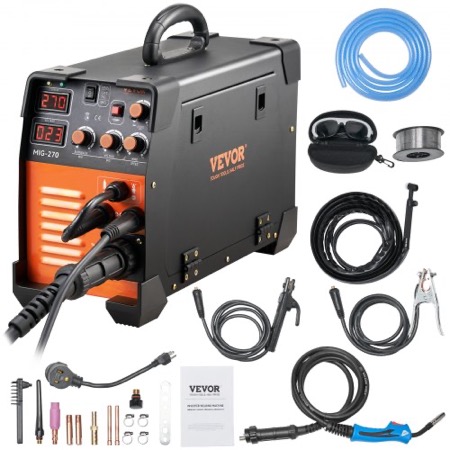
The MIG-270 is the lightest multi-process machine on this list at 21.7 lb, and it covers the three processes most home welders actually use: MIG with gas or flux core wire, stick and lift TIG. It runs on 110V or 220V, and knobs set current, voltage and wire speed, with an LCD that is easy to read. Ignore the 270 in the name. The listed current range is 50 to 220 amps, which is still plenty for brackets, carts, racks and trailer repairs.
It takes 0.024, 0.031 and 0.039 inch (0.6, 0.8 and 1.0 mm) solid or flux core wire on 2.2 lb or 11 lb spools, with wire speed adjustable from 2.2 to 12 meters per minute. VEVOR lists a 40% duty cycle, IP21S protection against splashing water and automatic shutdown on overheating or overload. Rated input is 5.6 KVA.
The box is unusually complete. Along with a 3 m MIG torch, an electrode holder and a 2 m ground clamp, you get a 5 m TIG torch and a 2 m argon tube, so lift TIG works without buying a torch first. VEVOR also includes a 1 kg spool of 0.030 inch solid wire, a slag hammer, a brush and glasses. One limit to know: VEVOR says it will not TIG aluminum.
Key Features
- 50 to 220A listed current range
- MIG (gas or flux core), stick and lift TIG
- 110V/220V dual voltage
- 0.024, 0.031 and 0.039 in wire, 2.2 or 11 lb spools
- TIG torch, MIG torch and stick leads included
- 40% duty cycle, IP21S, overheat and overload shutoff
- 21.7 lb, model MIG-270
What We Like
- Lightest multi-process welder here
- TIG torch included, unlike the other multi-process picks
- Takes large 11 lb spools
- Runs on either voltage
- Starter wire spool in the box
What We Don’t Like
- The 270 in the name overstates it: the listed output range is 50 to 220 amps, and it cannot TIG aluminum.
Overall
If you want MIG, stick and TIG in a light box without buying extra torches, the MIG-270 is the practical choice. Size your projects to its real 220 amp ceiling and it covers most garage work at 1/4 inch and under.
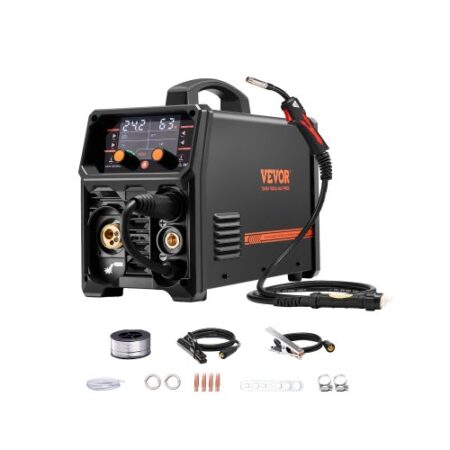
At a glance
- Max Output
- 200A
- Processes
- Pulse, gas MIG, flux, stick, lift TIG
- Input
- 110V/220V
- Max Thickness
- 15 mm
5. VEVOR MIG-200AU Pulse 5-in-1 MIG Welder (200A): Best for Aluminum
Aluminum is where cheap MIG welders fall apart. It conducts heat fast, burns through easily and the soft wire tends to bird-nest in a standard gun. Pulse MIG helps with the first two problems by switching rapidly between high and low current, so you get penetration without dumping so much heat into the part.
This machine adds pulse MIG to the usual gas MIG, flux core, stick and lift TIG, and it’s set up for aluminum wire in 0.040 and 0.047 inch (1.0 and 1.2 mm) as well as 0.030 and 0.035 inch steel wire. It takes 11 lb spools, runs on 110V or 220V, and VEVOR rates it for material up to 15 mm. It weighs 27.3 lb with accessories.
The catch is the gun. The stock torch is a 15AK-style steel gun, and VEVOR’s own answers say you need a separate aluminum torch (they point to a 24KD-style gun) for aluminum work. Budget for that and for pure argon, since aluminum doesn’t run on the 75/25 mix used for steel.
Key Features
- 200A with pulse MIG
- Gas MIG, flux core, stick, lift TIG and pulse
- Aluminum wire 0.040 and 0.047 in
- Steel wire 0.030 and 0.035 in
- 11 lb (5 kg) spool capacity
- 110V/220V dual voltage
- 27.3 lb, model MIG-200AU
What We Like
- Pulse mode controls heat on aluminum and thin stainless
- Cleaner beads with less spatter on steel
- Five processes in one compact box
- Large spool capacity
- Runs on either voltage
What We Don’t Like
- Aluminum needs a separate aluminum MIG torch, which isn’t in the box.
Overall
If aluminum is on your list, whether boat parts, trailer fenders or intake piping, this is the one to buy. Just order the right torch and a bottle of argon with it.
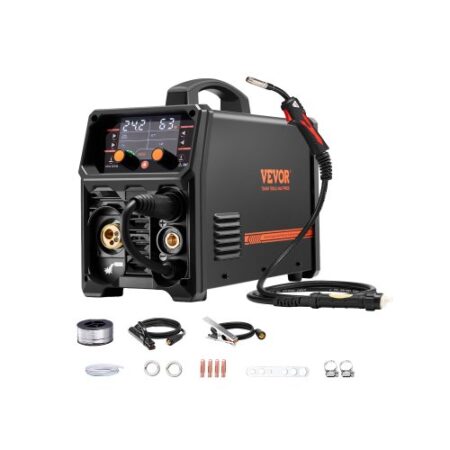
At a glance
- Max Output
- 250A
- Processes
- Pulse, gas MIG, flux, stick, lift TIG
- Input
- 110V/220V
- Max Thickness
- 15 mm
6. VEVOR MIG-250 Pulse 5-in-1 MIG Welder (250A): Most Power for Thick Steel
The 250 is the same pulse 5-in-1 platform as the MIG-200AU with more output on top. On 220V that extra 50 amps is what lets you run 0.035 wire hot on 3/8 inch plate and thicker structural work without stacking pass after pass. Input draw climbs to 8.2 KVA, so plan on a proper 240V circuit to get the full benefit.
Specs otherwise match the 200AU: pulse MIG, gas MIG, flux core, stick and lift TIG, aluminum wire support with an aluminum torch, 11 lb spools, 2T and 4T modes, and a 27.3 lb chassis that’s still light enough to carry by the handle. VEVOR rates it for material up to 15 mm.
It is a welder a beginner can grow into, and it runs gasless for jobs like rocker panels. The stock gun lead is short; VEVOR says a longer gun up to 5 meters works, but longer than that can cause feeding trouble.
Key Features
- 250A with pulse MIG
- Gas MIG, flux core, stick, lift TIG and pulse
- Aluminum wire support with aluminum torch
- 11 lb (5 kg) spool capacity
- 110V/220V dual voltage
- 8.2 KVA input
- 27.3 lb, model MIG-250
What We Like
- Most headroom here for thick steel on 220V
- Pulse mode for cleaner welds and thin material
- Still portable at 27 lb
- Room to grow from hobby to light fabrication
- Large spool capacity
What We Don’t Like
- The stock MIG gun lead is short, so you’ll be moving the machine around the project more than you’d like.
Overall
If you work on trailers, equipment and heavy frames, or you just never want to run out of power, buy the 250 and give it a dedicated 240V circuit.
Side-by-Side Comparison
| Welder | Max Output | Processes | Input | Max Thickness | Max Spool | Weight | Aluminum | Price |
|---|---|---|---|---|---|---|---|---|
| MIG-180 5-in-1 | 180A | Gas MIG, flux, stick, lift TIG, aluminum MIG | 110V/220V | 8 mm | 11 lb | 34.2 lb | Yes, spool gun included | Check price |
| MIG130 Gasless | 130A | Flux core only | 110V | 8 mm | 2.2 lb | 12.4 lb | No | Check price |
| MIG130G 2-in-1 | 130A | Gas MIG, flux | 110V | 4 to 8 mm | 2.2 lb | 13.9 lb | No | Check price |
| MIG-270 3-in-1 | 50 to 220A listed | MIG, stick, lift TIG | 110V/220V | Not listed | 11 lb | 21.7 lb | No | Check price |
| MIG-200AU Pulse | 200A | Pulse, gas MIG, flux, stick, lift TIG | 110V/220V | 15 mm | 11 lb | 27.3 lb | With aluminum torch | Check price |
| MIG-250 Pulse | 250A | Pulse, gas MIG, flux, stick, lift TIG | 110V/220V | 15 mm | 11 lb | 27.3 lb | With aluminum torch | Check price |
Specs are VEVOR’s own figures. Maximum thickness assumes 220V input on dual-voltage machines. The MIG-270 output is the current range VEVOR lists in its specs, not the 270 in the product name.
Flux Core vs Gas MIG: Which Do You Need?
Both use the same machine and gun; the difference is how the weld puddle is protected from air.
- Flux core (gasless): the wire has flux inside it that burns and shields the weld. No bottle, works outdoors in wind, penetrates well on dirty or rusty steel. The trade-off is more spatter and a slag crust you chip off afterward.
- Gas MIG: solid wire with shielding gas from a cylinder. Cleaner, flatter beads with no slag, and much easier on thin sheet metal. You need a regulator, a cylinder and a sheltered spot, since a breeze blows the gas away.
If most of your welding is outside, start with flux core. If it’s mostly inside a garage on car panels, furniture or thin tubing, you’ll want gas, so buy a machine that does both.
110V vs 220V: How Much Power Do You Need?
A handy rule of thumb is roughly one amp of output for every thousandth of an inch of steel in a single pass, so 1/8 inch steel wants about 125 amps. A 110V machine on a household circuit is happiest from thin sheet up to about 3/16 inch, with thicker joints needing multiple passes and good joint prep. For 1/4 inch and up, you want 220V.
Every dual-voltage pick here gives you both: run on 110V today and plug into a dryer-style 240V outlet when you have one. If you’re running a 110V machine anywhere but right next to the outlet, use a short, heavy-gauge cord, not a long light-duty one. Our guide to heavy-duty extension cords covers gauge and length. For remote repairs, check the surge rating of your portable generator against the welder’s input before you count on it.
What Else You Need to Start Welding
- Auto-darkening helmet: non-negotiable. Don’t use the flip-down shield that sometimes comes in the box for anything more than tacks.
- Gloves and clothing: thick leather work gloves or welding gauntlets, cotton or wool clothing (never synthetics), and leather boots.
- Gas setup for MIG: a regulator and cylinder. 75/25 argon and CO2 is the standard for mild steel; 100% argon for aluminum.
- A steel work surface: a sturdy heavy-duty workbench with a steel top doubles as a ground point.
- Angle grinder and wire wheel: clean, bright metal makes a bigger difference to weld quality than any setting.
- Fire extinguisher: sparks travel farther than you think, so clear out sawdust, rags and anything flammable.
A Scenario Worth Knowing About
You set up a new 110V welder at the far end of the driveway, run it off the 100 ft cord you use for the leaf blower, and start welding a trailer bracket. The wire sputters and stubs into the plate, the arc won’t settle, and after a few inches the breaker in the garage trips. The welder must be defective, right?
Almost certainly not. A long, thin cord drops voltage under a welder’s heavy draw, so the machine sees far less than 120V. Synergic settings that assume a full 120V then feed wire faster than the starved arc can melt it, which is exactly what stubbing looks like, and the extra current through the cord helps trip the breaker.
The fix is to bring the work to the power, not the other way around. Plug in directly, or use the shortest, heaviest cord you own: 10 or 12 gauge and as close to 25 feet as you can manage. Run the welder on a circuit with nothing else on it. If it still trips, the breaker is too small for the machine, and that’s a job for an electrician, not a bigger breaker.
Frequently Asked Questions
What is the best MIG welder for a beginner?
For a beginner on 110V, the MIG130G 2-in-1 is the easiest start: light, simple and able to run both flux core and gas. If you have or plan to add a 240V outlet, the MIG-180 gives you far more room to grow, including aluminum with its included spool gun.
Can a 110V MIG welder weld 1/4 inch steel?
It can with good prep and multiple passes, but it’s at the limit of what a 110V machine does well. For regular 1/4 inch work, run a dual-voltage welder on 220V, where it has the amperage to penetrate in fewer passes.
What is the best gas for MIG welding steel?
For mild steel, 75% argon and 25% CO2 (often sold as C25) is the standard: smooth arc, low spatter and good penetration. Straight CO2 is cheaper and penetrates deeper but spatters more. Aluminum needs 100% argon.
Can a MIG welder weld aluminum?
Only with the right setup. You need a machine that supports aluminum wire, ideally with pulse, plus an aluminum gun or spool gun and pure argon. The MIG-180 comes with a spool gun for aluminum wire, and the two pulse picks support it with a separate aluminum torch; the others don’t.
Do I need gas for a MIG welder?
No, if you run flux core wire, which shields itself. Gas MIG with solid wire gives cleaner welds indoors, but every pick here can weld gasless.
Is MIG or stick better for a home garage?
MIG is faster and easier to learn, and it’s better on thin metal. Stick is better outdoors and on rusty or painted steel. Four of the six picks here do both, so you don’t have to choose.
The Bottom Line
For most home garages, the VEVOR MIG-180 is the best MIG welder to buy: five processes, dual voltage and a spool gun in the box for aluminum. Pick the MIG-270 if you want stick and TIG with the torches included and mostly weld 1/4 inch and under, start small with the MIG130G on 110V, or go gasless with the MIG130 for outdoor repairs. Need pulse for aluminum or more power for thick steel? Look at the MIG-200AU or the MIG-250.
Whichever you pick, buy a good helmet, clean the metal down to bright steel and keep the cord short. Do that and your first real weld will hold, which is more than most people can say about their first welder.