A good meat slicer pays for itself faster than most kitchen gadgets. Deli meat sliced at home costs far less than the counter, holiday hams and roasts come out in neat, even slices, and hunters can turn a backstrap into jerky strips that dry at the same rate. This guide covers the best meat slicers for home use, plus a few commercial-grade machines for people who slice in volume.
All six picks are from VEVOR: an 8.6 inch two-blade home slicer, a compact 6.7 inch model that folds into a drawer, 10 and 12 inch commercial slicers with carbon steel blades, a fully automatic slicer and a manual tenderizer and jerky slicer. More brands will be added to this page as we review them.
For each slicer you get the blade size and type, motor power, thickness range, safety features and one honest drawback. After the reviews, the buying guide covers blade size, serrated versus smooth blades, stainless versus carbon steel, and how to slice and clean safely.
Our Quick Picks
Best Overall Meat Slicer for Home Use
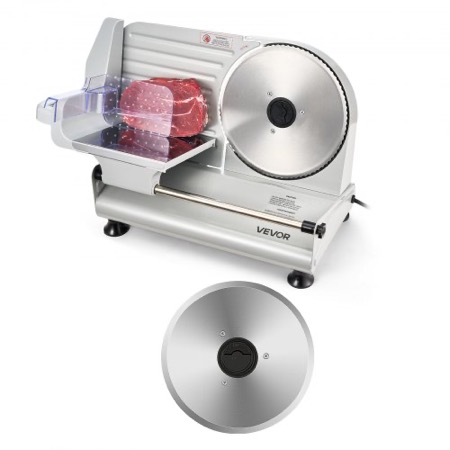
VEVOR 8.6 in Electric Meat Slicer with 2 Blades (SL-5239M12C)
8.6 in stainless, serrated + smooth · 200 W · 70 to 100 RPM
Check Price at VEVORRead the reviewBest Compact Slicer for Small Kitchens
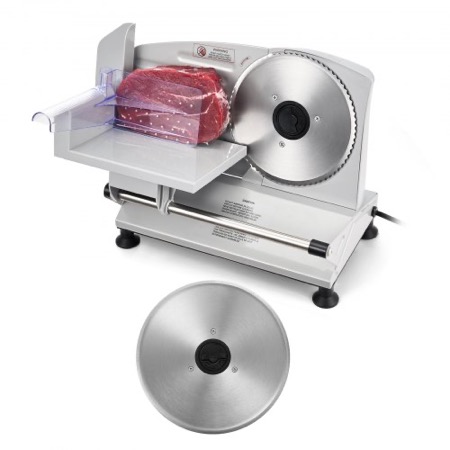
VEVOR 6.7 in Compact Meat Slicer (SL-517)
6.7 in stainless, serrated + smooth · 150 W · 65 to 90 RPM
Check Price at VEVORRead the reviewBest for Frozen Meat and Heavy Home Use
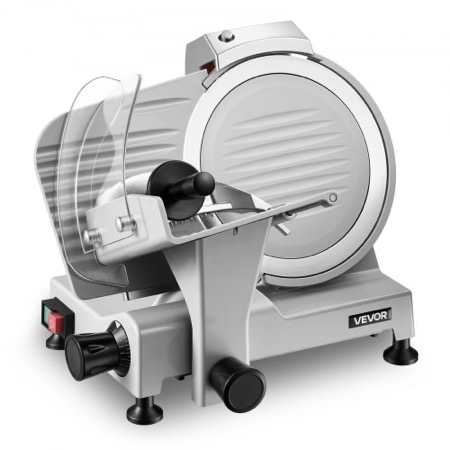
VEVOR 10 in Commercial Meat Slicer, 300W (SY-250JA)
10 in carbon steel · 300 W · 300 to 450 RPM
Check Price at VEVORRead the reviewBest for Large Roasts and Small Delis: VEVOR 12 in Commercial Meat Slicer, 400W (SY-300A)Best Automatic Slicer for High Volume: VEVOR Fully Automatic 10 in Meat Slicer (HC-QP-250B)Best for Jerky Makers: VEVOR 2-in-1 Manual Meat Tenderizer and Jerky Slicer (1A-MT113)Compare all 6 side by side
Best Meat Slicers: Full Reviews
At a glance
- Blade
- 8.6 in stainless, serrated + smooth
- Motor
- 200 W
- Speed
- 70 to 100 RPM
- Thickness
- 0 to 0.6 in
1. VEVOR 8.6 in Electric Meat Slicer with 2 Blades (SL-5239M12C): Best Overall Meat Slicer for Home Use
For most home kitchens, this is the slicer we would buy. It is big enough for deli roasts, holiday ham and a block of cheese, small enough to store, and it comes with two blades: a serrated one for crusty bread and firm vegetables and a smooth one for clean, even meat slices. Both are 8.6 inch SUS420 stainless steel, and swapping them takes a few minutes.
A 200 watt motor turns the blade at 70 to 100 RPM, a steady, controlled speed for home use. Slice thickness sets from paper-thin up to 0.6 inch (15 mm) with a side knob, which covers shaved deli meat, sandwich slices and thick-cut bacon or steaks. VEVOR says the carriage, the platform the food rides on, is cast aluminum, so it does not flex under a heavy roast, while the food pusher is plastic.
Safety basics are well covered: a dual security lock means two buttons must be pressed to start it, a food pusher keeps your fingers away from the blade, and suction-cup feet hold it to the counter. The blade, pusher and slide bar extender come off for cleaning, and the meat tray reverses so you can wipe the body down. VEVOR says it is ETL approved. It weighs 13.92 pounds and measures 18.11 x 11.42 x 12.32 inches.
Key Features
- Model SL-5239M12C, 8.6 in serrated and smooth SUS420 blades
- 200 W motor, 70 to 100 RPM
- Thickness 0 to 0.6 in (0 to 15 mm)
- Cast aluminum carriage, plastic food pusher
- Dual security lock, food pusher, suction-cup feet
- Removable blade, pusher and slide bar extender, reversible tray
- ETL approved per VEVOR
- 13.92 lb, 18.11 x 11.42 x 12.32 in
What We Like
- Two blades for meat and bread
- Wide thickness range
- Rigid metal carriage
- Easy to take apart and clean
- Light enough to store away
What We Don’t Like
- Its 70 to 100 RPM home motor is slower than commercial slicers, so long sessions take more time.
Overall
The best meat slicer for home use for most people. It handles roasts, deli meats, cheese and bread, the two blades add real flexibility, and it is easy to clean and put away. Choose a 10 or 12 inch commercial slicer only if you slice in volume.
VEVOR Black Friday
Up to 50% off, plus an extra 8% with code VVOTD (Nov 19 to Nov 30).
At a glance
- Blade
- 6.7 in stainless, serrated + smooth
- Motor
- 150 W
- Speed
- 65 to 90 RPM
- Thickness
- 0 to 0.6 in
2. VEVOR 6.7 in Compact Meat Slicer (SL-517): Best Compact Slicer for Small Kitchens
If counter and cabinet space are tight, this 6.7 inch VEVOR slicer gives you most of what the larger home model does in a much smaller package. It still comes with two blades, one serrated and one smooth, and still slices from paper-thin to 0.6 inch thick. At 6.94 pounds and 13.98 x 8.86 x 10.24 inches, it folds away into a drawer or cabinet.
A 150 watt motor turns the blades at 65 to 90 RPM, which VEVOR says suits partly frozen meat as well as deli meats, roast beef, turkey breast, bread, vegetables and fruit. The carriage tray, blade, food pusher and slider extension all come off without tools, so cleaning after raw meat is quick and thorough.
Safety is layered: the housing sits 1 mm above the blade edge to keep fingers off it, a security lock prevents accidental starts, and rubber suction feet hold it steady. VEVOR says it is ETL certified. Note that VEVOR says this machine is designed only for its 6.7 inch blades, so you cannot upgrade to a larger blade later.
Key Features
- Model SL-517, two 6.7 in SUS420 blades (serrated and smooth)
- 150 W motor, 65 to 90 RPM
- Thickness 0 to 0.6 in (0 to 15 mm)
- Tool-free removal of tray, blade, pusher and slider extension
- Raised housing guard, security lock, suction feet
- Foldable for drawer or cabinet storage
- ETL certified per VEVOR
- 6.94 lb, 13.98 x 8.86 x 10.24 in
What We Like
- Smallest and lightest slicer here
- Folds away for storage
- Two blades included
- Full thickness range
- Quick tool-free cleaning
What We Don’t Like
- The 6.7 in blade limits the size of roasts and loaves, and VEVOR says a larger blade cannot be fitted.
Overall
The best compact slicer for apartments and small kitchens. It slices meat, cheese and bread nearly as well as bigger home models and folds into a drawer when you are done. Choose the 8.6 inch model if you often slice large roasts.
At a glance
- Blade
- 10 in carbon steel
- Motor
- 300 W
- Speed
- 300 to 450 RPM
- Thickness
- 0 to 0.47 in
3. VEVOR 10 in Commercial Meat Slicer, 300W (SY-250JA): Best for Frozen Meat and Heavy Home Use
This is the step up from home slicers: a 10 inch commercial-style machine with a carbon steel blade and a 300 watt motor spinning at 300 to 450 RPM, several times faster than the home models. That speed and blade size make short work of partly frozen meat, dense deli blocks, big roasts and whole baguettes, and VEVOR rates the motor for long, back-to-back runs.
Carbon steel holds a sharp edge longer than standard stainless, and a built-in sharpener lets you touch up the edge without removing the blade. A fixed blade guard, a transparent guard cover and a finger-guard ring on the handle keep hands in a safe position. VEVOR says it runs at about 60 decibels, roughly the level of normal conversation.
The stainless steel food tray, food holder and pusher detach without tools for cleaning, and the blade is removable. Thickness adjusts continuously from paper-thin to 0.47 inch (12 mm). VEVOR lists it as ETL approved with FDA-compliant food-contact materials. The housing is ABS plastic, which keeps the weight to 24.91 pounds, and it measures 16.85 x 14.57 x 13.19 inches.
Key Features
- Model SY-250JA, 10 in removable carbon steel blade
- 300 W motor, 300 to 450 RPM
- Thickness 0 to 0.47 in (0 to 12 mm)
- Built-in sharpener
- Blade guard, transparent cover, finger-guard ring
- Tool-free removable stainless tray, holder and pusher
- About 60 dB, ETL approved, FDA food-contact materials
- 24.91 lb, 16.85 x 14.57 x 13.19 in
What We Like
- Fast commercial blade speed
- Sharpener built in
- Handles frozen meat and big roasts
- Quiet for its power
- Lighter than metal-bodied commercial slicers
What We Don’t Like
- Its maximum thickness is 0.47 in (12 mm), a little less than the other electric slicers here.
Overall
The best choice for serious home cooks, hunters and anyone who slices a lot of frozen meat. It brings commercial blade speed and a built-in sharpener at a weight you can still move around the kitchen.
At a glance
- Blade
- 12 in carbon steel
- Motor
- 400 W
- Speed
- 300 to 450 RPM
- Thickness
- 0 to 0.6 in
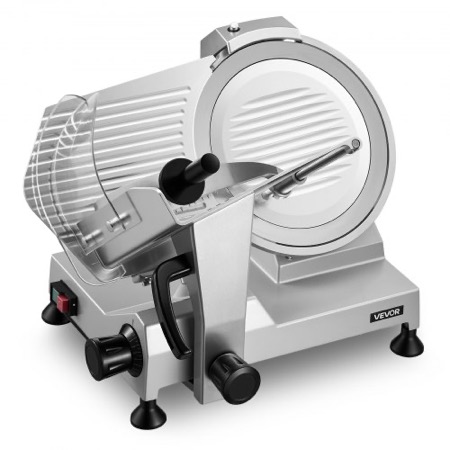
4. VEVOR 12 in Commercial Meat Slicer, 400W (SY-300A): Best for Large Roasts and Small Delis
When roasts get big or slicing becomes part of a business, a 12 inch blade is the standard. This VEVOR slicer pairs a 12 inch carbon steel blade, coated against rust and corrosion, with a 400 watt motor at 300 to 450 RPM. The larger blade takes wide cuts of meat, whole vegetables and oversized deli portions in one pass instead of trimming them to fit.
Thickness sets from paper-thin to 0.6 inch (15 mm) with a side knob that clicks and holds its setting through long runs, which matters when you need a stack of identical slices. A built-in sharpener restores the edge in a few strokes without removing the blade, and the food pusher has multi-guard tines, with a blade cover and hand guard for safety. A grooved texture helps keep food from sticking.
The body is aluminum alloy, the food tray is stainless steel, and the blade, food holder and pusher are removable for cleaning. VEVOR lists it as ETL approved and suitable for restaurants, butcher shops, cafeterias and home kitchens. At 45.42 pounds and 21.65 x 17.72 x 16.54 inches, it needs a sturdy, permanent spot.
Key Features
- Model SY-300A, 12 in coated carbon steel blade
- 400 W motor, 300 to 450 RPM
- Thickness 0 to 0.6 in (0 to 15 mm), click-lock knob
- Built-in sharpener
- Multi-guard food pusher, blade cover, hand guard
- Aluminum alloy body, stainless steel tray
- Removable blade, food holder and pusher, ETL approved
- 45.42 lb, 21.65 x 17.72 x 16.54 in
What We Like
- Largest blade for big roasts
- Thickness setting holds for repeat slices
- Sharpener built in
- Solid aluminum body
- Suited to small commercial use
What We Don’t Like
- At 45.42 lb and nearly 22 in long, it is too big and heavy for many home counters.
Overall
The best slicer for large roasts, butchers and small delis. The 12 inch blade and steady thickness control handle volume work, and the built-in sharpener keeps it cutting cleanly. For most homes, the 10 inch model is enough.
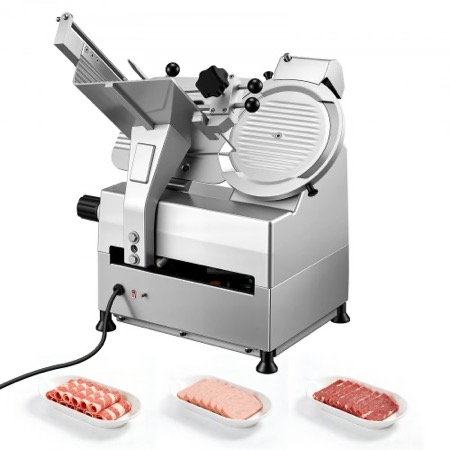
At a glance
- Blade
- 10 in carbon steel
- Motor
- 550 W total
- Speed
- 300 to 450 RPM
- Thickness
- 0 to 0.3 in
5. VEVOR Fully Automatic 10 in Meat Slicer (HC-QP-250B): Best Automatic Slicer for High Volume
Most slicers need someone to push the carriage back and forth for every slice. This VEVOR slicer does it for you. It has two motors: a 180 watt feeding motor that moves the carriage and a 370 watt blade motor, 550 watts in total. Load the food, switch on the feed, and it slices hands-free at up to 450 RPM while you stack or prep.
The 10 inch blade is 75Cr1 carbon steel, and a built-in sharpening stone keeps it keen. A 7.68 inch wide loading platform takes larger cuts, and separate feeding and blade switches plus an emergency stop give you control. The body is aluminum alloy with Q235 steel, on non-slip rubber feet.
Thickness adjusts from paper-thin to 0.3 inch (7 mm), so this is a machine for thin slicing: deli meats, bacon, prosciutto, hot pot and shabu-shabu cuts, and cold cut platters. It is aimed at delis, restaurants, caterers and home charcuterie makers who slice a lot at once. VEVOR does not list its weight.
Key Features
- Model HC-QP-250B, fully automatic
- 180 W feed motor plus 370 W blade motor (550 W total)
- 300 to 450 RPM
- 10 in 75Cr1 carbon steel blade, built-in sharpening stone
- Thickness 0 to 0.3 in (0 to 7 mm)
- 7.68 in wide loading platform
- Feed switch, blade switch, emergency stop
- Aluminum alloy and Q235 steel body, rubber feet
What We Like
- Hands-free automatic slicing
- Two motors for steady feeding
- Emergency stop
- Sharpening stone built in
- Great for thin, uniform slices
What We Don’t Like
- It slices only up to 0.3 in (7 mm) thick, so it is not for steaks or thick-cut portions.
Overall
The pick for high-volume thin slicing. If you make deli trays, bacon or charcuterie in quantity, the automatic feed saves hours. For thicker cuts or occasional home use, a manual-feed slicer is the better fit.
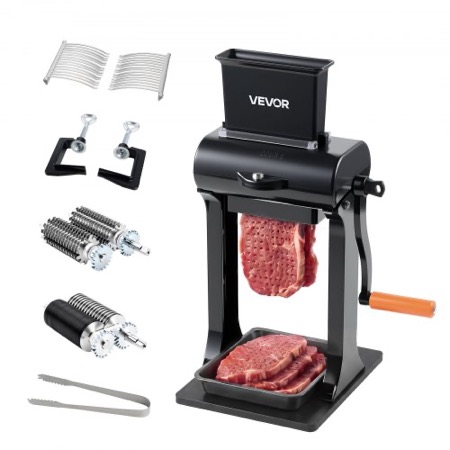
At a glance
- Blade
- Jerky and tenderizer blade sets
- Motor
- Hand crank
- Speed
- Manual
- Thickness
- Fixed by blade set
6. VEVOR 2-in-1 Manual Meat Tenderizer and Jerky Slicer (1A-MT113): Best for Jerky Makers
Jerky makers have different needs. Instead of single slices from a roast, you want a pile of evenly cut strips that dry at the same rate. This VEVOR hand-crank machine does two jobs: one blade set tenderizes steaks and cutlets, and the second set cuts meat into jerky strips. You swap the blade sets to switch modes.
The feed opening measures 5.83 x 1.97 inches, wide enough for steaks, pork chops and chicken breasts without pre-cutting. VEVOR lists 31 stainless steel blades and stainless steel gears inside a die-cast aluminum housing, with clamps that hold it to the edge of a counter or table while you crank.
Because it is manual, there is no motor to wear out and nothing to plug in, which makes it easy to use at a hunting camp or on a processing day in the garage. It weighs 10.6 pounds. Slice thickness is set by the blade set rather than a dial, so pick this if you want consistent jerky strips rather than adjustable slices.
Key Features
- Model 1A-MT113, manual 2-in-1
- Tenderizer blade set and jerky slicer blade set
- 31 stainless steel blades, stainless steel gears
- Feed opening 5.83 x 1.97 in
- Die-cast aluminum, stainless steel and ABS
- Counter clamps, hand crank
- No power needed
- 10.6 lb
What We Like
- Even jerky strips every time
- Also tenderizes steaks and cutlets
- No electricity needed
- Clamps to any sturdy edge
- Simple, durable build
What We Don’t Like
- Slice thickness is fixed by the blade set, and meat must fit the 5.83 x 1.97 in opening.
Overall
The best tool for jerky makers and hunters. It turns out uniform strips that dry evenly and doubles as a tenderizer, all without power. Pair it with an electric slicer if you also want deli slices.
Side-by-Side Comparison
| Slicer | Blade | Motor | Speed | Thickness | Feed | Weight | Price |
|---|---|---|---|---|---|---|---|
| 1. VEVOR 8.6 in (SL-5239M12C) | 8.6 in stainless, serrated + smooth | 200 W | 70 to 100 RPM | 0 to 0.6 in | Manual | 13.92 lb | Check price |
| 2. VEVOR 6.7 in (SL-517) | 6.7 in stainless, serrated + smooth | 150 W | 65 to 90 RPM | 0 to 0.6 in | Manual | 6.94 lb | Check price |
| 3. VEVOR 10 in (SY-250JA) | 10 in carbon steel | 300 W | 300 to 450 RPM | 0 to 0.47 in | Manual | 24.91 lb | Check price |
| 4. VEVOR 12 in (SY-300A) | 12 in carbon steel | 400 W | 300 to 450 RPM | 0 to 0.6 in | Manual | 45.42 lb | Check price |
| 5. VEVOR Automatic (HC-QP-250B) | 10 in carbon steel | 550 W total | 300 to 450 RPM | 0 to 0.3 in | Automatic | Not stated | Check price |
| 6. VEVOR 2-in-1 (1A-MT113) | Jerky and tenderizer blade sets | Hand crank | Manual | Fixed by blade set | Manual crank | 10.6 lb | Check price |
Specs come from VEVOR.
How to Choose a Meat Slicer for Home Use
Blade size
Blade diameter sets how big a piece of food you can slice. A 6 to 7 inch blade suits small kitchens and occasional deli meat and cheese. An 8 to 9 inch blade is the sweet spot for most homes, handling roasts and holiday hams. Ten inch blades are for serious home use, hunting season and light commercial work, and 12 inches is the standard for delis and butcher shops.
Serrated or smooth blade?
A smooth blade gives the cleanest cut on cooked and cured meats and cheese. A serrated blade grips crusty bread, firm vegetables and partly frozen meat. Home slicers that include both, like the two VEVOR home models here, let you switch depending on the job.
Stainless or carbon steel?
Stainless steel blades resist rust and are easy to care for, which suits home use. Carbon steel blades, common on commercial slicers, hold a sharp edge longer but should be dried after cleaning. A built-in sharpener, found on the 10 and 12 inch picks, makes keeping any blade sharp much easier.
Motor and speed
Home slicers turn the blade slowly, around 65 to 100 RPM, which is controlled and safe for occasional use. Commercial slicers spin at 300 RPM and up, cutting faster and handling frozen meat better, and their motors are built for longer runs. If you slice for more than a few minutes at a time, a commercial-speed machine is worth it.
Thickness range
Most slicers here go from paper-thin to about 0.5 to 0.6 inch, enough for deli slices, sandwich cuts and thick bacon. Check the maximum if you want thick steaks or chops; the automatic slicer here tops out at 0.3 inch.
Safety and cleaning
- Blade guards and food pushers keep fingers away from the edge. Always use the pusher, even for the last bit of a roast.
- Power locks that need two buttons prevent accidental starts.
- Suction or rubber feet stop the slicer moving on the counter.
- Removable parts make it possible to clean properly after raw meat. Look for a removable blade, carriage and pusher.
- Safety certification such as ETL or UL shows the machine meets North American electrical standards. Several picks here list ETL.
Tips for Better Slicing
- Chill or partly freeze the meat. Thirty minutes to an hour in the freezer firms meat up for thinner, cleaner slices.
- Never slice through bone. Slicers are for boneless meat, cheese, bread and produce. Remove bones first.
- Let the blade do the work. Push the carriage at a steady pace; forcing it strains the motor and gives ragged slices.
- Unplug before cleaning. Remove the blade carefully, wash parts in warm soapy water, dry them fully, and wear cut-resistant gloves when handling the blade.
- Store meat right away. Pair your slicer with an industrial vacuum sealer so sliced meat keeps well in the fridge or freezer.
- Give it a stable home. A heavy duty kitchen island cart makes a good dedicated station for a heavy slicer.
A Scenario Worth Knowing About
Picture someone who buys a compact slicer the week before a holiday dinner, planning to slice a whole bone-in ham at the table. On the day, the ham is too tall to fit the small carriage, and the bone runs right through the middle. They try to slice around it, the blade catches the bone and stalls, and the ham ends up carved by hand anyway.
Two things would have made it easy. A slicer with an 8 to 10 inch blade has room for a large ham or roast, and taking the meat off the bone first, then slicing the boneless pieces, keeps the blade clear. The same thinking applies to hunting season: bone out the meat, chill it, and run it through the slicer for steaks, roasts or jerky, then grind the trim in a heavy duty meat grinder. For more gear, see our kitchen equipment guides.
Frequently Asked Questions
What size meat slicer do I need for home use?
For most homes, an 8 to 9 inch blade is ideal. Choose a 6 to 7 inch slicer if space is very tight, and a 10 inch slicer if you slice a lot, process game, or work with frozen meat often.
Can a meat slicer cut frozen meat?
Partly frozen meat, yes; it actually slices better. Rock-hard frozen meat is tough on any slicer, especially home models. Commercial slicers with faster blades handle firm, frozen meat better than slow home units.
Can I slice cheese and bread with a meat slicer?
Yes. A smooth blade works well on cheese, and a serrated blade handles bread. Clean the blade between foods.
How do I slice jerky?
Partly freeze the meat, then slice it evenly so all the strips dry at the same rate. A manual jerky slicer like the VEVOR 2-in-1 gives uniform strips, or set an electric slicer to a consistent thickness.
Are carbon steel slicer blades worth it?
For heavy use, yes. Carbon steel holds an edge longer, and the commercial slicers here include built-in sharpeners. Dry the blade after washing to prevent rust.
Is an automatic meat slicer worth it?
Only if you slice in volume. An automatic slicer feeds the food for you, which saves real time for delis, caterers and big charcuterie batches. For home cooking, a manual-feed slicer is simpler and more flexible.
The Bottom Line
For most homes, the VEVOR 8.6 inch two-blade slicer is the best meat slicer for home use: big enough for roasts and ham, with serrated and smooth blades, a full thickness range and easy cleaning. If space is tight, the 6.7 inch compact model folds into a drawer.
Serious home cooks and hunters should step up to the 10 inch commercial slicer for its speed and built-in sharpener, and small delis or butchers will want the 12 inch model. Choose the automatic slicer for high-volume thin slicing, and the manual 2-in-1 if jerky is your main goal. Whatever you buy, chill the meat, keep bones out, and always use the pusher.