A wet carpet has about a day or two before it starts to smell, and not much longer before the pad underneath becomes a mold problem. A household box fan pointed at the floor will not win that race. What you need is a heavy duty carpet dryer, the low, snail-shaped air mover that restoration crews line up along walls after a flood, because it pushes a fast sheet of air flat across the floor instead of blowing it around the room.
We rebuilt this guide around the air movers sold through Lasko, which includes Lasko’s own models and its BlueDri restoration line. The six picks run from an 8.4 lb mini unit for a closet or bathroom up to a 1 HP, 4,050 CFM machine for a flooded basement. Everything here comes from the manufacturer’s specs and listing details, not from hands-on testing, and we will add more brands to this page as we review them.
Two numbers matter most when you compare carpet dryers: CFM, which tells you how much air the unit moves, and amps, which tells you how many you can run on one circuit. We cover both, plus how many units a wet room needs, in the buying guide below the reviews.
Our Quick Picks
Best Overall
Top pick
BlueDri Super Monsoon 1 HP Air Mover: Most Powerful
1 HP · 4,050 · 10
Check Price at LaskoRead the reviewBest Classic Restoration Unit
Best Low-Amp Unit for Running Several: BlueDri Max Storm 25 1/4 HP Air MoverBest for Homeowners: Lasko Super Fan Max Air MoverBest Mini Air Mover: BlueDri ONE-15 Mini Air MoverCompare all 6 side by side
Best Heavy Duty Carpet Dryers: Full Reviews
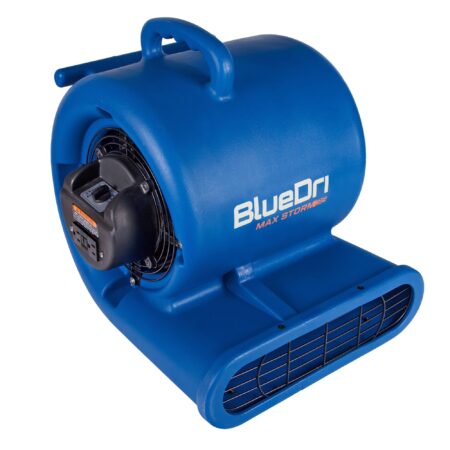
1. BlueDri Max Storm 35 1/3 HP Air Mover: Best Overall
The Max Storm 35 is the pick that balances airflow against power draw better than anything else here. BlueDri rates it at 2,900 CFM from a 1/3 HP motor, while it draws only 2.0 to 3.3 amps depending on speed. That is more air than the 1/2 HP Monsoon below for less current, which matters the moment you want to run more than one unit on a household circuit.
It is built for exactly that. A GFCI daisy-chain port lets you power up to five units in a line, there are two built-in outlets for other tools, and the 25 foot cord reaches a long way from the wall outlet. The head sits at 0, 45 or 90 degrees, so you can blow flat across a carpet, angle into a wall cavity or point straight up to dry a ceiling patch.
The housing is roto-molded polyethylene that BlueDri says is drop tested, and the unit carries a C-ETL-US listing along with a grounded plug and built-in circuit breaker. It measures 17.3 x 16 x 18 inches and weighs about 26 lb, with a built-in handle and cord wrap for carrying between rooms.
Key Features
- Rated airflow of 2,900 CFM
- 1/3 HP motor drawing 2.0 to 3.3 amps
- Three speeds
- Head positions at 0, 45 and 90 degrees
- GFCI daisy-chain port for up to 5 units, plus 2 outlets
- 25 foot power cord with cord wrap
- Roto-molded housing, circuit breaker, C-ETL-US listed
What We Like
- Best airflow per amp in this guide
- Daisy chaining makes multi-unit setups tidy
- Long cord reaches across large rooms
- Three drying angles cover floors, walls and ceilings
- Tough housing built for restoration work
What We Don’t Like
- At about 26 lb and 18 inches tall it is bulky to carry up and down stairs.
Overall
If you are drying more than a small spill, start here. The Max Storm 35 moves serious air, runs in groups without tripping breakers as easily as bigger motors, and has the features restoration crews expect.
VEVOR Black Friday Pre-Sale
Up to 50% off, plus an extra 8% with code VVOTD (Nov 9 to Nov 18).
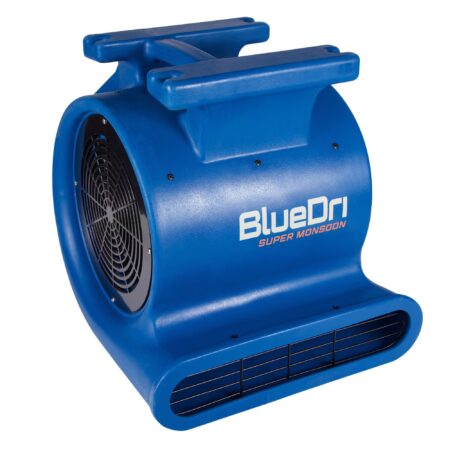
2. BlueDri Super Monsoon 1 HP Air Mover: Most Powerful
The Super Monsoon is the biggest air mover in the lineup: a 1 HP motor rated at 4,050 CFM across three speeds. It is meant for the jobs where you need to move a lot of air fast, like a flooded basement, a large commercial floor or a warehouse that has to be dry before the next shift.
That power has a price on the electrical side. Lasko lists the unit at 10 amps, so on a typical 15 amp household circuit it should run more or less on its own. Its listing also does not mention the outlets or daisy-chain port of the Max Storm models, and the cord is 15 feet rather than 25. In return you get the same 0, 45 and 90 degree head positions and a housing that stacks up to three units for storage and transport.
Construction follows the rest of the BlueDri line, with roto-molded polyethylene housing that is drop tested for job sites, a recessed switch designed to resist water exposure and a C-ETL-US listing. It measures 19.5 x 21 x 21 inches and weighs 36 lb, so it is the heaviest unit on this page by a clear margin.
Key Features
- Rated airflow of 4,050 CFM
- 1 HP motor, 10 amp draw
- Three speeds
- Head positions at 0, 45 and 90 degrees
- Stacks up to 3 units
- 15 foot cord and built-in handle
- Recessed water-resistant switch, C-ETL-US listed
What We Like
- The most airflow of any pick here
- One unit can do the work of two smaller ones
- Stackable for storage between jobs
- Recessed switch suits wet job sites
- Same versatile drying angles as the smaller units
What We Don’t Like
- The 10 amp draw means you can rarely run more than one on a household circuit.
Overall
Choose the Super Monsoon when raw airflow matters more than flexibility, such as one big wet room with its own circuit. For spreading air across several rooms, two Max Storm 35 units are usually the smarter setup.
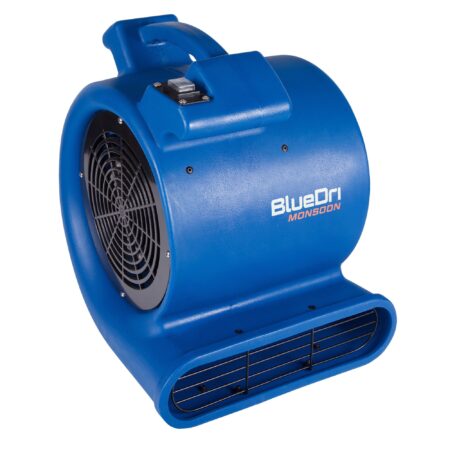
3. BlueDri Monsoon 1/2 HP Air Mover: Best Classic Restoration Unit
The Monsoon is the traditional restoration air mover: a 1/2 HP motor, two speeds and a rated 2,550 CFM in a housing that stacks three high. It is the kind of unit you see lined up along walls after a burst pipe, and it does that job without fuss.
The head sets at 0, 45 or 90 degrees, and there are two built-in outlets plus a 25 foot cord. Lasko lists a 5 amp draw, which is more than the Max Storm 35 pulls for less rated airflow, so the Monsoon is the better buy mainly if you want a straightforward two-speed control or are matching units you already own.
It measures 16 x 16.5 x 19.5 inches and has a built-in ergonomic handle and cord wrap. The roto-molded housing is drop tested, the switch is recessed against water and the unit is C-ETL-US listed for restoration and remediation work.
Key Features
- Rated airflow of 2,550 CFM
- 1/2 HP motor, 5 amp draw
- Two speeds
- Head positions at 0, 45 and 90 degrees
- Two built-in outlets
- 25 foot cord with cord wrap
- Stacks up to 3 units, C-ETL-US listed
What We Like
- Proven restoration-style design
- Long cord and built-in outlets
- Stacks neatly for storage
- Simple two-speed control
- Recessed switch for wet environments
What We Don’t Like
- It draws more current than the Max Storm 35 while moving less rated air.
Overall
The Monsoon is a dependable workhorse, but on paper the Max Storm 35 does more with less power. Buy the Monsoon if you prefer its simpler controls or want to match an existing fleet.
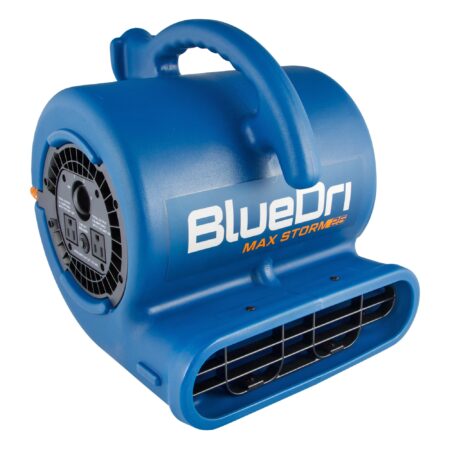
4. BlueDri Max Storm 25 1/4 HP Air Mover: Best Low-Amp Unit for Running Several
The Max Storm 25 is the unit to buy in multiples. It draws just 1.7 amps for a rated 900 CFM, so you can line several up along a wet hallway or around a room without pushing a household circuit hard. Like its bigger sibling, it has a GFCI port for daisy chaining up to five units and two built-in outlets.
It is also the easiest full-feature unit to carry. At 13.6 x 13.8 x 13 inches and 13.2 lb, it fits under a sink, inside a closet or in a crawl space where a larger air mover would not, and the units stack for storage. Three speeds and the usual 0, 45 and 90 degree head positions let you aim it at floors, walls and cabinet bases.
Electrical protection includes a grounded plug, built-in circuit breaker and C-ETL-US listing, and the housing is roto-molded polyethylene. The one real compromise is reach: the cord is 10 feet, so in big rooms you will be leaning on the daisy chain or a good extension cord.
Key Features
- Rated airflow of 900 CFM
- 1/4 HP motor, 1.7 amp draw
- Three speeds
- Head positions at 0, 45 and 90 degrees
- GFCI daisy-chain port for up to 5 units, plus 2 outlets
- 13.2 lb, 13.6 x 13.8 x 13 inches
- Circuit breaker and C-ETL-US listing
What We Like
- Very low power draw per unit
- Daisy chain up to five on one outlet
- Small enough for closets and crawl spaces
- Light enough to carry several at once
- Stacks for storage
What We Don’t Like
- The 10 foot cord is short for large rooms.
Overall
For drying a whole floor of a house, a set of Max Storm 25 units spread around the space often works better than one big blower. They are light, efficient and built to run together.
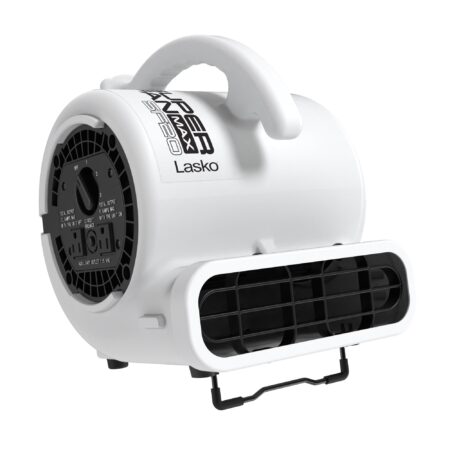
5. Lasko Super Fan Max Air Mover: Best for Homeowners
If you want one air mover in the garage for the next spill, leak or freshly mopped floor, the Lasko Super Fan Max is the most homeowner-friendly unit here. It is rated at up to 600 CFM, offers three speeds, and has a pivoting blower head with four angles plus a foldable stand.
It weighs 10.4 lb and measures 13 x 11.2 x 11.8 inches, so it sits easily on a shelf and carries with one hand using the ergonomic grip. Two 115 volt outlets let you connect up to three fans, the 10 foot cord has an integrated wrap, and a built-in circuit breaker with a reset button guards against overloads. Lasko lists a draw of 1.21 to 1.47 amps.
The housing is roto-molded and impact resistant, and Lasko describes it as commercial grade for garages, basements and job sites. At the time of writing, only the white version showed as available on Lasko’s site, with the black one out of stock.
Key Features
- Up to 600 CFM
- Three speeds
- Pivoting head with four angles and foldable stand
- Two outlets to connect up to 3 fans
- Circuit breaker with reset button
- 10 foot cord with integrated wrap
- 10.4 lb, 1.21 to 1.47 amp draw
What We Like
- Easy to store and grab for small jobs
- Four angles plus a foldable stand
- Overload protection with a reset button
- Can power two more fans
- Low power draw
What We Don’t Like
- Only the white version was in stock on Lasko’s site when we checked.
Overall
For homeowners who want a capable air mover on hand rather than a restoration fleet, the Super Fan Max is the sensible choice. It is light, versatile and protected against overloads.
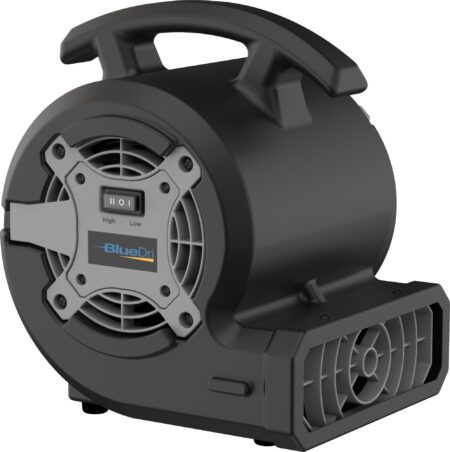
6. BlueDri ONE-15 Mini Air Mover: Best Mini Air Mover
The ONE-15 is the smallest air mover in this guide at 8.4 lb and 12.7 x 11.4 x 9.7 inches. BlueDri still rates it at 600 CFM from a 1/8 HP motor, with two speeds and head positions at 0, 45 and 90 degrees.
It is the right tool for small, tight wet spots: a bathroom floor after a toilet overflow, a closet carpet, the toe kick under a kitchen cabinet or the floor of a camper. Non-slip rubber feet keep it planted on smooth floors, and at 1.3 amps and 150 watts it uses very little power, so you can leave it running for a long stretch without much on the electric bill.
The housing is impact-resistant roto-molded plastic and the unit is C-ETL-US certified. Its listing does not mention built-in outlets or daisy chaining, so treat it as a standalone dryer rather than part of a linked set.
Key Features
- Rated airflow of 600 CFM
- 1/8 HP motor, 1.3 amps, 150 watts
- Two speeds
- Head positions at 0, 45 and 90 degrees
- 8.4 lb, 12.7 x 11.4 x 9.7 inches
- Non-slip rubber feet
- Roto-molded housing, C-ETL-US certified
What We Like
- Lightest and smallest unit here
- Very low power use for long runs
- Fits closets, bathrooms and cabinet bases
- Stable on smooth floors
- Three useful drying angles
What We Don’t Like
- No outlets or daisy chaining are listed, so each unit needs its own plug.
Overall
Keep a ONE-15 for small spills and tight spaces. It will not dry a basement, but it is the easiest air mover here to carry, store and leave running.
Side-by-Side Comparison
| Model | Motor | Rated CFM | Amps | Speeds | Linking | Weight | Price |
|---|---|---|---|---|---|---|---|
| BlueDri Max Storm 35 | 1/3 HP | 2,900 | 2.0 to 3.3 | 3 | Daisy chain up to 5 | About 26 lb | Check price |
| BlueDri Super Monsoon | 1 HP | 4,050 | 10 | 3 | Stacks up to 3 | 36 lb | Check price |
| BlueDri Monsoon | 1/2 HP | 2,550 | 5 | 2 | 2 outlets | See note | Check price |
| BlueDri Max Storm 25 | 1/4 HP | 900 | 1.7 | 3 | Daisy chain up to 5 | 13.2 lb | Check price |
| Lasko Super Fan Max | Not listed | 600 | 1.21 to 1.47 | 3 | Connect up to 3 | 10.4 lb | Check price |
| BlueDri ONE-15 | 1/8 HP | 600 | 1.3 | 2 | Not listed | 8.4 lb | Check price |
Specs come from Lasko’s US product listings at the time of writing. The Monsoon’s listing gives two different weights, so we have left that figure out.
Air Mover vs Floor Fan: Why the Shape Matters
A regular floor fan throws a wide cone of air into the room. Some of it reaches the carpet, most of it does not. An air mover uses a centrifugal blower that pulls air in through the side and forces it out of a narrow, flat outlet near the floor. The result is a fast, concentrated stream that skims across the carpet surface and keeps replacing the damp air sitting on top of the fibers with drier air, which is what speeds up evaporation.
That is also why the angle settings on these units matter. Flat, at 0 degrees, is for floors. Angled at 45 degrees, the air can be aimed into the base of a wall or under a cabinet. Pointed straight up at 90 degrees, it dries a wet ceiling or blows up into a wall cavity. For cooling a garage or workshop rather than drying a surface, a high velocity floor fan is the better tool, and our guide to heavy duty industrial floor fans covers those.
CFM, Amps and How Many Units You Can Run
CFM, or cubic feet per minute, is the volume of air a unit moves. More CFM dries faster, but it usually comes with a bigger motor and a higher current draw. Amps are the practical limit at home. A standard household circuit is rated at 15 amps, and electricians generally recommend keeping a continuous load to about 80 percent of that, around 12 amps. Anything else on the same circuit counts too.
That makes the spec sheets in this guide easy to plan with. The BlueDri Super Monsoon at 10 amps uses most of a circuit on its own. Three Max Storm 35 units at full speed draw about 10 amps between them, and you could run several Max Storm 25 units at 1.7 amps each before getting close. If you are not sure which outlets share a circuit, test by plugging units in one at a time and spread them across rooms.
How Many Air Movers Does a Wet Room Need?
Restoration crews often use a rule of thumb of one air mover for every 10 to 16 feet of wall in a wet room, aimed along the wall so the airflow circles the room in one direction, plus extra units for wet spots in the middle. For a typical 12 x 12 foot bedroom with soaked carpet, that works out to three or four smaller units, or two larger ones placed in opposite corners.
More units help, but only up to the point where the air in the room becomes saturated. That is why professionals pair air movers with a dehumidifier. The air movers pull moisture out of the carpet and into the air, and the dehumidifier pulls it out of the air. Without one, open windows on a dry day or run the home’s air conditioning to carry humidity away.
Drying Wet Carpet: A Practical Order of Work
- Stop the water source and switch off power to any wet outlets or areas before you start.
- Extract as much standing water as you can with a wet-dry vac or extractor. Our guides to heavy duty shop vacuums and industrial carpet cleaners cover the tools for this step.
- Lift the carpet edge if the pad is soaked. Wet pad dries slowly and is often cheaper to replace than to save.
- Set air movers flat or slightly angled, pointing along the walls in a circular pattern, and add a dehumidifier if you have one.
- Run them around the clock and check moisture daily. Most carpets need two to three days of continuous drying.
- Clean and disinfect if the water was from a sewer backup or flood, and call a professional for anything involving contaminated water.
The EPA advises drying water-damaged materials within 24 to 48 hours to help prevent mold growth, which is why getting air movers running quickly matters so much. Use grounded outlets, keep cords off wet floors where possible, and if you need extra reach, use a properly rated heavy duty extension cord rather than a light household one.
A Scenario Worth Knowing About
Picture a finished basement after a sump pump struggled through a heavy storm. The homeowner buys the most powerful air mover available, sets it up and plugs it into the nearest outlet. Twenty minutes later the breaker trips. That outlet shares a circuit with the sump pump, and now the pump is off too while the ground is still wet.
This is exactly the situation where amps matter more than CFM. A 10 amp unit like the Super Monsoon plus a sump pump can be too much for one 15 amp circuit. Before you plug in, find out which outlets share the pump’s circuit and keep air movers off it. If the outlets are limited, a few low-draw units such as the Max Storm 25 or Max Storm 35 spread across separate circuits can dry the room just as well without risking the pump.
Frequently Asked Questions
How long does it take to dry carpet with an air mover?
Most wet carpets dry in about 24 to 72 hours with air movers running continuously, depending on how wet the pad is, room humidity and how many units you use. Pairing them with a dehumidifier shortens the time.
Can I use a regular box fan to dry carpet?
A box fan helps a little, but it spreads air across the room instead of pushing it across the carpet surface. An air mover’s low, concentrated airflow dries carpet much faster.
How many CFM do I need to dry a room?
There is no single number, but more total CFM spread around the room dries faster. For a typical bedroom, two to four units totaling a few thousand CFM, placed along the walls, is a common setup.
Is it safe to leave an air mover running overnight?
Air movers are designed for continuous operation, and the units in this guide include features such as circuit breakers and ETL listings. Keep cords away from standing water, use grounded outlets and avoid overloading a circuit.
What does daisy chaining mean on an air mover?
Daisy chaining lets you plug one unit into the outlet on another, so several air movers run from a single wall outlet. The Max Storm 25 and 35 support up to five units this way, but the total current still has to stay within the circuit’s limit.
Should I use air movers with a dehumidifier?
Yes, whenever you can. Air movers lift moisture into the air, and a dehumidifier removes it. Without that, humidity builds up in a closed room and drying slows down.
The Bottom Line
For most drying jobs, the BlueDri Max Storm 35 is the carpet dryer to buy. It moves 2,900 CFM on a modest current draw, links up to five units together and has the long cord and drying angles real water damage calls for. The Super Monsoon is the choice for one big room with its own circuit, and the Max Storm 25 is the one to buy in multiples.
Homeowners who just want a reliable air mover on hand should look at the Lasko Super Fan Max, and the BlueDri ONE-15 covers small spills and tight spaces. Whichever you pick, start drying quickly, watch your circuits and add a dehumidifier if you can.