
Most people buy their first welder because of one specific job. A cracked mower deck. A rusted-out floor pan. A trailer tongue that needs a gusset, or a gate that keeps sagging no matter how many hinges you throw at it. You can pay a shop to fix it, or you can spend about the same money on a machine and fix the next twenty things yourself.
For that kind of work, the best MIG welder is the one that matches your power outlet, the metal you actually weld and whether you want to deal with a gas bottle. MIG is the easiest process to learn: you pull the trigger, wire feeds out of the gun, and the machine handles most of the hard part. Modern inverter machines also weigh a fraction of what the old transformer boxes did and run on a regular household outlet.
We picked six VEVOR MIG welders, from a 12 lb gasless starter to a 250 amp pulse machine that handles aluminum with the right gun. We worked from VEVOR’s published specs, buyer feedback and general welding know-how, and gave each one a clear job so you can skip straight to the one that fits.
Guide Navigation Table of Contents
Our Quick Picks
- Best overall: VEVOR MIG-200 4-in-1 (200A)
- Best budget flux core welder: VEVOR MIG130 Gasless (130A)
- Best 120V starter that grows into gas: VEVOR MIG130G 2-in-1 (130A)
- Best for the money: VEVOR MIG160D 4-in-1 (160A)
- Best for aluminum: VEVOR MIG-200AU Pulse 5-in-1 (200A)
- Most power for thick steel: VEVOR MIG-250 Pulse 5-in-1 (250A)
Best MIG Welders: Full Reviews
1. VEVOR MIG-200 4-in-1 MIG Welder (200A): Best Overall
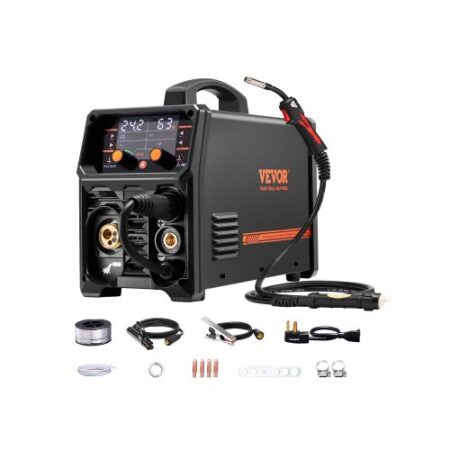
If you only buy one welder for a home garage, this is the sweet spot. It does gas MIG, gasless flux core, stick and lift TIG from one box, runs on 110V or 220V with the included adapter, and tops out at 200 amps, enough for VEVOR to rate it at up to 15 mm (about 0.59 inch) of steel on 220V.
The control is synergic, which means you pick the wire size and the machine matches wire speed to voltage for you. That’s the feature that makes a beginner’s first beads look like beads instead of bird droppings, and you can still fine-tune it once you know what you’re doing. It takes both 1 kg and 5 kg (11 lb) spools of 0.030 or 0.035 inch wire, so you’re not swapping small rolls every hour on a big project.
It’s a compact 16.9 by 7.1 by 12.6 inches and 27.3 lb with accessories. It comes with a gas hose but no regulator, and the lift TIG torch is sold separately. Buyers rate it 4.4 stars across about 690 reviews; the recurring complaints are short cables and thin instructions, not weld quality. One reviewer who hadn’t welded in decades had a broken mower deck fixed within half an hour of unboxing.
Key Features
- 200A output, up to 15 mm steel on 220V
- Gas MIG, flux core, stick and lift TIG
- 110V/220V dual voltage with adapter
- Synergic control with 2T and 4T modes
- Takes 1 kg and 5 kg (11 lb) spools
- 0.030 and 0.035 in wire
- 27.3 lb with accessories, model MIG-200
What We Like
- Enough power for trailers, frames and farm repairs on 220V
- Still useful on a regular 110V outlet for sheet metal
- Synergic setup shortens the learning curve
- Big spool capacity for long sessions
- Stick mode for dirty or outdoor work
What We Don’t Like
- It can’t weld aluminum, and VEVOR confirms that on the listing, so step up to the pulse models if that matters.
Overall
For mild and stainless steel at home, this is the one we’d buy. It covers almost every process a hobbyist uses and has enough headroom that you won’t outgrow it in a year.
2. VEVOR MIG130 Gasless Flux Core Welder (130A): Best Budget Flux Core Welder
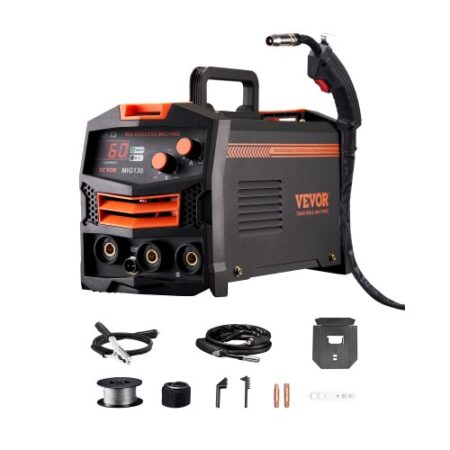
Not everyone needs four processes. If your plan is to fix a fence, patch a trailer, build a few brackets and weld outside without fighting the wind, a gasless flux core machine is the simplest way in. There’s no bottle, no regulator and nothing to blow away your shielding gas on a breezy day.
This one plugs into a standard 110V outlet, and VEVOR says it runs fine on a 20 amp breaker. It puts out up to 130 amps, takes 1 kg spools of 0.030 or 0.035 inch flux core wire, and VEVOR rates it for steel up to 8 mm. At 12.4 lb and roughly the size of a shoebox, it comes with a shoulder strap and fits in a truck toolbox.
It’s rated 4.4 stars across about 670 reviews. One buyer burned almost a full 2 lb roll in a weekend patching rust holes with 18 gauge sheet and called the welds great; others mention short cables and thin instructions. Keep expectations realistic: flux core leaves slag you’ll chip and brush off, and it’s not the tidiest process for show-quality bodywork.
Key Features
- 130A gasless flux core MIG
- Runs on 110V, 20A circuit
- Up to 8 mm steel (VEVOR rating)
- 0.030 and 0.035 in flux core wire, 1 kg spools
- Synergic control with digital display
- 12.4 lb, 13 x 6.3 x 9.1 in, shoulder strap
- Model MIG130
What We Like
- No gas bottle to buy, rent or refill
- Works outdoors in a breeze
- Light enough to carry to the job
- Plugs into a normal garage outlet
- Simple controls for a first welder
What We Don’t Like
- Flux core only, so there’s no upgrade path to cleaner gas MIG welds later on.
Overall
For outdoor repairs and farm or yard projects on a tight budget, this does the job. If you think you’ll want cleaner welds on thin sheet metal later, spend a bit more on the 2-in-1 below.
3. VEVOR MIG130G 2-in-1 Gas and Gasless MIG Welder (130A): Best 120V Starter That Grows Into Gas
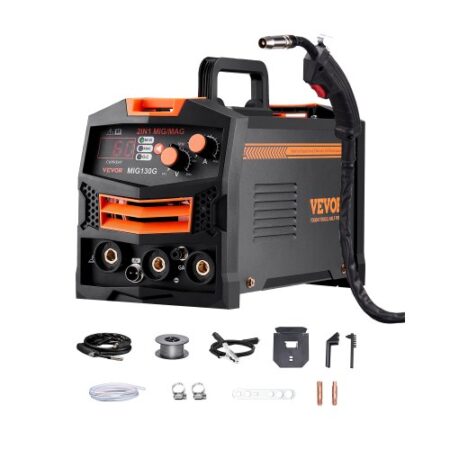
This is the same compact 110V, 130 amp platform as pick #2, with one important difference: it also runs gas-shielded solid wire. Start with flux core while you learn, then add a bottle of 75/25 argon and CO2 when you want cleaner beads with no slag on thin auto body steel.
It takes 1 kg spools of 0.030 or 0.035 inch wire, ships with a 1 lb spool of 0.030 E71T-GS flux core wire, and includes a gas hose, though not a regulator. VEVOR’s spec table lists steel up to 8 mm, while the feature text says 4 mm; for single-pass welds on 110V, plan on the lower number. It weighs 13.9 lb and measures 13 by 6.3 by 9.1 inches.
Buyers rate it 4.4 stars across 700-plus reviews, with one first-time welder using it every weekend for garage shelving and exhaust work. The same notes about short leads and thin manuals apply here as on the rest of VEVOR’s line.
Key Features
- 130A gas MIG and gasless flux core
- 110V plug-in power
- 0.030 and 0.035 in wire, 1 kg spools
- Gas hose included, regulator not included
- Synergic control and digital display
- 13.9 lb with shoulder strap
- Model MIG130G
What We Like
- Room to grow from flux core to gas MIG
- Gas mode gives clean welds on thin sheet metal
- Ships with a starter spool of wire
- Light and easy to store
- Good fit for auto body and garage projects
What We Don’t Like
- You’ll still need to buy a regulator and a gas cylinder before you can use the gas mode.
Overall
For a beginner on 110V who wants both processes without paying for stick and TIG they may never use, this is the smart starting point.
4. VEVOR MIG160D 4-in-1 MIG Welder (160A): Best for the Money
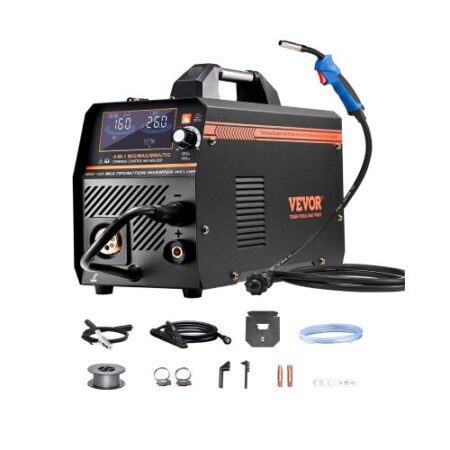
The 160D sits between the little 130 amp machines and the 200 amp flagship, and for a lot of home welders it’s the best value in the lineup. You get the same four processes as pick #1 (gas MIG, flux core, stick and lift TIG), dual 110V/220V input with an adapter, and room for 11 lb spools, at a lighter 24.3 lb.
VEVOR rates it for steel up to 10 mm on 220V, which covers most hobby fabrication: brackets, carts, racks, trailer repairs and exhaust work. Synergic control matches wire speed to voltage, there’s a 2T and 4T trigger mode, and the LCD shows amps, volts and wire speed at a glance. Input draw is listed at 4.3 KVA, the lowest of the multi-process machines here.
One detail worth knowing from VEVOR’s own answers: the drive roll is V-grooved, which suits solid wire, and you’ll want a knurled roll for best feeding with flux core wire. That’s a cheap part, but order it with the welder if you plan to run mostly gasless. The lift TIG torch (a WP-17V style) is sold separately. It’s rated 4.4 stars across 700-plus reviews.
Key Features
- 160A, up to 10 mm steel on 220V
- Gas MIG, flux core, stick and lift TIG
- 110V/220V dual voltage with adapter
- Synergic control, 2T and 4T modes
- Takes 11 lb (5 kg) spools
- 0.030 and 0.035 in wire
- 24.3 lb, model MIG160D
What We Like
- Four processes at a lower price than the 200A
- Lighter than the bigger machines
- Plenty of power for typical garage projects
- Large spool capacity
- Lowest input draw of the multi-process picks
What We Don’t Like
- It ships with a V-groove drive roll, so flux core users should buy a knurled roll for reliable feeding.
Overall
If 200 amps is more than you’ll realistically use, the 160D gives you the same flexibility for less money and less weight. It’s our pick for most home garages that mostly weld 1/4 inch and under.
5. VEVOR MIG-200AU Pulse 5-in-1 MIG Welder (200A): Best for Aluminum
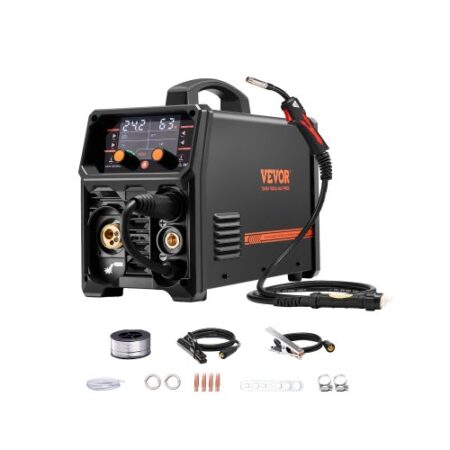
Aluminum is where cheap MIG welders fall apart. It conducts heat fast, burns through easily and the soft wire tends to bird-nest in a standard gun. Pulse MIG helps with the first two problems by switching rapidly between high and low current, so you get penetration without dumping so much heat into the part.
This machine adds pulse MIG to the usual gas MIG, flux core, stick and lift TIG, and it’s set up for aluminum wire in 0.040 and 0.047 inch (1.0 and 1.2 mm) as well as 0.030 and 0.035 inch steel wire. It takes 11 lb spools, runs on 110V or 220V, and VEVOR rates it for material up to 15 mm. It weighs 27.3 lb with accessories.
The catch is the gun. The stock torch is a 15AK-style steel gun, and VEVOR’s own answers say you need a separate aluminum torch (they point to a 24KD-style gun) for aluminum work. Budget for that and for pure argon, since aluminum doesn’t run on the 75/25 mix used for steel. It’s rated 4.4 stars across 700-plus reviews.
Key Features
- 200A with pulse MIG
- Gas MIG, flux core, stick, lift TIG and pulse
- Aluminum wire 0.040 and 0.047 in
- Steel wire 0.030 and 0.035 in
- 11 lb (5 kg) spool capacity
- 110V/220V dual voltage
- 27.3 lb, model MIG-200AU
What We Like
- Pulse mode controls heat on aluminum and thin stainless
- Cleaner beads with less spatter on steel
- Five processes in one compact box
- Large spool capacity
- Runs on either voltage
What We Don’t Like
- Aluminum needs a separate aluminum MIG torch, which isn’t in the box.
Overall
If aluminum is on your list, whether boat parts, trailer fenders or intake piping, this is the one to buy. Just order the right torch and a bottle of argon with it.
6. VEVOR MIG-250 Pulse 5-in-1 MIG Welder (250A): Most Power for Thick Steel
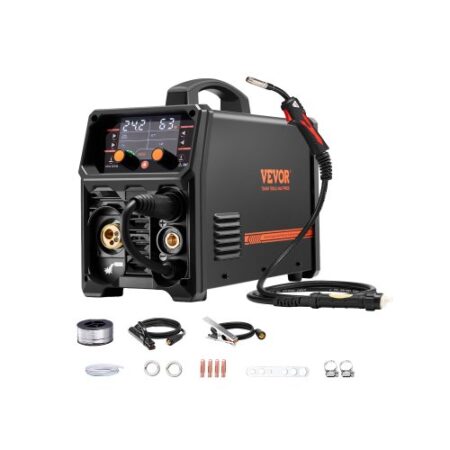
The 250 is the same pulse 5-in-1 platform as pick #5 with more output on top. On 220V that extra 50 amps is what lets you run 0.035 wire hot on 3/8 inch plate and thicker structural work without stacking pass after pass. Input draw climbs to 8.2 KVA, so plan on a proper 240V circuit to get the full benefit.
Specs otherwise match the 200AU: pulse MIG, gas MIG, flux core, stick and lift TIG, aluminum wire support with an aluminum torch, 11 lb spools, 2T and 4T modes, and a 27.3 lb chassis that’s still light enough to carry by the handle. VEVOR rates it for material up to 15 mm.
It’s rated 4.4 stars across about 700 reviews. A beginner who called it his second welder said he’s done half a dozen projects and is growing into it, and another buyer uses it gasless on rocker panels. The common complaint is the short stock gun lead; VEVOR says a longer gun up to 5 meters works, but longer than that can cause feeding trouble.
Key Features
- 250A with pulse MIG
- Gas MIG, flux core, stick, lift TIG and pulse
- Aluminum wire support with aluminum torch
- 11 lb (5 kg) spool capacity
- 110V/220V dual voltage
- 8.2 KVA input
- 27.3 lb, model MIG-250
What We Like
- Most headroom here for thick steel on 220V
- Pulse mode for cleaner welds and thin material
- Still portable at 27 lb
- Room to grow from hobby to light fabrication
- Large spool capacity
What We Don’t Like
- The stock MIG gun lead is short, so you’ll be moving the machine around the project more than you’d like.
Overall
If you work on trailers, equipment and heavy frames, or you just never want to run out of power, buy the 250 and give it a dedicated 240V circuit.
Side-by-Side Comparison
| Welder | Max Output | Processes | Input | Max Thickness | Max Spool | Weight | Aluminum |
|---|---|---|---|---|---|---|---|
| MIG-200 4-in-1 | 200A | Gas MIG, flux, stick, lift TIG | 110V/220V | 15 mm | 11 lb | 27.3 lb | No |
| MIG130 Gasless | 130A | Flux core only | 110V | 8 mm | 2.2 lb | 12.4 lb | No |
| MIG130G 2-in-1 | 130A | Gas MIG, flux | 110V | 4 to 8 mm | 2.2 lb | 13.9 lb | No |
| MIG160D 4-in-1 | 160A | Gas MIG, flux, stick, lift TIG | 110V/220V | 10 mm | 11 lb | 24.3 lb | No |
| MIG-200AU Pulse | 200A | Pulse, gas MIG, flux, stick, lift TIG | 110V/220V | 15 mm | 11 lb | 27.3 lb | With aluminum torch |
| MIG-250 Pulse | 250A | Pulse, gas MIG, flux, stick, lift TIG | 110V/220V | 15 mm | 11 lb | 27.3 lb | With aluminum torch |
Specs are from VEVOR’s US product listings. Maximum thickness assumes 220V input on dual-voltage machines.
Flux Core vs Gas MIG: Which Do You Need?
Both use the same machine and gun; the difference is how the weld puddle is protected from air.
- Flux core (gasless): the wire has flux inside it that burns and shields the weld. No bottle, works outdoors in wind, penetrates well on dirty or rusty steel. The trade-off is more spatter and a slag crust you chip off afterward.
- Gas MIG: solid wire with shielding gas from a cylinder. Cleaner, flatter beads with no slag, and much easier on thin sheet metal. You need a regulator, a cylinder and a sheltered spot, since a breeze blows the gas away.
If most of your welding is outside, start with flux core. If it’s mostly inside a garage on car panels, furniture or thin tubing, you’ll want gas, so buy a machine that does both.
110V vs 220V: How Much Power Do You Need?
A handy rule of thumb is roughly one amp of output for every thousandth of an inch of steel in a single pass, so 1/8 inch steel wants about 125 amps. A 110V machine on a household circuit is happiest from thin sheet up to about 3/16 inch, with thicker joints needing multiple passes and good joint prep. For 1/4 inch and up, you want 220V.
Every dual-voltage pick here gives you both: run on 110V today and plug into a dryer-style 240V outlet when you have one. If you’re running a 110V machine anywhere but right next to the outlet, use a short, heavy-gauge cord, not a long light-duty one. Our guide to heavy-duty extension cords covers gauge and length. For remote repairs, check the surge rating of your portable generator against the welder’s input before you count on it.
What Else You Need to Start Welding
- Auto-darkening helmet: non-negotiable. Don’t use the flip-down shield that sometimes comes in the box for anything more than tacks.
- Gloves and clothing: thick leather work gloves or welding gauntlets, cotton or wool clothing (never synthetics), and leather boots.
- Gas setup for MIG: a regulator and cylinder. 75/25 argon and CO2 is the standard for mild steel; 100% argon for aluminum.
- A steel work surface: a sturdy heavy-duty workbench with a steel top doubles as a ground point.
- Angle grinder and wire wheel: clean, bright metal makes a bigger difference to weld quality than any setting.
- Fire extinguisher: sparks travel farther than you think, so clear out sawdust, rags and anything flammable.
A Scenario Worth Knowing About
You set up a new 110V welder at the far end of the driveway, run it off the 100 ft cord you use for the leaf blower, and start welding a trailer bracket. The wire sputters and stubs into the plate, the arc won’t settle, and after a few inches the breaker in the garage trips. The welder must be defective, right?
Almost certainly not. A long, thin cord drops voltage under a welder’s heavy draw, so the machine sees far less than 120V. Synergic settings that assume a full 120V then feed wire faster than the starved arc can melt it, which is exactly what stubbing looks like, and the extra current through the cord helps trip the breaker.
The fix is to bring the work to the power, not the other way around. Plug in directly, or use the shortest, heaviest cord you own: 10 or 12 gauge and as close to 25 feet as you can manage. Run the welder on a circuit with nothing else on it. If it still trips, the breaker is too small for the machine, and that’s a job for an electrician, not a bigger breaker.
Frequently Asked Questions
What is the best MIG welder for a beginner?
For a beginner on 110V, the MIG130G 2-in-1 is the easiest start: light, simple and able to run both flux core and gas. If you have or plan to add a 240V outlet, the MIG160D gives you far more room to grow for not much more.
Can a 110V MIG welder weld 1/4 inch steel?
It can with good prep and multiple passes, but it’s at the limit of what a 110V machine does well. For regular 1/4 inch work, run a dual-voltage welder on 220V, where it has the amperage to penetrate in fewer passes.
What is the best gas for MIG welding steel?
For mild steel, 75% argon and 25% CO2 (often sold as C25) is the standard: smooth arc, low spatter and good penetration. Straight CO2 is cheaper and penetrates deeper but spatters more. Aluminum needs 100% argon.
Can a MIG welder weld aluminum?
Only with the right setup. You need a machine that supports aluminum wire, ideally with pulse, plus an aluminum gun or spool gun and pure argon. The two pulse picks here support it with a separate aluminum torch; the others don’t.
Do I need gas for a MIG welder?
No, if you run flux core wire, which shields itself. Gas MIG with solid wire gives cleaner welds indoors, but every pick here can weld gasless.
Is MIG or stick better for a home garage?
MIG is faster and easier to learn, and it’s better on thin metal. Stick is better outdoors and on rusty or painted steel. Four of the six picks here do both, so you don’t have to choose.
The Bottom Line
For most home garages, the VEVOR MIG-200 is the best MIG welder to buy: four processes, dual voltage and enough power to grow into. Save some money with the MIG160D if you mostly weld 1/4 inch and under, start small with the MIG130G on 110V, or go gasless with the MIG130 for outdoor repairs. Need aluminum or more power? Look at the MIG-200AU or the MIG-250.
Whichever you pick, buy a good helmet, clean the metal down to bright steel and keep the cord short. Do that and your first real weld will hold, which is more than most people can say about their first welder.