
It’s 18 degrees outside, the truck needs a water pump, and your garage feels exactly like the driveway. An electric heater big enough to matter needs a 240-volt circuit you probably don’t have. A propane torpedo heater will warm the place in minutes, but it also fills the air with fumes and moisture until every tool in the room is sweating.
That’s why so many people with shops, pole barns, RVs, and ice-fishing shacks have switched to a diesel garage heater. These little air heaters burn fuel in a sealed chamber, send the exhaust outside through a pipe, and blow clean, dry heat into the room. They sip roughly a gallon of diesel on a long night and run on about the same 12-volt power as a car stereo once they’re lit.
VEVOR sells more of these than almost anyone in the US, and its lineup covers everything from a 2kW unit for a camper van to an 8kW portable you can roll into a two-car garage. We went through the specs, safety features, and install requirements of the current models to pick the six worth your money, plus what you need to know before you light one.
Guide Navigation Table of Contents
- Our Quick Picks
- Best Diesel Garage Heaters: Full Reviews
- Side-by-Side Comparison
- How a Diesel Air Heater Works (and Why the Heat Feels Different)
- 2kW, 5kW, or 8kW: Which Size Do You Need?
- What Does It Cost to Run a Diesel Heater?
- Diesel Heater Safety: The Non-Negotiables
- A Scenario Worth Knowing About
- Frequently Asked Questions
- The Bottom Line
Our Quick Picks
- Best overall: VEVOR 8kW All-in-One with Bluetooth and Altitude Adjustment (XMZ-D1)
- Best for garages and workshops: VEVOR 8kW Portable with CO Alarm (XMZ-TB20 Pro)
- Best for hunting camps and high altitude: VEVOR 8kW Trolley Diesel Heater (ZM8008)
- Best value 8kW: VEVOR 8kW Portable with Remote (XMZ-TB30)
- Best for vans and small spaces: VEVOR 2kW All-in-One with CO Alarm (ZM2003)
- Best for permanent installs: VEVOR 5kW Split Kit with 10L Tank (WF5001)
Best Diesel Garage Heaters: Full Reviews
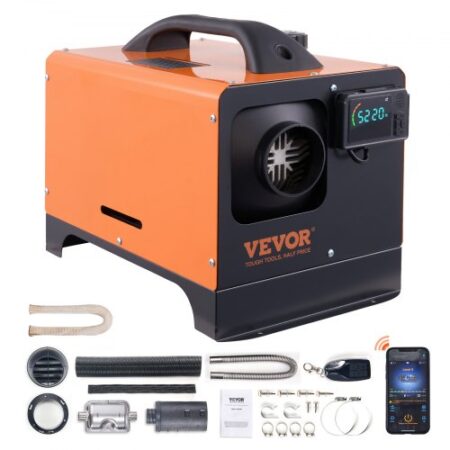
1. VEVOR 8kW All-in-One Diesel Heater with Bluetooth (XMZ-D1): Best Overall
This is the heater that made VEVOR’s name in the diesel heater world, and it’s still the one we’d send most people to. It carries thousands of owner reviews on VEVOR’s US store, which is a track record most of the newer models simply don’t have yet.
Everything lives in one box: the burner, fuel pump, and a 1.3-gallon tank. Set it in the corner of a garage, run the exhaust pipe out through a wall or window panel, plug it in, and it’s heating. You can control it from the LCD panel, the included remote, or VEVOR’s Bluetooth app, which lets you set a target temperature between 46 and 97°F and fire it up before you walk out to the shop.
The feature that sets it apart is automatic altitude compensation. Diesel heaters struggle in thin air because the fuel-to-air ratio gets thrown off, which leads to soot and error codes. This one adjusts itself up to 18,045 feet, so it works the same at a Colorado cabin as it does in an Ohio garage. Fuel use runs 0.16 to 0.62 liters per hour, and VEVOR rates a full tank at up to 8 hours on high.
Key Features
- 8kW heating power, 12V (3A running)
- 1.3 gal / 5 L built-in fuel tank
- 0.16 to 0.62 L/h fuel consumption
- LCD panel, remote control, and Bluetooth app
- Automatic altitude compensation up to 18,045 ft
- Overheat protection at 518°F and voice alerts
- 20.6 lb, 15.7 x 9.8 x 12.2 in
What We Like
- Longest track record of any VEVOR diesel heater
- Altitude compensation is automatic, no menu diving
- Three ways to control it, including from your phone
- Tank size gets you through most of a winter night
- 3-inch outlet works with standard ducting if you want to pipe heat elsewhere
What We Don’t Like
- A built-in CO alarm isn’t listed for this model, so plan on a separate battery CO detector in the space (you should have one anyway).
Overall
For a garage, shop, or cabin where you want proven hardware and don’t need to worry about elevation, the XMZ-D1 is the safest buy in VEVOR’s lineup.
2. VEVOR 8kW Portable Diesel Heater with CO Alarm (XMZ-TB20 Pro): Best for Garages and Workshops
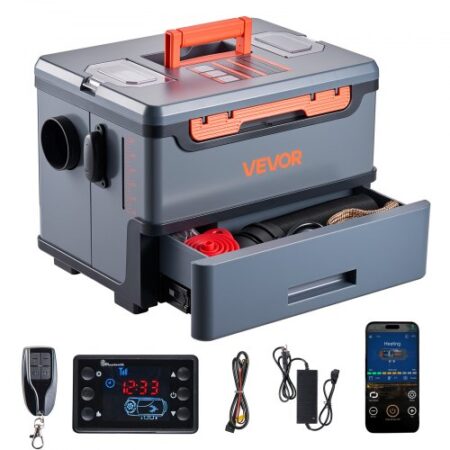
If the heater is going to live in a garage, this is the one we’d pick. It runs on 12V or 24V DC like the others, but it also plugs straight into a regular 110V wall outlet. No battery, no separate power supply, no alligator clips across the workbench.
VEVOR also added the safety features we want in a building where people work: a built-in carbon monoxide alarm, a heat sleeve over the hot exhaust pipe, a sealed fuel cap, plus reverse polarity and overvoltage protection on the control board. Overheat shutoff kicks in at 518°F.
It burns 0.04 to 0.1 gallons per hour with a claimed combustion efficiency above 90%. On the 1.3-gallon tank, that’s about 13 hours at full output and much longer when the thermostat backs it down. The Bluetooth app works from up to 98 feet away, so you can start it from the kitchen and walk into a warm shop.
Key Features
- 8kW, runs on 12V/24V DC or 110V AC
- Built-in CO alarm
- 1.3 gal / 5 L tank, 0.04 to 0.1 gal/h
- Bluetooth app (98 ft range), remote, and LCD
- Exhaust heat sleeve and sealed fuel cap
- Overheat, reverse polarity, and overvoltage protection
- Rated to 9,842 ft, 23.4 lb with accessories
What We Like
- Plugs into a normal wall outlet, no battery needed
- Built-in CO alarm is the right call for a garage
- Heat sleeve on the exhaust pipe cuts burn risk
- 98-foot Bluetooth range reaches from the house
- Very strong owner ratings on VEVOR’s store
What We Don’t Like
- At 23.4 pounds with accessories, it’s the heaviest all-in-one here, so pick a spot and leave it there.
Overall
For a home garage or workshop with a standard outlet, the XMZ-TB20 Pro is the easiest diesel heater to live with and the one we trust most around people.
3. VEVOR 8kW Trolley Diesel Heater (ZM8008): Best for Hunting Camps and High Altitude
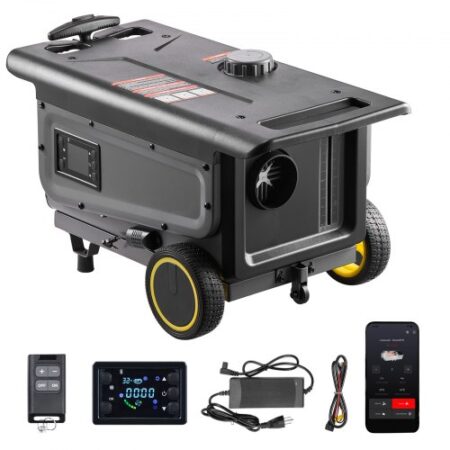
The ZM8008 takes the XMZ-TB20’s feature list and puts it on wheels. A telescoping handle lets you roll it out of the truck bed and across a gravel camp like a carry-on suitcase instead of hauling it by hand.
It’s also the best pick for the mountains. VEVOR built in a high-altitude mode that covers 9,842 to 18,044 feet with a sensor that adjusts fuel and airflow automatically. Elk camp at 10,000 feet, a ski cabin, or a winter trip over the passes are all fair game.
You still get the CO alarm, exhaust heat sleeve, and sealed fuel cap, plus Bluetooth, remote, and LCD control. It runs on 12V/24V DC or 110V AC and burns 0.05 to 0.09 gallons per hour from a 1.3-gallon tank. VEVOR rates it for 215 to 269 square feet.
Key Features
- 8kW, 12V/24V DC or 110V AC
- Telescoping handle and trolley wheels
- High-altitude mode from 9,842 to 18,044 ft
- Built-in CO alarm, heat sleeve, sealed fuel cap
- 1.3 gal tank, 0.05 to 0.09 gal/h
- Bluetooth app, remote, and LCD
- Rated noise ≤75 dB
What We Like
- Rolls instead of carries
- Works in thin mountain air without manual tuning
- Same CO alarm and safety upgrades as the XMZ-TB20 Pro
- Runs from a wall outlet at camp or a battery in the field
- Low fuel burn for long weekends away
What We Don’t Like
- It’s a newer model with a shorter track record than VEVOR’s long-running best sellers.
Overall
If your heater travels to camp, a cabin, or anywhere above 9,800 feet, the ZM8008 is the one to get.
4. VEVOR 8kW Portable Diesel Heater with Remote (XMZ-TB30): Best Value 8kW
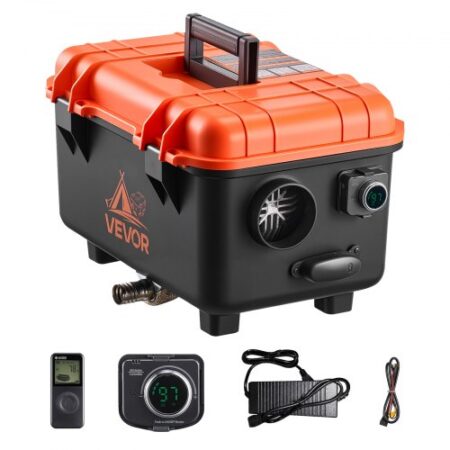
Want full 8kW heat without paying for an app? The XMZ-TB30 keeps the important parts of VEVOR’s newer portables and drops Bluetooth. You still get a CO alarm, exhaust heat sleeve, sealed fuel cap, and overheat shutoff (set at 536°F on this one).
Control is through the LCD panel or a remote that works from up to 98 feet. The thermostat covers the same 46 to 97°F range across 10 levels. Like the TB20 Pro, it runs on 12V/24V DC or a 110V outlet, so it’s just as easy to set up in a garage.
The trade-off is a slightly smaller 1.1-gallon tank. At the 0.04 to 0.1 gallons per hour VEVOR lists, that still covers 11 hours or more, and it’s lighter too at 17.2 pounds with accessories.
Key Features
- 8kW, 12V/24V DC or 110V AC
- Built-in CO alarm, heat sleeve, sealed fuel cap
- 1.1 gal / 4 L tank, 0.04 to 0.1 gal/h
- LCD panel and 98 ft remote, 10-level thermostat
- Overheat shutoff at 536°F
- Rated to 9,842 ft
- 17.2 lb, 16.9 x 11.8 x 10 in
What We Like
- Keeps the CO alarm while trimming cost
- Plugs into a wall outlet like the pricier models
- Lightest 8kW portable on this list
- Simple remote control if you don’t want another app
- Easy to move between the garage and the camper
What We Don’t Like
- No Bluetooth app, so you can’t start it from inside the house.
Overall
If you just want a safe, plug-in 8kW heater for the garage and don’t care about your phone, the XMZ-TB30 is the smart money pick.
5. VEVOR 2kW All-in-One Diesel Heater with CO Alarm (ZM2003): Best for Vans and Small Spaces
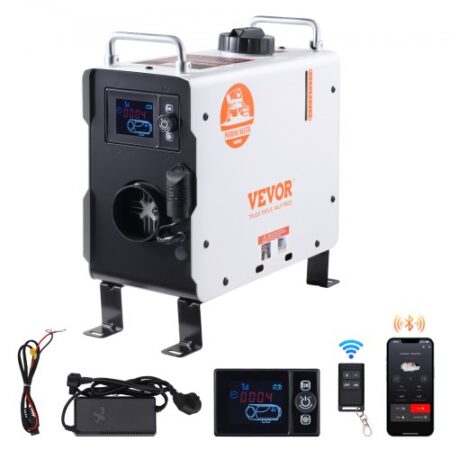
Bigger isn’t better in a small space. An 8kW heater in a camper van spends most of its time cycling on and off, which is noisy and leads to carbon buildup. A 2kW unit runs steadily at a comfortable level, and that’s exactly what this one is for.
It’s a compact all-in-one with a 2-liter tank, a CO alarm that warns at 300 ppm and shuts the heater down at 500 ppm, a leak-proof fuel cap, a fuel level indicator, and overheat protection. You get all three control options: Bluetooth app, remote, and display panel.
It comes with two wiring options, a direct 12V lead and an adapter for wall power, so it works off a vehicle battery, a household outlet, or a portable power station. Fuel use is 0.18 to 0.35 liters per hour, and the whole kit weighs 15.7 pounds.
Key Features
- 2kW, 12V/24V DC plus wall adapter
- CO alarm: warns at 300 ppm, shuts off at 500 ppm
- 2 L built-in tank with fuel level indicator
- 0.18 to 0.35 L/h fuel consumption
- Bluetooth app, remote, and display panel
- Rated to 9,842 ft
- 15.7 lb with accessories
What We Like
- Right-sized for vans, truck cabs, and small campers
- CO alarm with automatic shutdown
- Fuel gauge on the tank, no guessing
- Runs off a power station for off-grid trips
- Easy to carry
What We Don’t Like
- The 2-liter tank gives roughly 7 hours of run time, per VEVOR, so on a long night you’ll top it off or run a bigger external tank.
Overall
For a camper van, small RV, ice shack, or tiny cabin, the ZM2003 heats steadily without the stop-start cycling a big unit would do.
6. VEVOR 5kW Diesel Air Heater Split Kit with 10L Tank (WF5001): Best for Permanent Installs
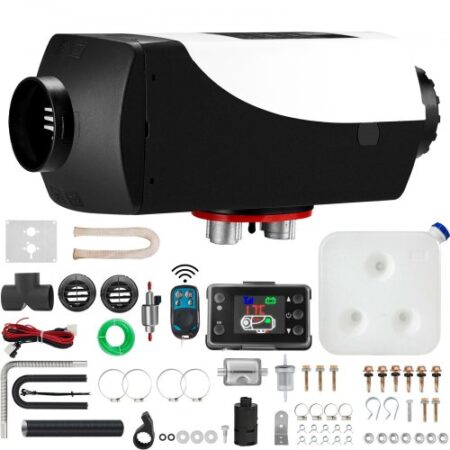
All-in-one boxes are convenient, but the cleanest install in a truck, boat, bus conversion, or shop is a split kit. The heater body mounts under a seat, in a cabinet, or on a shelf. The tank goes wherever it fits, and the intake and exhaust run through the floor or wall. All you see in the room is a vent.
The WF5001 is VEVOR’s long-running 5kW kit, with thousands of owner reviews on its US store. It comes with a 10-liter (2.6-gallon) tank, fuel pump, LCD controller, remote, silencer, intake and exhaust pipes, two air outlet pipes with vents, a mounting plate, and a wiring harness. VEVOR says a full tank can run it for up to 100 hours at the low end of its 0.11 to 0.51 L/h burn range.
Mid-size 5kW output is a good match for a truck sleeper, a boat cabin, or a small insulated workshop. The LCD offers manual and automatic thermostat modes plus a timer, so you can schedule it to warm the cab before you head out.
Key Features
- 5kW, 12V (operating range 10.5 to 16V)
- 10 L / 2.6 gal separate fuel tank
- 0.11 to 0.51 L/h fuel consumption
- LCD controller with thermostat and timer, plus remote
- Full install kit: pump, silencer, pipes, vents, harness
- Heater body 15.4 x 5.7 x 5.7 in, 9.9 lb
- Rated for -40°F operation
What We Like
- Cleanest, most permanent install
- Big tank for days of run time
- Everything needed to install is in the box
- Thousands of reviews behind this design
- Heater body is small enough to hide almost anywhere
What We Don’t Like
- It needs a real installation, including drilling through the floor or wall and wiring to a 12V source, so it’s not a plug-and-play option.
Overall
If you want a heater that’s part of the truck, boat, or shop rather than a box sitting on the floor, the WF5001 kit is the one to install.
Side-by-Side Comparison
| Model | Power | Type | Tank | Power Source | Controls | CO Alarm | Max Altitude |
|---|---|---|---|---|---|---|---|
| XMZ-D1 | 8kW | All-in-one | 1.3 gal | 12V | App, remote, LCD | Not listed | 18,045 ft |
| XMZ-TB20 Pro | 8kW | All-in-one | 1.3 gal | 12/24V or 110V | App, remote, LCD | Yes | 9,842 ft |
| ZM8008 | 8kW | All-in-one, wheeled | 1.3 gal | 12/24V or 110V | App, remote, LCD | Yes | 18,044 ft |
| XMZ-TB30 | 8kW | All-in-one | 1.1 gal | 12/24V or 110V | Remote, LCD | Yes | 9,842 ft |
| ZM2003 | 2kW | All-in-one | 2 L | 12/24V + adapter | App, remote, LCD | Yes | 9,842 ft |
| WF5001 | 5kW | Split kit | 10 L tank | 12V | Remote, LCD | Not listed | Not listed |
Specs are from VEVOR’s US product listings. Fuel burn varies with the thermostat setting and outside temperature.
How a Diesel Air Heater Works (and Why the Heat Feels Different)
A diesel air heater has two completely separate air paths. Outside air is pulled into a sealed combustion chamber, mixed with a fine mist of diesel from a small pulsing pump, lit by a glow plug, and burned. The exhaust from that fire leaves through its own pipe to the outdoors. Meanwhile, a fan pushes room air across the outside of the hot aluminum heat exchanger and back into your space.
Because the two paths never mix (when the heater is installed properly), the air you breathe never touches the flame. That’s the big difference from a propane or kerosene torpedo heater, which burns fuel right in the room and adds water vapor and combustion gases to the air. It’s why diesel heat feels dry and why your tools stop rusting.
The electrical side is small. The glow plug draws more power for a minute or two during startup (VEVOR lists about 150 to 200 watts), then the heater settles to around 40 watts to run the fan and pump. That’s low enough to run one for hours from a deep-cycle battery or a portable power station like the ones in our Jackery power station comparison.
2kW, 5kW, or 8kW: Which Size Do You Need?
One kilowatt is about 3,412 BTU per hour, so on paper a 2kW heater puts out around 6,800 BTU, a 5kW around 17,000 BTU, and an 8kW around 27,000 BTU. Treat those numbers as a ceiling. Real-world output depends on altitude, fuel quality, and how the heater is set up.
- 2kW: Camper vans, truck cabs, small RVs, ice shacks, and tents. Spaces under about 100 square feet.
- 5kW: Larger RVs, boat cabins, truck sleepers, and small insulated sheds or workshops.
- 8kW: One and two-car garages, pole barn work areas, larger cabins, and drafty spaces where a smaller unit can’t keep up.
Oversizing has a cost. A heater that hits its target temperature in minutes will spend the rest of the night cycling or idling at its lowest setting, and running a diesel heater on low for long stretches is the fastest way to coke up the burner with carbon. If you’re between sizes in a small, well-insulated space, go smaller.
If you’d rather avoid fuel altogether, a 240-volt electric unit is the cleaner option for a garage with the right circuit. Our guide to heavy duty electric garage heaters compares them.
What Does It Cost to Run a Diesel Heater?
VEVOR’s own estimate for its 8kW units is about a gallon of diesel for a full night, and that matches the fuel figures on the spec sheets. Most units burn somewhere between 0.04 and 0.15 gallons per hour depending on the setting.
Here’s the math. At 0.1 gallons per hour and diesel at $4 a gallon, you’re spending about 40 cents an hour on high, or a little over $3 for an 8-hour evening in the shop. On a lower setting it can drop to half that. Electricity for the fan and pump adds pennies. Plug in your local diesel price for an exact figure.
Diesel Heater Safety: The Non-Negotiables
- Exhaust always goes outside. Every diesel air heater makes carbon monoxide. The exhaust pipe must vent outdoors, sealed and clamped, and pointed away from doors, windows, and the heater’s own air intake.
- Run a separate CO detector. Even if the heater has a built-in alarm, put a battery-powered CO detector in the space at breathing height. Two alarms are better than one.
- Keep the hot exhaust clear. The pipe gets hot enough to scorch wood and melt plastic. Use a heat sleeve and a proper through-wall or floor fitting, and keep fuel, rags, and solvents away from it.
- Use the right fuel. These heaters are designed for diesel. Check your manual before trying anything else.
- Shut down properly. Always turn it off with the controller and let it run its cool-down cycle. Pulling the plug while it’s hot can damage the heater.
A note on using one in a house: VEVOR markets several of these for homes and cabins, but a diesel heater isn’t a replacement for a code-approved home heating system. If you want one in a living space, have the install checked locally and talk to your insurer first.
A Scenario Worth Knowing About
Your heater worked perfectly all through November. Then the first real cold snap hits, the overnight low drops into the single digits, and the next morning it won’t light. You get a few clicks from the pump, some white smoke, and an error code.
Nine times out of ten, the heater is fine. The fuel isn’t. Regular #2 diesel starts to cloud and thicken as it gets cold, and in hard freezes it can gel. The wax crystals clog the tiny fuel line and pump on a diesel heater long before they’d bother a truck engine.
The fix is cheap. Use winter-blend diesel from the pump (most stations in cold regions switch over automatically), add an anti-gel additive, or keep the tank somewhere it won’t freeze. If your tank lives outside, insulate the fuel line. And if a cold-morning start fails, don’t keep hitting the button. Warm the fuel and lines first, or you’ll flood the burner and end up cleaning soot out of it.
Frequently Asked Questions
Is a diesel heater safe to use in a garage?
Yes, if the exhaust is vented outside and sealed, the heater has room to breathe, and there’s a working CO detector in the garage. The XMZ-TB20 Pro and XMZ-TB30 both have built-in CO alarms, which is why we like them for garages.
How much diesel does a diesel heater use per night?
About a gallon for a full night on an 8kW unit, based on VEVOR’s figures. A 2kW heater uses noticeably less. Your actual burn depends on the thermostat setting, insulation, and outside temperature.
Can I run a diesel heater from a regular wall outlet?
Some models, yes. The XMZ-TB20 Pro, ZM8008, and XMZ-TB30 run on 110V AC as well as 12/24V DC, and the 2kW ZM2003 includes a wall adapter. Others, like the WF5001 split kit, need a 12V battery or power supply.
How loud are diesel heaters?
VEVOR rates its portables at up to 75 dB, which is about as loud as a running dishwasher. The fuel pump makes a steady ticking sound. In a garage you’ll barely notice it. In a van, mounting the pump on a rubber pad makes a big difference.
Do diesel heaters work at high altitude?
Standard models are rated to about 9,800 feet. Above that, choose one with altitude compensation like the XMZ-D1 or the ZM8008, both rated past 18,000 feet.
Why does my diesel heater smoke when it starts?
A little white smoke at startup and a light smell on the first few runs is normal as the new parts burn off. Heavy or black smoke usually means a fuel or air problem, often a kinked fuel line, a blocked intake, or carbon buildup from running on low too long.
The Bottom Line
For a garage or workshop with a regular outlet, the XMZ-TB20 Pro is our pick thanks to its 110V plug and built-in CO alarm. If you want the model with the longest track record, the XMZ-D1 is the proven choice. Heading into the mountains, take the ZM8008. For a van or small camper, the 2kW ZM2003 is the right size.
Whichever you choose, the rules are the same: vent the exhaust outside, keep a CO detector nearby, use winter fuel when it gets cold, and run it hot now and then to keep the burner clean. Do that, and a diesel heater is one of the cheapest ways to turn a frozen garage into a place you actually want to work.